Free AI Skills by Deeper Signals

AI skills that make you an assessment expert

Four free AI skills for Claude and ChatGPT, built by the I-O psychologists at Deeper Signals, for building the business case, choosing the right assessments and working with the data they produce.
Why we built these skills
To make the more challenging parts of assessment work easier for practitioners
$
Estimate the strategic ROI
Build the financial case for your assessment strategy using your own workforce data, not a generic benchmark.
§
Audit the suitability of your assessments
Understand an assessment’s psychometric properties, validity, and whether it is suitable for your use cases.
±
Turn results into a coaching people
Build a sequenced, evidence-based coaching plan a practitioner can pick up and start using right away.
Draft an assessment report
Pull interviews, psychometrics, and references into one criteria-aligned narrative, ready for the assessor to review and own.
Skills Overview
Your Assessment Toolkit
Each skill is a self-contained  tool designed to be used with Claude or GPT, and produces a document designed for immediate use.
01
business case
Assessment ROI Calculator
Build a defensible financial business case for a selection or promotion program using your own workforce data.
The problem it solves
Estimating the return on an assessment strategy is hard and often ambiguous. This skill estimates out the financial impact from your own workforce data, giving you the business case and the credibility to get buy-in.
02
evidence review
Assessment Evidence Review
Review how well an assessment is evidenced against APA, SIOP, EFPA and ITC testing standards.
The problem it solves
It's hard to judge an assessment's evidence on your own. This skill reviews the published psychometric data and shows you how well the tool holds up for what you plan to use it for.
03
development & coaching
Development Plan & Team Coaching Guide
Turn assessment results into a structured, evidence-based coaching plan for an individual or team.
The problem it solves
Most assessment debriefs create insight, but not always a clear path forward. This skill turns a profile into a practical coaching plan a practitioner can use immediately.
04
executive assessment
Leadership Narrative Summary
Synthesize interviews, psychometrics, references and other assessment data into a criteria-aligned leadership narrative.
The problem it solves
Executive assessment reports are valuable, but slow to produce well. This helps turn multiple sources of evidence into a structured, committee-ready draft, with every claim traceable to a source.
Building a strong, evidence-based assessment strategy usually takes time and expertise most teams don't have on hand. These skills put that expertise to work, so good decisions happen faster.
Getting started
How to use the skills
Skills run inside the AI desktop apps. Download once, add to Claude or GPT and invoke the skill in any conversation.
Read the AI Skills help guide →
1
Download a skill
Grab the skill folder from the download panel.
2
Open Claude or ChatGPT
In Claude, go to Settings Customize → Skills → Add
In ChatGPT, go to Plugins → Skills  → Upload
3
Add the skill
Select the zipped folder. It will be installed in your workspace.
4
Start a conversation
Open a new chat, invoke the skill by name, and share your inputs. Claude or ChatGPT will generate the final document.
Ready when you are
Use these skills to build evidence-based and practical assessment strategies within your organizations.
Before you decide
Frequently Asked Questions
business case
Assessment ROI Calculator
Build a research-backed financial business case for a selection or promotion program using your own workforce data.
The headline output
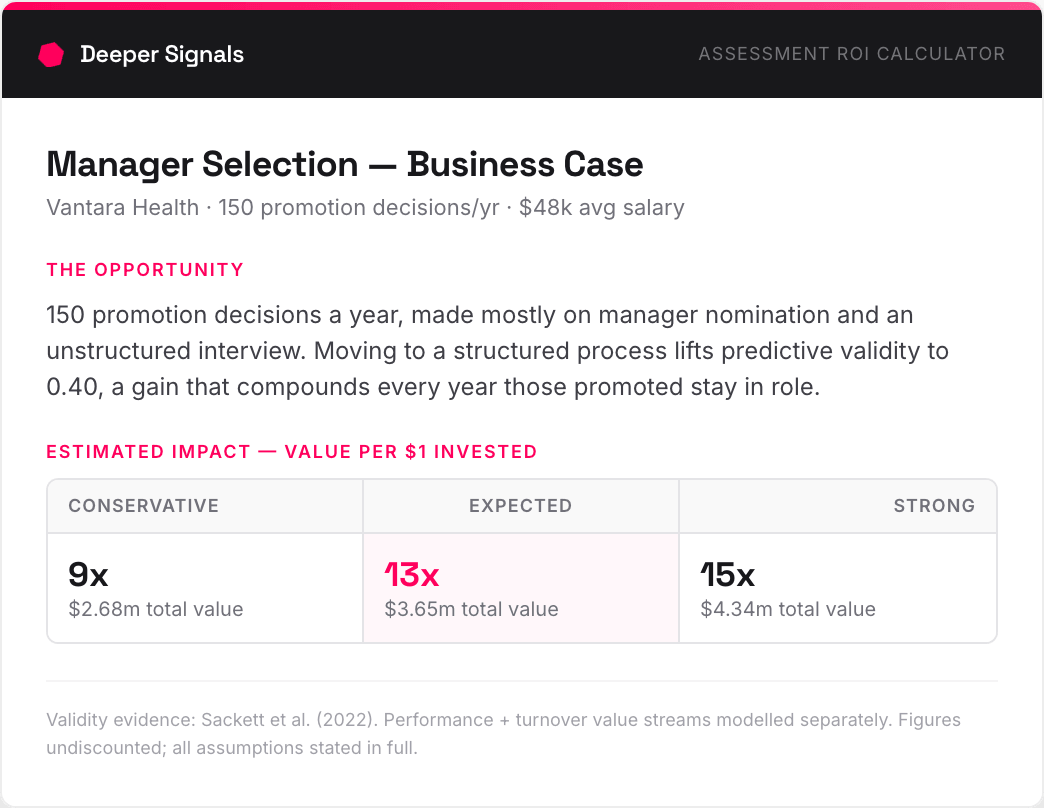
For every $1 invested in better hiring and promotion decisions, the model estimates $X.XX in value over the time those selected stay with the organization.
What it is
The Assessment ROI Calculator helps you build a defensible business case for assessment investment. Using a small set of workforce data, it produces a professional Word document that explains the financial opportunity, the methodology behind the estimate, and the expected return.
What you provide
  • Number of hiring or promotion decisions each year
  • Average salary for those roles
  • Your current selection process
  • The assessment methods you're considering
  • Annual assessment investment
  • Optionally: turnover, expected tenure, selection ratio, and organization size to refine the estimate
What the skill does
  • Compares the predictive validity of your current and proposed selection process
  • Models the financial impact using published selection research
  • Estimates the value of better hiring decisions and, where applicable, reduced voluntary turnover
  • Produces Conservative, Expected, and Strong scenarios to present a defensible range rather than a single estimate
What the document contains
The opportunity
The cost of the current approach, explained in plain language.
The proposed approach
A summary of the recommended assessment strategy and why it improves decision quality.
Estimated impact
Value per dollar invested, scenario comparisons, and where the estimated value comes from.
Methodology and assumptions
A concise explanation of the model, inputs, and assumptions.
About Deeper Signals
Background on Deeper Signals.
When to use it
"We need to make a financial case before this gets approved."
Build a business case for finance or executive stakeholders.
"Can we demonstrate the value of our assessment program?"
Model the impact of an existing program using your own workforce data.
"Which assessment approach creates the most value?"
Compare different assessment methods or hiring populations.
"I need an example business case."
Generate a client-agnostic document for conferences, workshops, or internal discussions.
evidence review
Assessment Evidence Review
Review how well an assessment is evidenced against APA, SIOP, EFPA and ITC testing standards.
The headline output
A clear, neutral, standards-based picture of an assessment's evidence base, so the reader can make their own informed decision.
What it is
The Assessment Evidence Review helps you review a psychometric or pre-hire assessment against recognized professional testing standards. It produces a professional Word document that sets out what the evidence shows, where information was not found in the materials reviewed, and what questions or next steps would complete the picture.

It does not give a verdict, rating, ranking, or suitability judgment. It reviews the instrument and its evidence, never a candidate.
What you provide
  • Assessment name and publisher
  • Whether it is a single instrument or a battery
  • Evidence to review, such as a technical manual, public sources, or both
  • Intended use, such as selection or development
  • Decision weight
  • Population, including geography, level, and language requirements
What the skill does
  • Reviews the assessment against APA, SIOP, EFPA and ITC standards
  • Examines the evidence across theoretical rationale, reliability, validity, fairness, norms, and scoring
  • Uses neutral documentation statuses to describe what was found
  • Records missing information as "Not found in materials reviewed" rather than guessing
  • Turns gaps into questions for the publisher and practical next steps
What the document contains
Scope of review
The intended use, decision weight, population, materials reviewed, evidence sources, and standards applied.
Overview
A neutral summary of what the assessment measures and what is documented.
Evidence against standards
An at-a-glance findings table grouped by review area, with a neutral status and basis for each finding.
Well-documented areas
A short summary of the areas where the evidence base is strongest.
Questions and next steps
Specific questions for the publisher and practical actions to strengthen the evidence base.
When to use it
"How do we know this assessment is actually evidenced?"
Create a standards-based review of the evidence behind an assessment.
"We're comparing several tools."
Apply a consistent framework without ranking or disparaging any vendor.
"We've used this assessment for years."
Review an incumbent tool against current professional standards.
"We need a more defensible governance process."
Create a repeatable way to document assessment evidence and identify gaps.
development & coaching
Development Plan & Team Coaching Guide
Turn assessment results into a structured, evidence-based coaching plan for an individual or team.
The headline output
A practitioner guide with coaching priorities, development modules, and a session-by-session plan built from the assessment profile and context.
What it is
The Development Plan & Team Coaching Guide helps coaches, facilitators, and managers turn assessment results into structured development plans. Grounded in published coaching research, it produces a professional Word document in two modes: an individual coaching plan or a team coaching guide.
What you provide
  • Individual or team mode
  • Context, including role, level, priorities, history, and development goals
  • Time horizon
  • For team mode, the team composition, purpose, and current challenges
  • Optionally, one or more assessment profiles
What the skill does
  • Interprets the assessment while clearly separating observations from inferences
  • Identifies the highest-priority development areas
  • Builds each priority into a coaching module with goals, questions, activities, and progress measures
  • Creates a structured coaching or facilitation journey
  • Uses a strengths-based approach throughout
What the document contains
How to use this guide
Guidance for the coach, facilitator, or manager.
The evidence behind the plan
A summary of the coaching research underpinning the recommendations.
Profile summary
A clear distinction between what the assessment shows and what is inferred.
Development priorities
Coaching modules with goals, questions, activities, and progress indicators.
Session or facilitation plan
A structured sequence of coaching sessions or a team facilitation agenda.
When to use it
"Help me turn these assessment results into a coaching plan."
Create a structured program that a coach can use immediately.
"We're running a team development session."
Generate a facilitation guide built around the team's assessment results.
"I'm supporting the development of one of my managers."
Create a practical development plan that can be used alongside regular manager conversations.
"I need an example coaching program."
Generate a client-agnostic plan for workshops, conferences, or internal discussions.
executive assessment
Leadership Narrative Summary
Synthesize multi-source executive assessment data into a criteria-aligned narrative for a search committee, CEO, or board.
The headline output
An evidence-mapped leadership narrative structured against the role's success criteria, with every claim traceable to a source.
What it is
The Leadership Narrative Summary helps assessors turn multiple sources of executive assessment data into a structured working draft. It can use psychometrics from any vendor, 360 feedback, interview notes, references, case or simulation performance, and biodata.

The output is a draft for a qualified assessor to review, test, edit, and own before it is shared. It does not give a score, ranking, recommendation, or hire/no-hire verdict.
What you provide
  • Success criteria for the role
  • Behavioral indicators for each criterion
  • Candidate materials, such as psychometrics, 360 feedback, interviews, references, case performance, or biodata
  • Role and business context
  • Audience and preferred length
What the skill does
  • Confirms the success criteria and behavioral indicators before reviewing candidate materials
  • Breaks each source into discrete evidence items
  • Codes each evidence item against the agreed indicators
  • Assigns an evidence status for each criterion using a fixed decision framework
  • Excludes protected-characteristic content
What the document contains
How to use this document
Guidance on how the draft should be reviewed and who owns the final judgment.
Assessment basis and summary
How the criteria and evidence frame were established, followed by the headline picture.
Evidence against criteria
An at-a-glance view of evidence coverage, followed by a section for each criterion.
Open questions for the committee
Specific questions the evidence does not fully resolve.
Methodology and evidence map
How evidence was weighed, coded, and translated into the narrative.
When to use it
"Can you help us pull this into a report for the committee?"
Create the working draft an assessor would otherwise spend days assembling by hand.
"We're moving someone into a critical role and need to document the evidence."
Produce a criteria-structured record for promotion or succession discussions.
"The committee needs something more structured to review."
Turn assessment data into a clear evidence-against-criteria narrative.
"We have data from multiple vendors and sources."
Bring different types of assessment evidence into one coherent report.