All posts

How Can Companies Benchmark Soft Skills Across Departments and Regions?

Author
Anjana Unni
Created on
January 14, 2026

Companies can benchmark soft skills across departments and regions by using a single, behavior-based measurement framework, collecting data consistently across roles and geographies, and normalizing results against internal benchmarks. This allows organizations to make fairer, more accurate decisions in hiring, development, workforce planning, and leadership.

What does it mean to benchmark soft skills?

Soft skills benchmarking is the process of measuring and comparing behavioral capabilities, such as communication, collaboration, adaptability, and judgment, across teams, functions, and regions using the same standard.

A valid benchmark is:

  • Consistent across the organization
  • Comparable across roles and geographies
  • Actionable for real decisions

Why most organizations get this wrong

Many companies still rely on:

  • Manager ratings shaped by local norms
  • Different competency models across functions
  • Self-report surveys that measure confidence, not capability

The result: soft skills data that cannot be compared or trusted.

Why consistent soft skills benchmarks matter

A shared, data-driven benchmark improves decisions in four critical areas:

Hiring

  • Reduces interview bias
  • Enables fair candidate comparison across regions
  • Lowers early attrition in people-heavy roles

Development

  • Identifies skill gaps by role or geography
  • Enables targeted, measurable upskilling

Workforce planning

  • Reveals capability risks during change
  • Helps compare team readiness across regions

Leadership decisions

  • Supports evidence-based promotions
  • Improves succession planning in global teams

A practical way to benchmark soft skills

Step 1: Use a universal skill framework

Focus on 8–10 observable skills that apply across roles.

Example framework:

Step 2: Use behavior-based assessments

Soft skills must be measured through observable, structured inputs:

  • Simulated scenarios (decision making under pressure)
  • Role-relevant tasks (team collaboration exercises)
  • Multi-rater data (peer, manager, and self insights)

Tools like Deeper Signals’ Core Drivers, Core Values and Core Reasoning assessments support structured benchmarking across populations free from bias.

Step 3: Normalize across roles and geographies

Raw scores cannot be compared directly. Normalize results by:

  • Role function (e.g., technical vs. leadership): Adjusts expectations based on what the role primarily does, for example, communication in engineering focuses on clarity and documentation, while in leadership it focuses on alignment and influence.
  • Seniority bands: Compares individuals at similar levels of responsibility, for example, decision-making for a first-time manager is evaluated differently than for a senior leader handling ambiguity.
  • Regional baselines: Accounts for cultural and workplace norms, for example, indirect communication in some regions is normalized, so it isn’t misread as low confidence or influence.

Deeper Signals’ Soft Skills Assessment Platform makes it easy to assess, develop and coach your people by setting the benchmarks based on industry standards and the company’s priorities.

Step 4: Create internal benchmarks

Rather than benchmarking against vague external claims, build internal performance baselines:

  • Identify top performers in each role
  • Map their soft skills profiles
  • Use these profiles as internal yardsticks

This approach is evidence-based and tied to performance outcomes.

Step 5: Embed into decisions

To avoid “data gathering” without impact:

  • Integrate soft skills benchmarks with ATS/HRIS workflows
  • Tie skill profiles to hiring scorecards
  • Use benchmarks in promotion and succession matrices

When soft skills data is treated as decision evidence, organizations see better alignment between talent decisions and business outcomes.

What have we observed as I/O psychologists?

  • Research shows that developing rigorous soft skills instruments can more reliably assess interpersonal skills in organizational contexts.
  • Modern assessment platforms are now emphasizing the importance of structured tests and simulations for soft skills evaluation.
  • Systematic academic reviews highlight the growing importance of soft skills for performance and adaptability in the 21st century.

FAQs

  1. What are soft skills?
    Behavioral and cognitive capabilities that shape how work gets done.
  2. Can soft skills be measured objectively?
    Yes, when measured through behavior-based tools rather than self-report alone.
  3. Can benchmarks work across regions?
    Yes, if results are normalized against regional baselines.
  4. Are soft skills more important than hard skills?
    They determine how effectively hard skills are applied, especially in leadership roles.
  5. Is this worth it for smaller companies?
    Yes, especially during growth or global expansion.

Recent posts
Articles
How Can Companies Benchmark Soft Skills Across Departments and Regions?
Learn how to consistently benchmark soft skills across all departments and regions using a single, behavior-based framework and normalized internal data for fairer, more accurate hiring and development decisions.
Read more
Articles
How to Predict Team Performance Under Pressure
How teams perform under pressure isn’t luck. Learn the team-level signals, such as identity, trust, resilience, and learning, that reliably predict performance when stakes are high.
Read more
Articles
How Organizations Can Improve Employee Engagement by Assessing Values and Motivations
Employee engagement improves when values and motivations align with work. Learn how modern organizations assess motivation fairly, at scale, and turn insight into action.
Read more
Articles
What Are Personality Assessments in Hiring and How They Predict Job Performance
Personality tests for hiring can provide valuable insights into candidates. Read on for the pros and cons, best practices, and top test recommendations.
Read more
Articles
Deeper Signals 2025 - Year in Review
2025 was about clarity in talent decisions. This review looks at how organizations used soft skills intelligence to understand people and support growth.
Read more
All posts

How Can Companies Benchmark Soft Skills Across Departments and Regions?

Author
Anjana Unni
Created on
January 14, 2026

Companies can benchmark soft skills across departments and regions by using a single, behavior-based measurement framework, collecting data consistently across roles and geographies, and normalizing results against internal benchmarks. This allows organizations to make fairer, more accurate decisions in hiring, development, workforce planning, and leadership.

What does it mean to benchmark soft skills?

Soft skills benchmarking is the process of measuring and comparing behavioral capabilities, such as communication, collaboration, adaptability, and judgment, across teams, functions, and regions using the same standard.

A valid benchmark is:

  • Consistent across the organization
  • Comparable across roles and geographies
  • Actionable for real decisions

Why most organizations get this wrong

Many companies still rely on:

  • Manager ratings shaped by local norms
  • Different competency models across functions
  • Self-report surveys that measure confidence, not capability

The result: soft skills data that cannot be compared or trusted.

Why consistent soft skills benchmarks matter

A shared, data-driven benchmark improves decisions in four critical areas:

Hiring

  • Reduces interview bias
  • Enables fair candidate comparison across regions
  • Lowers early attrition in people-heavy roles

Development

  • Identifies skill gaps by role or geography
  • Enables targeted, measurable upskilling

Workforce planning

  • Reveals capability risks during change
  • Helps compare team readiness across regions

Leadership decisions

  • Supports evidence-based promotions
  • Improves succession planning in global teams

A practical way to benchmark soft skills

Step 1: Use a universal skill framework

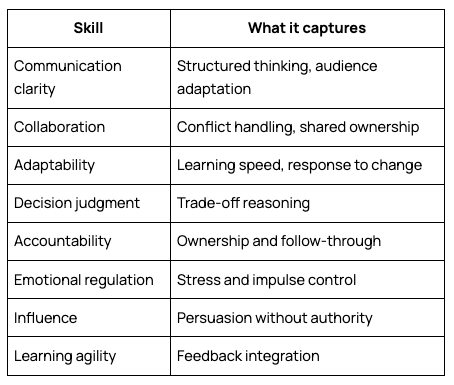
Focus on 8–10 observable skills that apply across roles.

Example framework:
Step 2: Use behavior-based assessments

Soft skills must be measured through observable, structured inputs:

  • Simulated scenarios (decision making under pressure)
  • Role-relevant tasks (team collaboration exercises)
  • Multi-rater data (peer, manager, and self insights)

Tools like Deeper Signals’ Core Drivers, Core Values and Core Reasoning assessments support structured benchmarking across populations free from bias.

Step 3: Normalize across roles and geographies

Raw scores cannot be compared directly. Normalize results by:

  • Role function (e.g., technical vs. leadership): Adjusts expectations based on what the role primarily does, for example, communication in engineering focuses on clarity and documentation, while in leadership it focuses on alignment and influence.
  • Seniority bands: Compares individuals at similar levels of responsibility, for example, decision-making for a first-time manager is evaluated differently than for a senior leader handling ambiguity.
  • Regional baselines: Accounts for cultural and workplace norms, for example, indirect communication in some regions is normalized, so it isn’t misread as low confidence or influence.

Deeper Signals’ Soft Skills Assessment Platform makes it easy to assess, develop and coach your people by setting the benchmarks based on industry standards and the company’s priorities.

Step 4: Create internal benchmarks

Rather than benchmarking against vague external claims, build internal performance baselines:

  • Identify top performers in each role
  • Map their soft skills profiles
  • Use these profiles as internal yardsticks

This approach is evidence-based and tied to performance outcomes.

Step 5: Embed into decisions

To avoid “data gathering” without impact:

  • Integrate soft skills benchmarks with ATS/HRIS workflows
  • Tie skill profiles to hiring scorecards
  • Use benchmarks in promotion and succession matrices

When soft skills data is treated as decision evidence, organizations see better alignment between talent decisions and business outcomes.

What have we observed as I/O psychologists?

  • Research shows that developing rigorous soft skills instruments can more reliably assess interpersonal skills in organizational contexts.
  • Modern assessment platforms are now emphasizing the importance of structured tests and simulations for soft skills evaluation.
  • Systematic academic reviews highlight the growing importance of soft skills for performance and adaptability in the 21st century.

FAQs

  1. What are soft skills?
    Behavioral and cognitive capabilities that shape how work gets done.
  2. Can soft skills be measured objectively?
    Yes, when measured through behavior-based tools rather than self-report alone.
  3. Can benchmarks work across regions?
    Yes, if results are normalized against regional baselines.
  4. Are soft skills more important than hard skills?
    They determine how effectively hard skills are applied, especially in leadership roles.
  5. Is this worth it for smaller companies?
    Yes, especially during growth or global expansion.

Recent posts
Articles
How Can Companies Benchmark Soft Skills Across Departments and Regions?
Learn how to consistently benchmark soft skills across all departments and regions using a single, behavior-based framework and normalized internal data for fairer, more accurate hiring and development decisions.
Read more
Articles
How to Predict Team Performance Under Pressure
How teams perform under pressure isn’t luck. Learn the team-level signals, such as identity, trust, resilience, and learning, that reliably predict performance when stakes are high.
Read more
Articles
How Organizations Can Improve Employee Engagement by Assessing Values and Motivations
Employee engagement improves when values and motivations align with work. Learn how modern organizations assess motivation fairly, at scale, and turn insight into action.
Read more
Articles
What Are Personality Assessments in Hiring and How They Predict Job Performance
Personality tests for hiring can provide valuable insights into candidates. Read on for the pros and cons, best practices, and top test recommendations.
Read more
Articles
Deeper Signals 2025 - Year in Review
2025 was about clarity in talent decisions. This review looks at how organizations used soft skills intelligence to understand people and support growth.
Read more
All posts

How Can Companies Benchmark Soft Skills Across Departments and Regions?

Author
Anjana Unni
Created on
January 14, 2026

Companies can benchmark soft skills across departments and regions by using a single, behavior-based measurement framework, collecting data consistently across roles and geographies, and normalizing results against internal benchmarks. This allows organizations to make fairer, more accurate decisions in hiring, development, workforce planning, and leadership.

What does it mean to benchmark soft skills?

Soft skills benchmarking is the process of measuring and comparing behavioral capabilities, such as communication, collaboration, adaptability, and judgment, across teams, functions, and regions using the same standard.

A valid benchmark is:

  • Consistent across the organization
  • Comparable across roles and geographies
  • Actionable for real decisions

Why most organizations get this wrong

Many companies still rely on:

  • Manager ratings shaped by local norms
  • Different competency models across functions
  • Self-report surveys that measure confidence, not capability

The result: soft skills data that cannot be compared or trusted.

Why consistent soft skills benchmarks matter

A shared, data-driven benchmark improves decisions in four critical areas:

Hiring

  • Reduces interview bias
  • Enables fair candidate comparison across regions
  • Lowers early attrition in people-heavy roles

Development

  • Identifies skill gaps by role or geography
  • Enables targeted, measurable upskilling

Workforce planning

  • Reveals capability risks during change
  • Helps compare team readiness across regions

Leadership decisions

  • Supports evidence-based promotions
  • Improves succession planning in global teams

A practical way to benchmark soft skills

Step 1: Use a universal skill framework

Focus on 8–10 observable skills that apply across roles.

Example framework:

Step 2: Use behavior-based assessments

Soft skills must be measured through observable, structured inputs:

  • Simulated scenarios (decision making under pressure)
  • Role-relevant tasks (team collaboration exercises)
  • Multi-rater data (peer, manager, and self insights)

Tools like Deeper Signals’ Core Drivers, Core Values and Core Reasoning assessments support structured benchmarking across populations free from bias.

Step 3: Normalize across roles and geographies

Raw scores cannot be compared directly. Normalize results by:

  • Role function (e.g., technical vs. leadership): Adjusts expectations based on what the role primarily does, for example, communication in engineering focuses on clarity and documentation, while in leadership it focuses on alignment and influence.
  • Seniority bands: Compares individuals at similar levels of responsibility, for example, decision-making for a first-time manager is evaluated differently than for a senior leader handling ambiguity.
  • Regional baselines: Accounts for cultural and workplace norms, for example, indirect communication in some regions is normalized, so it isn’t misread as low confidence or influence.

Deeper Signals’ Soft Skills Assessment Platform makes it easy to assess, develop and coach your people by setting the benchmarks based on industry standards and the company’s priorities.

Step 4: Create internal benchmarks

Rather than benchmarking against vague external claims, build internal performance baselines:

  • Identify top performers in each role
  • Map their soft skills profiles
  • Use these profiles as internal yardsticks

This approach is evidence-based and tied to performance outcomes.

Step 5: Embed into decisions

To avoid “data gathering” without impact:

  • Integrate soft skills benchmarks with ATS/HRIS workflows
  • Tie skill profiles to hiring scorecards
  • Use benchmarks in promotion and succession matrices

When soft skills data is treated as decision evidence, organizations see better alignment between talent decisions and business outcomes.

What have we observed as I/O psychologists?

  • Research shows that developing rigorous soft skills instruments can more reliably assess interpersonal skills in organizational contexts.
  • Modern assessment platforms are now emphasizing the importance of structured tests and simulations for soft skills evaluation.
  • Systematic academic reviews highlight the growing importance of soft skills for performance and adaptability in the 21st century.

FAQs

  1. What are soft skills?
    Behavioral and cognitive capabilities that shape how work gets done.
  2. Can soft skills be measured objectively?
    Yes, when measured through behavior-based tools rather than self-report alone.
  3. Can benchmarks work across regions?
    Yes, if results are normalized against regional baselines.
  4. Are soft skills more important than hard skills?
    They determine how effectively hard skills are applied, especially in leadership roles.
  5. Is this worth it for smaller companies?
    Yes, especially during growth or global expansion.

Recent posts
Articles
How Can Companies Benchmark Soft Skills Across Departments and Regions?
Learn how to consistently benchmark soft skills across all departments and regions using a single, behavior-based framework and normalized internal data for fairer, more accurate hiring and development decisions.
Read more
Articles
How to Predict Team Performance Under Pressure
How teams perform under pressure isn’t luck. Learn the team-level signals, such as identity, trust, resilience, and learning, that reliably predict performance when stakes are high.
Read more
Articles
How Organizations Can Improve Employee Engagement by Assessing Values and Motivations
Employee engagement improves when values and motivations align with work. Learn how modern organizations assess motivation fairly, at scale, and turn insight into action.
Read more
Articles
What Are Personality Assessments in Hiring and How They Predict Job Performance
Personality tests for hiring can provide valuable insights into candidates. Read on for the pros and cons, best practices, and top test recommendations.
Read more
Articles
Deeper Signals 2025 - Year in Review
2025 was about clarity in talent decisions. This review looks at how organizations used soft skills intelligence to understand people and support growth.
Read more
All posts

How Can Companies Benchmark Soft Skills Across Departments and Regions?

Author
Anjana Unni
Created on
January 14, 2026

Companies can benchmark soft skills across departments and regions by using a single, behavior-based measurement framework, collecting data consistently across roles and geographies, and normalizing results against internal benchmarks. This allows organizations to make fairer, more accurate decisions in hiring, development, workforce planning, and leadership.

What does it mean to benchmark soft skills?

Soft skills benchmarking is the process of measuring and comparing behavioral capabilities, such as communication, collaboration, adaptability, and judgment, across teams, functions, and regions using the same standard.

A valid benchmark is:

  • Consistent across the organization
  • Comparable across roles and geographies
  • Actionable for real decisions

Why most organizations get this wrong

Many companies still rely on:

  • Manager ratings shaped by local norms
  • Different competency models across functions
  • Self-report surveys that measure confidence, not capability

The result: soft skills data that cannot be compared or trusted.

Why consistent soft skills benchmarks matter

A shared, data-driven benchmark improves decisions in four critical areas:

Hiring

  • Reduces interview bias
  • Enables fair candidate comparison across regions
  • Lowers early attrition in people-heavy roles

Development

  • Identifies skill gaps by role or geography
  • Enables targeted, measurable upskilling

Workforce planning

  • Reveals capability risks during change
  • Helps compare team readiness across regions

Leadership decisions

  • Supports evidence-based promotions
  • Improves succession planning in global teams

A practical way to benchmark soft skills

Step 1: Use a universal skill framework

Focus on 8–10 observable skills that apply across roles.

Example framework:

Step 2: Use behavior-based assessments

Soft skills must be measured through observable, structured inputs:

  • Simulated scenarios (decision making under pressure)
  • Role-relevant tasks (team collaboration exercises)
  • Multi-rater data (peer, manager, and self insights)

Tools like Deeper Signals’ Core Drivers, Core Values and Core Reasoning assessments support structured benchmarking across populations free from bias.

Step 3: Normalize across roles and geographies

Raw scores cannot be compared directly. Normalize results by:

  • Role function (e.g., technical vs. leadership): Adjusts expectations based on what the role primarily does, for example, communication in engineering focuses on clarity and documentation, while in leadership it focuses on alignment and influence.
  • Seniority bands: Compares individuals at similar levels of responsibility, for example, decision-making for a first-time manager is evaluated differently than for a senior leader handling ambiguity.
  • Regional baselines: Accounts for cultural and workplace norms, for example, indirect communication in some regions is normalized, so it isn’t misread as low confidence or influence.

Deeper Signals’ Soft Skills Assessment Platform makes it easy to assess, develop and coach your people by setting the benchmarks based on industry standards and the company’s priorities.

Step 4: Create internal benchmarks

Rather than benchmarking against vague external claims, build internal performance baselines:

  • Identify top performers in each role
  • Map their soft skills profiles
  • Use these profiles as internal yardsticks

This approach is evidence-based and tied to performance outcomes.

Step 5: Embed into decisions

To avoid “data gathering” without impact:

  • Integrate soft skills benchmarks with ATS/HRIS workflows
  • Tie skill profiles to hiring scorecards
  • Use benchmarks in promotion and succession matrices

When soft skills data is treated as decision evidence, organizations see better alignment between talent decisions and business outcomes.

What have we observed as I/O psychologists?

  • Research shows that developing rigorous soft skills instruments can more reliably assess interpersonal skills in organizational contexts.
  • Modern assessment platforms are now emphasizing the importance of structured tests and simulations for soft skills evaluation.
  • Systematic academic reviews highlight the growing importance of soft skills for performance and adaptability in the 21st century.

FAQs

  1. What are soft skills?
    Behavioral and cognitive capabilities that shape how work gets done.
  2. Can soft skills be measured objectively?
    Yes, when measured through behavior-based tools rather than self-report alone.
  3. Can benchmarks work across regions?
    Yes, if results are normalized against regional baselines.
  4. Are soft skills more important than hard skills?
    They determine how effectively hard skills are applied, especially in leadership roles.
  5. Is this worth it for smaller companies?
    Yes, especially during growth or global expansion.

Recent posts
Articles
How Can Companies Benchmark Soft Skills Across Departments and Regions?
Learn how to consistently benchmark soft skills across all departments and regions using a single, behavior-based framework and normalized internal data for fairer, more accurate hiring and development decisions.
Read more
Articles
How to Predict Team Performance Under Pressure
How teams perform under pressure isn’t luck. Learn the team-level signals, such as identity, trust, resilience, and learning, that reliably predict performance when stakes are high.
Read more
Articles
How Organizations Can Improve Employee Engagement by Assessing Values and Motivations
Employee engagement improves when values and motivations align with work. Learn how modern organizations assess motivation fairly, at scale, and turn insight into action.
Read more
Articles
What Are Personality Assessments in Hiring and How They Predict Job Performance
Personality tests for hiring can provide valuable insights into candidates. Read on for the pros and cons, best practices, and top test recommendations.
Read more
Articles
Deeper Signals 2025 - Year in Review
2025 was about clarity in talent decisions. This review looks at how organizations used soft skills intelligence to understand people and support growth.
Read more
All posts

How Can Companies Benchmark Soft Skills Across Departments and Regions?

Customer
Job Title

Companies can benchmark soft skills across departments and regions by using a single, behavior-based measurement framework, collecting data consistently across roles and geographies, and normalizing results against internal benchmarks. This allows organizations to make fairer, more accurate decisions in hiring, development, workforce planning, and leadership.

What does it mean to benchmark soft skills?

Soft skills benchmarking is the process of measuring and comparing behavioral capabilities, such as communication, collaboration, adaptability, and judgment, across teams, functions, and regions using the same standard.

A valid benchmark is:

  • Consistent across the organization
  • Comparable across roles and geographies
  • Actionable for real decisions

Why most organizations get this wrong

Many companies still rely on:

  • Manager ratings shaped by local norms
  • Different competency models across functions
  • Self-report surveys that measure confidence, not capability

The result: soft skills data that cannot be compared or trusted.

Why consistent soft skills benchmarks matter

A shared, data-driven benchmark improves decisions in four critical areas:

Hiring

  • Reduces interview bias
  • Enables fair candidate comparison across regions
  • Lowers early attrition in people-heavy roles

Development

  • Identifies skill gaps by role or geography
  • Enables targeted, measurable upskilling

Workforce planning

  • Reveals capability risks during change
  • Helps compare team readiness across regions

Leadership decisions

  • Supports evidence-based promotions
  • Improves succession planning in global teams

A practical way to benchmark soft skills

Step 1: Use a universal skill framework

Focus on 8–10 observable skills that apply across roles.

Example framework:

Step 2: Use behavior-based assessments

Soft skills must be measured through observable, structured inputs:

  • Simulated scenarios (decision making under pressure)
  • Role-relevant tasks (team collaboration exercises)
  • Multi-rater data (peer, manager, and self insights)

Tools like Deeper Signals’ Core Drivers, Core Values and Core Reasoning assessments support structured benchmarking across populations free from bias.

Step 3: Normalize across roles and geographies

Raw scores cannot be compared directly. Normalize results by:

  • Role function (e.g., technical vs. leadership): Adjusts expectations based on what the role primarily does, for example, communication in engineering focuses on clarity and documentation, while in leadership it focuses on alignment and influence.
  • Seniority bands: Compares individuals at similar levels of responsibility, for example, decision-making for a first-time manager is evaluated differently than for a senior leader handling ambiguity.
  • Regional baselines: Accounts for cultural and workplace norms, for example, indirect communication in some regions is normalized, so it isn’t misread as low confidence or influence.

Deeper Signals’ Soft Skills Assessment Platform makes it easy to assess, develop and coach your people by setting the benchmarks based on industry standards and the company’s priorities.

Step 4: Create internal benchmarks

Rather than benchmarking against vague external claims, build internal performance baselines:

  • Identify top performers in each role
  • Map their soft skills profiles
  • Use these profiles as internal yardsticks

This approach is evidence-based and tied to performance outcomes.

Step 5: Embed into decisions

To avoid “data gathering” without impact:

  • Integrate soft skills benchmarks with ATS/HRIS workflows
  • Tie skill profiles to hiring scorecards
  • Use benchmarks in promotion and succession matrices

When soft skills data is treated as decision evidence, organizations see better alignment between talent decisions and business outcomes.

What have we observed as I/O psychologists?

  • Research shows that developing rigorous soft skills instruments can more reliably assess interpersonal skills in organizational contexts.
  • Modern assessment platforms are now emphasizing the importance of structured tests and simulations for soft skills evaluation.
  • Systematic academic reviews highlight the growing importance of soft skills for performance and adaptability in the 21st century.

FAQs

  1. What are soft skills?
    Behavioral and cognitive capabilities that shape how work gets done.
  2. Can soft skills be measured objectively?
    Yes, when measured through behavior-based tools rather than self-report alone.
  3. Can benchmarks work across regions?
    Yes, if results are normalized against regional baselines.
  4. Are soft skills more important than hard skills?
    They determine how effectively hard skills are applied, especially in leadership roles.
  5. Is this worth it for smaller companies?
    Yes, especially during growth or global expansion.

Ready for your Spotlight?
Contact us to book your Customer Spotlight and showcase your work to an extensive, global audience!
Start your free trial today
Free access to Deeper Signals’ quick, scientific assessments, feedback tools, and more.
Start Free Trial
Recent posts
Articles
How Can Companies Benchmark Soft Skills Across Departments and Regions?
Learn how to consistently benchmark soft skills across all departments and regions using a single, behavior-based framework and normalized internal data for fairer, more accurate hiring and development decisions.
Read more
Articles
How to Predict Team Performance Under Pressure
How teams perform under pressure isn’t luck. Learn the team-level signals, such as identity, trust, resilience, and learning, that reliably predict performance when stakes are high.
Read more
Articles
How Organizations Can Improve Employee Engagement by Assessing Values and Motivations
Employee engagement improves when values and motivations align with work. Learn how modern organizations assess motivation fairly, at scale, and turn insight into action.
Read more
Articles
What Are Personality Assessments in Hiring and How They Predict Job Performance
Personality tests for hiring can provide valuable insights into candidates. Read on for the pros and cons, best practices, and top test recommendations.
Read more
Articles
Deeper Signals 2025 - Year in Review
2025 was about clarity in talent decisions. This review looks at how organizations used soft skills intelligence to understand people and support growth.
Read more
Curious to learn more?

Schedule a call with Deeper Signals to understand how our assessments and feedback tools help people gain a deep awareness of their talents and reach their full potential. Underpinned by science and technology, we build talented people, leaders and companies.

  • Scalable and engaging assessment solutions
  • Measurable and predictive talent insights
  • Powered by technology and science that drives results
Let's talk!
  • Scalable interventions for growth
  • Measureable data, insights and outcomes for high performance
  • Proven scientific expertise that links results to outcomes
Thank you! Your submission has been received!
Please fill all fields before submiting the form.
Sign up
Want to be the first to know?
Thank you, we will be in touch soon!‍
Please fill all fields before submiting the form.