What Are Personality Assessments in Hiring and How They Predict Job Performance


Personality assessments have become a cornerstone in the recruitment process for many companies, yet they remain a topic of intense debate. Their value depends entirely on how they are designed and used.
When grounded in robust science and applied responsibly, personality assessments help bring structure and consistency to people decisions that are otherwise subjective. They provide insight into how individuals are likely to work, collaborate, and lead. When poorly designed or misapplied, however, they can distort decision-making, reinforce bias, and create misplaced confidence.
The role of personality assessment is not to predict outcomes in isolation, nor to label people. Used as one signal among many, it supports fairer, more transparent hiring decisions and creates a stronger foundation for development and growth.
What is a personality test?
At its core, a personality test is a tool designed to assess human personality and behavioral tendencies. These assessments aim to measure stable traits, such as conscientiousness, openness, and emotional stability, based on how individuals respond to a structured set of questions. One of the most widely used and scientifically validated frameworks behind these tools is the Big Five personality model.
Personality assessments are not just a modern fad. They have roots in early 20th-century psychology and emerged from decades of research aimed at understanding and measuring human behavior. While early thinkers such as Carl Jung helped shape interest in personality, modern assessments are built on empirical, data-driven models rather than typologies. Today, these assessments are used not just in hiring but in career counseling, team composition exercises, and talent development. When grounded in science and applied responsibly, they provide structured, objective insights that support better decisions and more meaningful development.
Why use personality tests for hiring?
Employers are increasingly turning to personality assessments to help predict job performance and workplace behavior. The rationale is simple: personality traits are well-established predictors of how people approach tasks, respond to challenges, and interact with others at work. For instance, an individual who scores high on conscientiousness may be more likely to excel in roles requiring attention to detail and organization.
However, it's important to understand that personality tests should not be used in isolation. They are most effective when applied as part of a broader, structured assessment strategy that also includes job-relevant skill tests, structured interviews, and reference checks. This multifaceted approach ensures a more comprehensive view of an individual’s capabilities and potential.
How to use personality tests for hiring
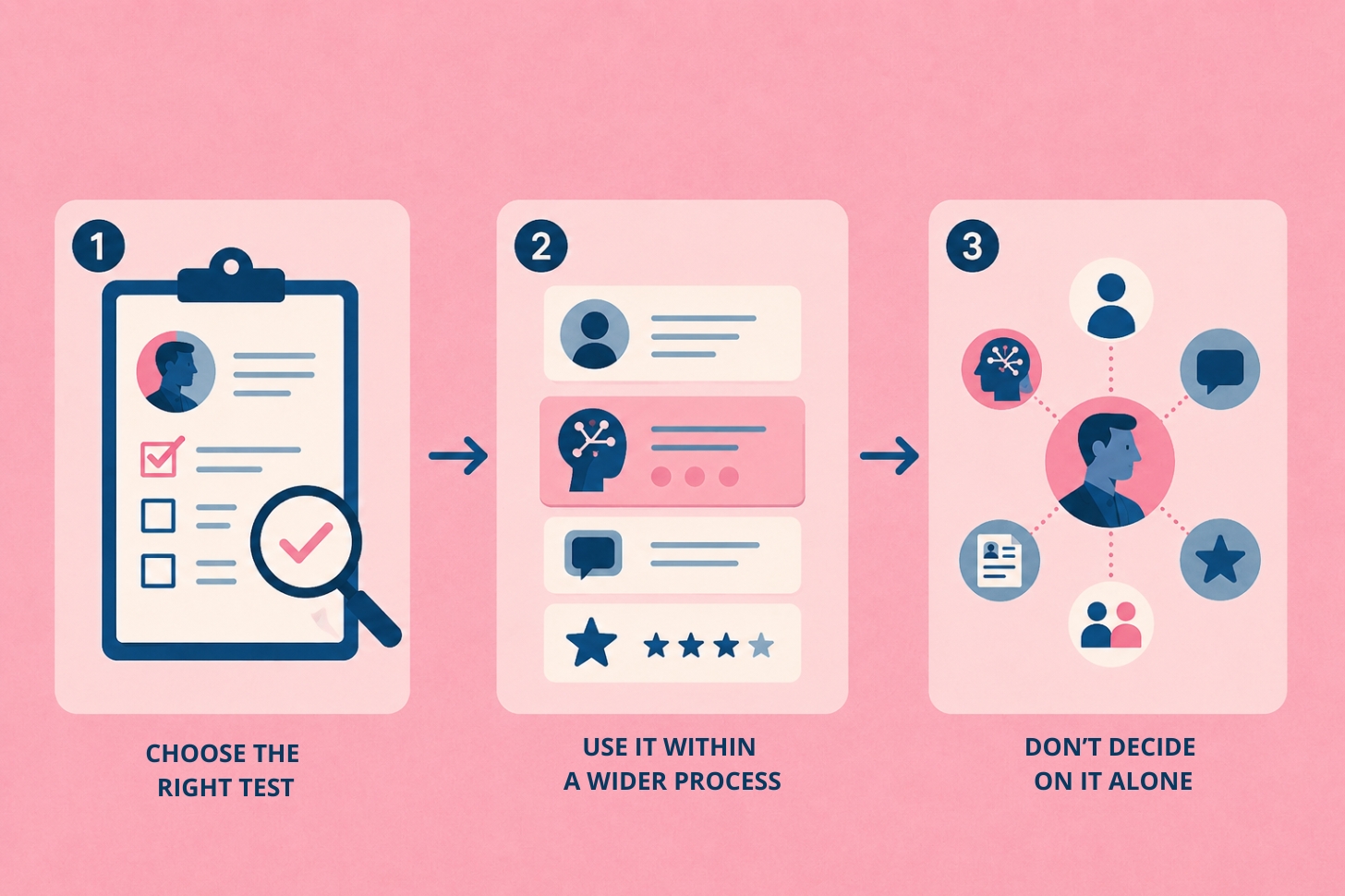
1. Choose the right personality test for your needs
Not all personality assessments are created equal. It’s important to select a test that measures job-relevant traits using a scientifically validated framework. The right assessment should align with the behaviors required for success in the role. For example, if you're hiring for a sales position, testing for traits related to sociability, influence, and goal orientation may be more relevant.
2. Use personality tests as part of a wider assessment process
Personality tests work best when they complement other evaluation methods. By integrating personality data into a broader hiring strategy, you can gather a richer and more accurate picture of a candidate's suitability for a role.
3. Don’t use personality tests to make hiring decisions on their own
Personality assessments should inform decisions, not make them. People are complex, and no single test captures the full range of an individual’s capabilities or potential. Always interpret results in context and corroborate them with other data points before making final hiring decisions.
The pros and cons of personality tests for hiring
Pros
- Objective insights: Personality tests can provide structured, objective data that helps reduce bias in the hiring process.
- Predictive power: When built on validated psychological models, personality assessments can predict job performance and cultural fit, leading to better hiring outcomes.
- Efficiency: Personality assessments allow organizations to efficiently screen large candidate pools and focus attention on individuals who are more likely to succeed in a role.
Expert insight: Research consistently shows that using personality measures alongside cognitive ability tests leads to more accurate predictions of job performance than relying on cognitive tests alone. Personality adds meaningful incremental validity, capturing aspects of behavior, motivation, and work style that cognitive ability does not measure, while remaining largely independent from it.

Cons
- Risk of misinterpretation: Without clear guidance or training, hiring managers may misunderstand results, which can lead to inconsistent or poor decision-making.
- Cultural bias: Poorly designed assessments may fail to account for cultural differences, potentially disadvantaging certain candidate groups and undermining fairness.
- Over-reliance: Personality data should not be treated as a final answer. Over-weighting test results can mean overlooking other important factors like experience and technical skills.
Best practices for personality tests for hiring
1. Be transparent with candidates
Candidates should clearly understand why a personality assessment is being used and how the results will inform the hiring process. Transparency builds trust, improves the candidate experience, and supports fair and ethical assessment practices.
2. Make sure your test is reliable and valid
Only use personality tests that are grounded in robust psychological science and demonstrate strong reliability and validity. Scientifically validated assessments produce more consistent, credible results and reduce the risk of misleading or biased decisions.
3. Don’t try to ‘game’ the system
Personality assessments are most effective when candidates respond honestly. Encouraging people to aim for an “ideal” personality profile undermines the value of the data. Authentic responses provide clearer, more actionable insights into how someone is likely to work and perform.
Examples of personality tests for hiring
1. The Predictive Index
The Predictive Index is renowned for its focus on behavioral assessments that predict workplace behavior. It offers a robust framework for understanding how personality traits impact job performance.
2. Hogan Assessments
Hogan Assessments are highly respected for their ability to predict occupational success. They focus on identifying both strengths and potential derailers in workplace settings.
3. 16 Personalities
Based on the MBTI model, 16 Personalities is popular for its user-friendly approach. While more descriptive than predictive, it can serve as an introductory tool for exploring personality differences.
4. Truity
Truity offers a range of assessments, including the Big Five and Enneagram, providing flexible options for different hiring needs.
5. The Deeper Signals
Deeper Signals offers fast, scientifically validated personality assessments built on modern psychometrics. Designed for hiring and development, the platform measures job-relevant traits in under 10 minutes and turns results into actionable soft skills insights for fairer, more predictive talent decisions.
Take a closer look at how personality data can improve hiring decisions in a real sales team.
Final thoughts on using personality tests for hiring
Personality assessments can be a powerful tool in the hiring toolkit, offering structured insights that complement traditional evaluation methods. Their impact depends on how they are designed, interpreted, and applied. By combining these tests with other assessment methods, companies can make more informed hiring decisions, improve cultural fit, and enhance overall workplace productivity. In a world where the human element is often overlooked, personality assessments remind us of the importance of understanding the people behind the resumes.
Personality tests for hiring: FAQs
What is a personality test?
A personality test measures stable individual traits and behavioral tendencies, helping employers understand how candidates are likely to work, collaborate, and fit within different roles and environments.
Why use personality tests for hiring?
They provide insights into a candidate's work style and interpersonal skills, helping to make better hiring decisions when used alongside other evaluation methods.
What are the top personality tests for employment?
There are many assessment providers on the market, including The Predictive Index, Hogan Assessments, and The Deeper Signals, each offering a unique approach to insights into candidate behavior.
What are the Big Five personality traits?
The Big Five personality traits, openness, conscientiousness, extraversion, agreeableness, and neuroticism, are widely accepted as a comprehensive model for understanding human personality.
What is a good score on a personality test?
There is no "good" or "bad" score on a personality test. Instead, results should be interpreted in the context of the role and the specific traits that predict success in that role.