All posts

Why SJTs Are Expanding How We Assess Talent

Author
Dr. Luke Treglown
Created on
May 27, 2026

At the heart of most hiring decisions is a simple question:

What is this person going to be like at work?

Not just what they say about themselves, or how they perform on an assessment, but how they are likely to respond when work becomes uncertain, complex, and ambiguous. When priorities clash, stakeholders disagree, and the right answer is not immediately clear.

For decades, organisations have relied on a combination of cognitive ability tests and personality assessments to answer that question. They have been popular for a good reason: cognitive ability remains one of the strongest predictors of job performance, closely followed by personality assessments that help us understand consistent patterns in how people tend to think, behave, and interact (Schmift & Hunter, 1998).

But anyone who has worked in a team knows that performance is not only shaped by ability or personality in isolation. Context matters too. The same strengths can lead to very different outcomes depending on the situation someone is in.

This is where Situational Judgement Tests (SJTs) add another powerful layer of insight. When combined with personality and cognitive ability assessments, they provide rich data into how someone is likely to approach real workplace situations.

From traits to behaviour

One challenge in talent assessment is that workplace behaviour is highly dependent on context.

A personality assessment tells you that someone tends to be assertive. A cognitive assessment suggests they process information quickly. Both are useful signals. What they do not fully capture is how that person will apply those qualities in a real situation: when they choose to speak up, how they frame their point, or whether they recognise the moment when assertiveness is helpful rather than counterproductive.

In practice, those are often the judgments that shape whether someone is effective or not.

Research on SJTs increasingly points in this direction. Rather than assessing only individual traits and dispositions, SJTs explore how people apply their knowledge, preferences, and reasoning in realistic workplace situations. Work by Motowidlo and Beier (2010), for example, suggests that SJT performance reflects what is called “implicit trait policies”; an understanding of which behaviours are likely to be effective in different contexts. Lievens and Motowidlo (2016) later expanded on this idea, arguing that SJTs can be understood as measures of general knowledge about effective behaviour at work.

SJTs are not just about what someone knows or prefers in theory, but how they are likely to apply that judgment in practice.

That matters because many of the capabilities organizations care about most, including leadership, influence, and collaboration, are not reducible to a single trait. They depend on recognising what a situation requires and adapting behaviour accordingly.

Why this expands what we can predict

Looking at behaviour in context expands what assessments are able to predict.

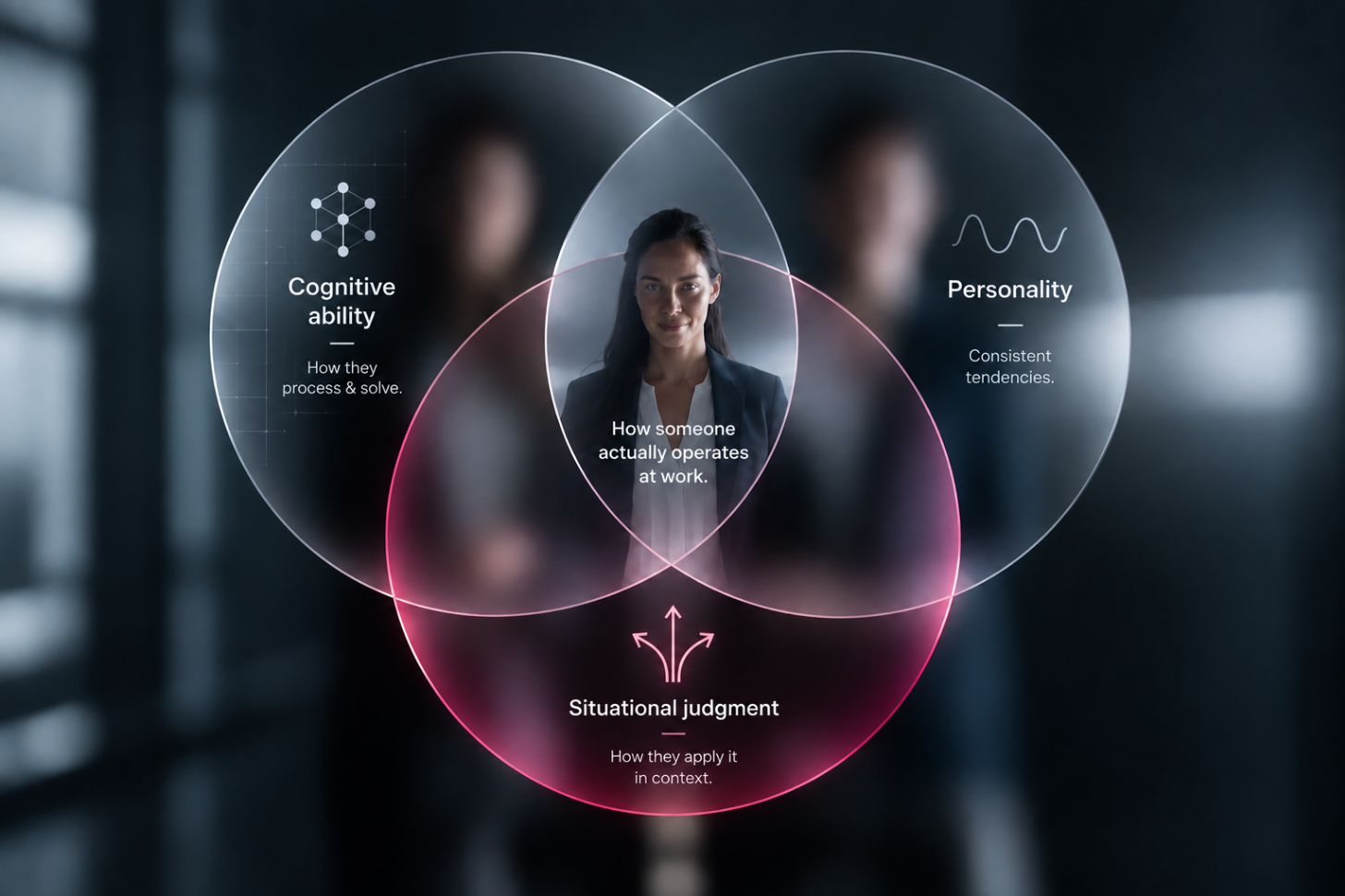
Cognitive ability assessments help us understand how people process information and solve problems. Personality assessments provide insight into consistent behavioural tendencies. SJTs explore how those capabilities are likely to be applied in specific workplace situations.

This helps explain why research consistently finds that SJTs predict job performance and can add value alongside other assessment methods. Meta-analytic studies show that SJTs are related to both cognitive ability and personality, but are not simply measuring the same thing. Instead, they appear to draw on a combination of cognitive processing, behavioural tendencies, experience, and situational judgement to provide additional insight into how someone is likely to operate at work.

Their value is often most visible in roles where success depends heavily on interpersonal judgement, prioritisation, and decision-making under uncertainty. In fields such as medical selection, for example, studies have found that SJTs predict performance in applied and interpersonal aspects of training, even after academic performance has been taken into account.

This is probably the most useful way to think about where SJTs fit within assessment. They are not designed to replace foundational measures such as cognitive ability, personality, or values assessments. Instead, they add behavioural context, helping organisations understand how those underlying qualities are likely to be expressed in real workplace situations.

Bringing workplace context into assessment

Another reason organisations are increasingly interested in SJTs is that they reflect the kinds of situations people encounter in day-to-day work.

Rather than relying only on self-description, SJTs present candidates with realistic scenarios and ask them to evaluate how they would respond. These situations are often ambiguous, socially complex, and open to interpretation, which allows organizations to observe something that is otherwise difficult to assess directly: how people make sense of situations in the first place.

More recent research suggests that SJT performance is partly driven by how accurately individuals interpret a situation before deciding how to respond. Performance depends not only on selecting an effective action, but also on recognising what matters in the situation, what constraints are present, and what the situation is actually demanding from them.

That ability to interpret situations is difficult to capture through self-report questionnaires alone, despite being central to many workplace roles.

This also changes the range of information an assessment can capture. SJTs draw on cognitive, interpersonal, and experiential elements at the same time, rather than depending heavily on a single type of processing. That broader sampling appears to matter in practice. Research has found that SJTs, particularly richer formats such as video-based assessments, can show smaller subgroup differences than more heavily cognitive assessments in some contexts.

The reason is unlikely to be that SJTs are somehow “bias-free”. A more plausible explanation is that they provide clearer contextual information and place less emphasis on factors that may be less central to successful performance in the role itself. Candidates are responding to realistic workplace situations, rather than relying solely on abstract self-description or narrow forms of reasoning.

More engaging assessments for candidates

There is another part of assessment design that often receives less attention: how the process feels from the candidate’s perspective.

Research on applicant reactions consistently shows that candidates respond more positively to assessments they perceive as job-relevant and fair. SJTs tend to perform well in this area because they present situations that resemble the kinds of challenges people may actually encounter in the role. Rather than relying entirely on abstract self-description, they give candidates something concrete and realistic to engage with, and preview or experience the role that they are applying for.

In a process that can often feel one-sided, this changes the dynamic slightly. Candidates are not only being asked to describe themselves, but are also given the opportunity to demonstrate how they would approach realistic workplace situations.

That can improve engagement with the assessment process, but also trust in the process itself.

Where SJTs fit in a modern assessment strategy

At Deeper Signals, we think about assessment as building a fuller picture of how someone is likely to think, work, and interact in a role.

No single method can do that on its own.

Cognitive ability assessments help us understand how people process information and solve problems. Personality assessments provide insight into behavioural tendencies and preferences. SJTs contribute something different by exploring how those qualities are likely to come together in realistic workplace situations.

We see SJTs as a valuable addition to a broader assessment strategy, particularly for roles where judgement, interpersonal effectiveness, and decision-making in context are important. Alongside foundational assessments such as cognitive ability, personality, and values, they add another layer of behavioural insight into how someone is likely to operate at work.

Our goal is to build a richer and more contextual understanding of how people are likely to perform in a role.

Organizations are still trying to answer the same fundamental question they always have: what is this person likely to be like to work with and work alongside? The difference is that assessment methods are becoming increasingly capable of exploring that question from multiple angles.

References

Chan, D., & Schmitt, N. (1997). Video-based versus paper-and-pencil method of assessment in situational judgment tests: Subgroup differences in test performance and face validity perceptions. Journal of Applied Psychology, 82(1), 143–159.

Christian, M. S., Edwards, B. D., & Bradley, J. C. (2010). Situational judgment tests: Constructs assessed and a meta-analysis of their criterion-related validities. Personnel Psychology, 63(1), 83–117. https://doi.org/10.1111/j.1744-6570.2009.01163.x

Hausknecht, J. P., Day, D. V., & Thomas, S. C. (2004). Applicant reactions to selection procedures: An updated model and meta-analysis. Personnel Psychology, 57(3), 639–683.

Knierim, M. T., et al. (2020). Branched situational judgment tests: Theoretical foundations and implications. Journal of Occupational and Organizational Psychology, 93(4), 1–23.

Lievens, F., Buyse, T., & Sackett, P. R. (2005). The operational validity of a video-based situational judgment test for medical college admissions: Illustrating the importance of matching predictor and criterion construct domains. Journal of Applied Psychology, 90(3), 442–452. https://doi.org/10.1037/0021-9010.90.3.442

Lievens, F., & Motowidlo, S. J. (2016). Situational judgment tests: From measures of situational judgment to measures of general domain knowledge. Industrial and Organizational Psychology, 9(1), 3–22.

McDaniel, M. A., & Nguyen, N. T. (2001). Situational judgment tests: A review of practice and constructs assessed. International Journal of Selection and Assessment, 9(1–2), 103–113. https://doi.org/10.1111/1468-2389.00167

McDaniel, M. A., Hartman, N. S., Whetzel, D. L., & Grubb, W. L. (2007). Situational judgment tests, response instructions, and validity: A meta-analysis. Personnel Psychology, 60(1), 63–91. https://doi.org/10.1111/j.1744-6570.2007.00065.x

Motowidlo, S. J., & Beier, M. E. (2010). Differentiating specific job knowledge from implicit trait policies in situational judgment tests. Journal of Applied Psychology, 95(2), 321–333. https://doi.org/10.1037/a0017975

Schmidt, F. L., & Hunter, J. E. (1998). The validity and utility of selection methods in personnel psychology: Practical and theoretical implications of 85 years of research findings. Psychological Bulletin, 124(2), 262–274.

Wang, M., Oostrom, J. K., & Schollaert, E. (2023). The role of situation evaluation and ATIC in situational judgment tests. Personality and Individual Differences, 204, 112049.

Whetzel, D. L., & McDaniel, M. A. (2009). Situational judgment tests: An overview of current research. Human Resource Management Review, 19(3), 188–202.

Webster, E. S., Paton, L. W., Crampton, P. E. S., & Tiffin, P. A. (2020). Situational judgement test validity for selection: A systematic review and meta-analysis. Medical Education, 54(10), 888–902. https://doi.org/10.1111/medu.14201

All posts

Why SJTs Are Expanding How We Assess Talent

Author
Dr. Luke Treglown
Created on
May 27, 2026

At the heart of most hiring decisions is a simple question:

What is this person going to be like at work?

Not just what they say about themselves, or how they perform on an assessment, but how they are likely to respond when work becomes uncertain, complex, and ambiguous. When priorities clash, stakeholders disagree, and the right answer is not immediately clear.

For decades, organisations have relied on a combination of cognitive ability tests and personality assessments to answer that question. They have been popular for a good reason: cognitive ability remains one of the strongest predictors of job performance, closely followed by personality assessments that help us understand consistent patterns in how people tend to think, behave, and interact (Schmift & Hunter, 1998).

But anyone who has worked in a team knows that performance is not only shaped by ability or personality in isolation. Context matters too. The same strengths can lead to very different outcomes depending on the situation someone is in.

This is where Situational Judgement Tests (SJTs) add another powerful layer of insight. When combined with personality and cognitive ability assessments, they provide rich data into how someone is likely to approach real workplace situations.

From traits to behaviour

One challenge in talent assessment is that workplace behaviour is highly dependent on context.

A personality assessment tells you that someone tends to be assertive. A cognitive assessment suggests they process information quickly. Both are useful signals. What they do not fully capture is how that person will apply those qualities in a real situation: when they choose to speak up, how they frame their point, or whether they recognise the moment when assertiveness is helpful rather than counterproductive.

In practice, those are often the judgments that shape whether someone is effective or not.

Research on SJTs increasingly points in this direction. Rather than assessing only individual traits and dispositions, SJTs explore how people apply their knowledge, preferences, and reasoning in realistic workplace situations. Work by Motowidlo and Beier (2010), for example, suggests that SJT performance reflects what is called “implicit trait policies”; an understanding of which behaviours are likely to be effective in different contexts. Lievens and Motowidlo (2016) later expanded on this idea, arguing that SJTs can be understood as measures of general knowledge about effective behaviour at work.

SJTs are not just about what someone knows or prefers in theory, but how they are likely to apply that judgment in practice.

That matters because many of the capabilities organizations care about most, including leadership, influence, and collaboration, are not reducible to a single trait. They depend on recognising what a situation requires and adapting behaviour accordingly.

Why this expands what we can predict

Looking at behaviour in context expands what assessments are able to predict.

Cognitive ability assessments help us understand how people process information and solve problems. Personality assessments provide insight into consistent behavioural tendencies. SJTs explore how those capabilities are likely to be applied in specific workplace situations.

This helps explain why research consistently finds that SJTs predict job performance and can add value alongside other assessment methods. Meta-analytic studies show that SJTs are related to both cognitive ability and personality, but are not simply measuring the same thing. Instead, they appear to draw on a combination of cognitive processing, behavioural tendencies, experience, and situational judgement to provide additional insight into how someone is likely to operate at work.

Their value is often most visible in roles where success depends heavily on interpersonal judgement, prioritisation, and decision-making under uncertainty. In fields such as medical selection, for example, studies have found that SJTs predict performance in applied and interpersonal aspects of training, even after academic performance has been taken into account.

This is probably the most useful way to think about where SJTs fit within assessment. They are not designed to replace foundational measures such as cognitive ability, personality, or values assessments. Instead, they add behavioural context, helping organisations understand how those underlying qualities are likely to be expressed in real workplace situations.

Bringing workplace context into assessment

Another reason organisations are increasingly interested in SJTs is that they reflect the kinds of situations people encounter in day-to-day work.

Rather than relying only on self-description, SJTs present candidates with realistic scenarios and ask them to evaluate how they would respond. These situations are often ambiguous, socially complex, and open to interpretation, which allows organizations to observe something that is otherwise difficult to assess directly: how people make sense of situations in the first place.

More recent research suggests that SJT performance is partly driven by how accurately individuals interpret a situation before deciding how to respond. Performance depends not only on selecting an effective action, but also on recognising what matters in the situation, what constraints are present, and what the situation is actually demanding from them.

That ability to interpret situations is difficult to capture through self-report questionnaires alone, despite being central to many workplace roles.

This also changes the range of information an assessment can capture. SJTs draw on cognitive, interpersonal, and experiential elements at the same time, rather than depending heavily on a single type of processing. That broader sampling appears to matter in practice. Research has found that SJTs, particularly richer formats such as video-based assessments, can show smaller subgroup differences than more heavily cognitive assessments in some contexts.

The reason is unlikely to be that SJTs are somehow “bias-free”. A more plausible explanation is that they provide clearer contextual information and place less emphasis on factors that may be less central to successful performance in the role itself. Candidates are responding to realistic workplace situations, rather than relying solely on abstract self-description or narrow forms of reasoning.

More engaging assessments for candidates

There is another part of assessment design that often receives less attention: how the process feels from the candidate’s perspective.

Research on applicant reactions consistently shows that candidates respond more positively to assessments they perceive as job-relevant and fair. SJTs tend to perform well in this area because they present situations that resemble the kinds of challenges people may actually encounter in the role. Rather than relying entirely on abstract self-description, they give candidates something concrete and realistic to engage with, and preview or experience the role that they are applying for.

In a process that can often feel one-sided, this changes the dynamic slightly. Candidates are not only being asked to describe themselves, but are also given the opportunity to demonstrate how they would approach realistic workplace situations.

That can improve engagement with the assessment process, but also trust in the process itself.

Where SJTs fit in a modern assessment strategy

At Deeper Signals, we think about assessment as building a fuller picture of how someone is likely to think, work, and interact in a role.

No single method can do that on its own.

Cognitive ability assessments help us understand how people process information and solve problems. Personality assessments provide insight into behavioural tendencies and preferences. SJTs contribute something different by exploring how those qualities are likely to come together in realistic workplace situations.

We see SJTs as a valuable addition to a broader assessment strategy, particularly for roles where judgement, interpersonal effectiveness, and decision-making in context are important. Alongside foundational assessments such as cognitive ability, personality, and values, they add another layer of behavioural insight into how someone is likely to operate at work.

Our goal is to build a richer and more contextual understanding of how people are likely to perform in a role.

Organizations are still trying to answer the same fundamental question they always have: what is this person likely to be like to work with and work alongside? The difference is that assessment methods are becoming increasingly capable of exploring that question from multiple angles.

References

Chan, D., & Schmitt, N. (1997). Video-based versus paper-and-pencil method of assessment in situational judgment tests: Subgroup differences in test performance and face validity perceptions. Journal of Applied Psychology, 82(1), 143–159.

Christian, M. S., Edwards, B. D., & Bradley, J. C. (2010). Situational judgment tests: Constructs assessed and a meta-analysis of their criterion-related validities. Personnel Psychology, 63(1), 83–117. https://doi.org/10.1111/j.1744-6570.2009.01163.x

Hausknecht, J. P., Day, D. V., & Thomas, S. C. (2004). Applicant reactions to selection procedures: An updated model and meta-analysis. Personnel Psychology, 57(3), 639–683.

Knierim, M. T., et al. (2020). Branched situational judgment tests: Theoretical foundations and implications. Journal of Occupational and Organizational Psychology, 93(4), 1–23.

Lievens, F., Buyse, T., & Sackett, P. R. (2005). The operational validity of a video-based situational judgment test for medical college admissions: Illustrating the importance of matching predictor and criterion construct domains. Journal of Applied Psychology, 90(3), 442–452. https://doi.org/10.1037/0021-9010.90.3.442

Lievens, F., & Motowidlo, S. J. (2016). Situational judgment tests: From measures of situational judgment to measures of general domain knowledge. Industrial and Organizational Psychology, 9(1), 3–22.

McDaniel, M. A., & Nguyen, N. T. (2001). Situational judgment tests: A review of practice and constructs assessed. International Journal of Selection and Assessment, 9(1–2), 103–113. https://doi.org/10.1111/1468-2389.00167

McDaniel, M. A., Hartman, N. S., Whetzel, D. L., & Grubb, W. L. (2007). Situational judgment tests, response instructions, and validity: A meta-analysis. Personnel Psychology, 60(1), 63–91. https://doi.org/10.1111/j.1744-6570.2007.00065.x

Motowidlo, S. J., & Beier, M. E. (2010). Differentiating specific job knowledge from implicit trait policies in situational judgment tests. Journal of Applied Psychology, 95(2), 321–333. https://doi.org/10.1037/a0017975

Schmidt, F. L., & Hunter, J. E. (1998). The validity and utility of selection methods in personnel psychology: Practical and theoretical implications of 85 years of research findings. Psychological Bulletin, 124(2), 262–274.

Wang, M., Oostrom, J. K., & Schollaert, E. (2023). The role of situation evaluation and ATIC in situational judgment tests. Personality and Individual Differences, 204, 112049.

Whetzel, D. L., & McDaniel, M. A. (2009). Situational judgment tests: An overview of current research. Human Resource Management Review, 19(3), 188–202.

Webster, E. S., Paton, L. W., Crampton, P. E. S., & Tiffin, P. A. (2020). Situational judgement test validity for selection: A systematic review and meta-analysis. Medical Education, 54(10), 888–902. https://doi.org/10.1111/medu.14201

All posts

Why SJTs Are Expanding How We Assess Talent

Author
Dr. Luke Treglown
Created on
May 27, 2026

At the heart of most hiring decisions is a simple question:

What is this person going to be like at work?

Not just what they say about themselves, or how they perform on an assessment, but how they are likely to respond when work becomes uncertain, complex, and ambiguous. When priorities clash, stakeholders disagree, and the right answer is not immediately clear.

For decades, organisations have relied on a combination of cognitive ability tests and personality assessments to answer that question. They have been popular for a good reason: cognitive ability remains one of the strongest predictors of job performance, closely followed by personality assessments that help us understand consistent patterns in how people tend to think, behave, and interact (Schmift & Hunter, 1998).

But anyone who has worked in a team knows that performance is not only shaped by ability or personality in isolation. Context matters too. The same strengths can lead to very different outcomes depending on the situation someone is in.

This is where Situational Judgement Tests (SJTs) add another powerful layer of insight. When combined with personality and cognitive ability assessments, they provide rich data into how someone is likely to approach real workplace situations.

From traits to behaviour

One challenge in talent assessment is that workplace behaviour is highly dependent on context.

A personality assessment tells you that someone tends to be assertive. A cognitive assessment suggests they process information quickly. Both are useful signals. What they do not fully capture is how that person will apply those qualities in a real situation: when they choose to speak up, how they frame their point, or whether they recognise the moment when assertiveness is helpful rather than counterproductive.

In practice, those are often the judgments that shape whether someone is effective or not.

Research on SJTs increasingly points in this direction. Rather than assessing only individual traits and dispositions, SJTs explore how people apply their knowledge, preferences, and reasoning in realistic workplace situations. Work by Motowidlo and Beier (2010), for example, suggests that SJT performance reflects what is called “implicit trait policies”; an understanding of which behaviours are likely to be effective in different contexts. Lievens and Motowidlo (2016) later expanded on this idea, arguing that SJTs can be understood as measures of general knowledge about effective behaviour at work.

SJTs are not just about what someone knows or prefers in theory, but how they are likely to apply that judgment in practice.

That matters because many of the capabilities organizations care about most, including leadership, influence, and collaboration, are not reducible to a single trait. They depend on recognising what a situation requires and adapting behaviour accordingly.

Why this expands what we can predict

Looking at behaviour in context expands what assessments are able to predict.

Cognitive ability assessments help us understand how people process information and solve problems. Personality assessments provide insight into consistent behavioural tendencies. SJTs explore how those capabilities are likely to be applied in specific workplace situations.

This helps explain why research consistently finds that SJTs predict job performance and can add value alongside other assessment methods. Meta-analytic studies show that SJTs are related to both cognitive ability and personality, but are not simply measuring the same thing. Instead, they appear to draw on a combination of cognitive processing, behavioural tendencies, experience, and situational judgement to provide additional insight into how someone is likely to operate at work.

Their value is often most visible in roles where success depends heavily on interpersonal judgement, prioritisation, and decision-making under uncertainty. In fields such as medical selection, for example, studies have found that SJTs predict performance in applied and interpersonal aspects of training, even after academic performance has been taken into account.

This is probably the most useful way to think about where SJTs fit within assessment. They are not designed to replace foundational measures such as cognitive ability, personality, or values assessments. Instead, they add behavioural context, helping organisations understand how those underlying qualities are likely to be expressed in real workplace situations.

Bringing workplace context into assessment

Another reason organisations are increasingly interested in SJTs is that they reflect the kinds of situations people encounter in day-to-day work.

Rather than relying only on self-description, SJTs present candidates with realistic scenarios and ask them to evaluate how they would respond. These situations are often ambiguous, socially complex, and open to interpretation, which allows organizations to observe something that is otherwise difficult to assess directly: how people make sense of situations in the first place.

More recent research suggests that SJT performance is partly driven by how accurately individuals interpret a situation before deciding how to respond. Performance depends not only on selecting an effective action, but also on recognising what matters in the situation, what constraints are present, and what the situation is actually demanding from them.

That ability to interpret situations is difficult to capture through self-report questionnaires alone, despite being central to many workplace roles.

This also changes the range of information an assessment can capture. SJTs draw on cognitive, interpersonal, and experiential elements at the same time, rather than depending heavily on a single type of processing. That broader sampling appears to matter in practice. Research has found that SJTs, particularly richer formats such as video-based assessments, can show smaller subgroup differences than more heavily cognitive assessments in some contexts.

The reason is unlikely to be that SJTs are somehow “bias-free”. A more plausible explanation is that they provide clearer contextual information and place less emphasis on factors that may be less central to successful performance in the role itself. Candidates are responding to realistic workplace situations, rather than relying solely on abstract self-description or narrow forms of reasoning.

More engaging assessments for candidates

There is another part of assessment design that often receives less attention: how the process feels from the candidate’s perspective.

Research on applicant reactions consistently shows that candidates respond more positively to assessments they perceive as job-relevant and fair. SJTs tend to perform well in this area because they present situations that resemble the kinds of challenges people may actually encounter in the role. Rather than relying entirely on abstract self-description, they give candidates something concrete and realistic to engage with, and preview or experience the role that they are applying for.

In a process that can often feel one-sided, this changes the dynamic slightly. Candidates are not only being asked to describe themselves, but are also given the opportunity to demonstrate how they would approach realistic workplace situations.

That can improve engagement with the assessment process, but also trust in the process itself.

Where SJTs fit in a modern assessment strategy

At Deeper Signals, we think about assessment as building a fuller picture of how someone is likely to think, work, and interact in a role.

No single method can do that on its own.

Cognitive ability assessments help us understand how people process information and solve problems. Personality assessments provide insight into behavioural tendencies and preferences. SJTs contribute something different by exploring how those qualities are likely to come together in realistic workplace situations.

We see SJTs as a valuable addition to a broader assessment strategy, particularly for roles where judgement, interpersonal effectiveness, and decision-making in context are important. Alongside foundational assessments such as cognitive ability, personality, and values, they add another layer of behavioural insight into how someone is likely to operate at work.

Our goal is to build a richer and more contextual understanding of how people are likely to perform in a role.

Organizations are still trying to answer the same fundamental question they always have: what is this person likely to be like to work with and work alongside? The difference is that assessment methods are becoming increasingly capable of exploring that question from multiple angles.

References

Chan, D., & Schmitt, N. (1997). Video-based versus paper-and-pencil method of assessment in situational judgment tests: Subgroup differences in test performance and face validity perceptions. Journal of Applied Psychology, 82(1), 143–159.

Christian, M. S., Edwards, B. D., & Bradley, J. C. (2010). Situational judgment tests: Constructs assessed and a meta-analysis of their criterion-related validities. Personnel Psychology, 63(1), 83–117. https://doi.org/10.1111/j.1744-6570.2009.01163.x

Hausknecht, J. P., Day, D. V., & Thomas, S. C. (2004). Applicant reactions to selection procedures: An updated model and meta-analysis. Personnel Psychology, 57(3), 639–683.

Knierim, M. T., et al. (2020). Branched situational judgment tests: Theoretical foundations and implications. Journal of Occupational and Organizational Psychology, 93(4), 1–23.

Lievens, F., Buyse, T., & Sackett, P. R. (2005). The operational validity of a video-based situational judgment test for medical college admissions: Illustrating the importance of matching predictor and criterion construct domains. Journal of Applied Psychology, 90(3), 442–452. https://doi.org/10.1037/0021-9010.90.3.442

Lievens, F., & Motowidlo, S. J. (2016). Situational judgment tests: From measures of situational judgment to measures of general domain knowledge. Industrial and Organizational Psychology, 9(1), 3–22.

McDaniel, M. A., & Nguyen, N. T. (2001). Situational judgment tests: A review of practice and constructs assessed. International Journal of Selection and Assessment, 9(1–2), 103–113. https://doi.org/10.1111/1468-2389.00167

McDaniel, M. A., Hartman, N. S., Whetzel, D. L., & Grubb, W. L. (2007). Situational judgment tests, response instructions, and validity: A meta-analysis. Personnel Psychology, 60(1), 63–91. https://doi.org/10.1111/j.1744-6570.2007.00065.x

Motowidlo, S. J., & Beier, M. E. (2010). Differentiating specific job knowledge from implicit trait policies in situational judgment tests. Journal of Applied Psychology, 95(2), 321–333. https://doi.org/10.1037/a0017975

Schmidt, F. L., & Hunter, J. E. (1998). The validity and utility of selection methods in personnel psychology: Practical and theoretical implications of 85 years of research findings. Psychological Bulletin, 124(2), 262–274.

Wang, M., Oostrom, J. K., & Schollaert, E. (2023). The role of situation evaluation and ATIC in situational judgment tests. Personality and Individual Differences, 204, 112049.

Whetzel, D. L., & McDaniel, M. A. (2009). Situational judgment tests: An overview of current research. Human Resource Management Review, 19(3), 188–202.

Webster, E. S., Paton, L. W., Crampton, P. E. S., & Tiffin, P. A. (2020). Situational judgement test validity for selection: A systematic review and meta-analysis. Medical Education, 54(10), 888–902. https://doi.org/10.1111/medu.14201

All posts

Why SJTs Are Expanding How We Assess Talent

Author
Dr. Luke Treglown
Created on
May 27, 2026

At the heart of most hiring decisions is a simple question:

What is this person going to be like at work?

Not just what they say about themselves, or how they perform on an assessment, but how they are likely to respond when work becomes uncertain, complex, and ambiguous. When priorities clash, stakeholders disagree, and the right answer is not immediately clear.

For decades, organisations have relied on a combination of cognitive ability tests and personality assessments to answer that question. They have been popular for a good reason: cognitive ability remains one of the strongest predictors of job performance, closely followed by personality assessments that help us understand consistent patterns in how people tend to think, behave, and interact (Schmift & Hunter, 1998).

But anyone who has worked in a team knows that performance is not only shaped by ability or personality in isolation. Context matters too. The same strengths can lead to very different outcomes depending on the situation someone is in.

This is where Situational Judgement Tests (SJTs) add another powerful layer of insight. When combined with personality and cognitive ability assessments, they provide rich data into how someone is likely to approach real workplace situations.

From traits to behaviour

One challenge in talent assessment is that workplace behaviour is highly dependent on context.

A personality assessment tells you that someone tends to be assertive. A cognitive assessment suggests they process information quickly. Both are useful signals. What they do not fully capture is how that person will apply those qualities in a real situation: when they choose to speak up, how they frame their point, or whether they recognise the moment when assertiveness is helpful rather than counterproductive.

In practice, those are often the judgments that shape whether someone is effective or not.

Research on SJTs increasingly points in this direction. Rather than assessing only individual traits and dispositions, SJTs explore how people apply their knowledge, preferences, and reasoning in realistic workplace situations. Work by Motowidlo and Beier (2010), for example, suggests that SJT performance reflects what is called “implicit trait policies”; an understanding of which behaviours are likely to be effective in different contexts. Lievens and Motowidlo (2016) later expanded on this idea, arguing that SJTs can be understood as measures of general knowledge about effective behaviour at work.

SJTs are not just about what someone knows or prefers in theory, but how they are likely to apply that judgment in practice.

That matters because many of the capabilities organizations care about most, including leadership, influence, and collaboration, are not reducible to a single trait. They depend on recognising what a situation requires and adapting behaviour accordingly.

Why this expands what we can predict

Looking at behaviour in context expands what assessments are able to predict.

Cognitive ability assessments help us understand how people process information and solve problems. Personality assessments provide insight into consistent behavioural tendencies. SJTs explore how those capabilities are likely to be applied in specific workplace situations.

This helps explain why research consistently finds that SJTs predict job performance and can add value alongside other assessment methods. Meta-analytic studies show that SJTs are related to both cognitive ability and personality, but are not simply measuring the same thing. Instead, they appear to draw on a combination of cognitive processing, behavioural tendencies, experience, and situational judgement to provide additional insight into how someone is likely to operate at work.

Their value is often most visible in roles where success depends heavily on interpersonal judgement, prioritisation, and decision-making under uncertainty. In fields such as medical selection, for example, studies have found that SJTs predict performance in applied and interpersonal aspects of training, even after academic performance has been taken into account.

This is probably the most useful way to think about where SJTs fit within assessment. They are not designed to replace foundational measures such as cognitive ability, personality, or values assessments. Instead, they add behavioural context, helping organisations understand how those underlying qualities are likely to be expressed in real workplace situations.

Bringing workplace context into assessment

Another reason organisations are increasingly interested in SJTs is that they reflect the kinds of situations people encounter in day-to-day work.

Rather than relying only on self-description, SJTs present candidates with realistic scenarios and ask them to evaluate how they would respond. These situations are often ambiguous, socially complex, and open to interpretation, which allows organizations to observe something that is otherwise difficult to assess directly: how people make sense of situations in the first place.

More recent research suggests that SJT performance is partly driven by how accurately individuals interpret a situation before deciding how to respond. Performance depends not only on selecting an effective action, but also on recognising what matters in the situation, what constraints are present, and what the situation is actually demanding from them.

That ability to interpret situations is difficult to capture through self-report questionnaires alone, despite being central to many workplace roles.

This also changes the range of information an assessment can capture. SJTs draw on cognitive, interpersonal, and experiential elements at the same time, rather than depending heavily on a single type of processing. That broader sampling appears to matter in practice. Research has found that SJTs, particularly richer formats such as video-based assessments, can show smaller subgroup differences than more heavily cognitive assessments in some contexts.

The reason is unlikely to be that SJTs are somehow “bias-free”. A more plausible explanation is that they provide clearer contextual information and place less emphasis on factors that may be less central to successful performance in the role itself. Candidates are responding to realistic workplace situations, rather than relying solely on abstract self-description or narrow forms of reasoning.

More engaging assessments for candidates

There is another part of assessment design that often receives less attention: how the process feels from the candidate’s perspective.

Research on applicant reactions consistently shows that candidates respond more positively to assessments they perceive as job-relevant and fair. SJTs tend to perform well in this area because they present situations that resemble the kinds of challenges people may actually encounter in the role. Rather than relying entirely on abstract self-description, they give candidates something concrete and realistic to engage with, and preview or experience the role that they are applying for.

In a process that can often feel one-sided, this changes the dynamic slightly. Candidates are not only being asked to describe themselves, but are also given the opportunity to demonstrate how they would approach realistic workplace situations.

That can improve engagement with the assessment process, but also trust in the process itself.

Where SJTs fit in a modern assessment strategy

At Deeper Signals, we think about assessment as building a fuller picture of how someone is likely to think, work, and interact in a role.

No single method can do that on its own.

Cognitive ability assessments help us understand how people process information and solve problems. Personality assessments provide insight into behavioural tendencies and preferences. SJTs contribute something different by exploring how those qualities are likely to come together in realistic workplace situations.

We see SJTs as a valuable addition to a broader assessment strategy, particularly for roles where judgement, interpersonal effectiveness, and decision-making in context are important. Alongside foundational assessments such as cognitive ability, personality, and values, they add another layer of behavioural insight into how someone is likely to operate at work.

Our goal is to build a richer and more contextual understanding of how people are likely to perform in a role.

Organizations are still trying to answer the same fundamental question they always have: what is this person likely to be like to work with and work alongside? The difference is that assessment methods are becoming increasingly capable of exploring that question from multiple angles.

References

Chan, D., & Schmitt, N. (1997). Video-based versus paper-and-pencil method of assessment in situational judgment tests: Subgroup differences in test performance and face validity perceptions. Journal of Applied Psychology, 82(1), 143–159.

Christian, M. S., Edwards, B. D., & Bradley, J. C. (2010). Situational judgment tests: Constructs assessed and a meta-analysis of their criterion-related validities. Personnel Psychology, 63(1), 83–117. https://doi.org/10.1111/j.1744-6570.2009.01163.x

Hausknecht, J. P., Day, D. V., & Thomas, S. C. (2004). Applicant reactions to selection procedures: An updated model and meta-analysis. Personnel Psychology, 57(3), 639–683.

Knierim, M. T., et al. (2020). Branched situational judgment tests: Theoretical foundations and implications. Journal of Occupational and Organizational Psychology, 93(4), 1–23.

Lievens, F., Buyse, T., & Sackett, P. R. (2005). The operational validity of a video-based situational judgment test for medical college admissions: Illustrating the importance of matching predictor and criterion construct domains. Journal of Applied Psychology, 90(3), 442–452. https://doi.org/10.1037/0021-9010.90.3.442

Lievens, F., & Motowidlo, S. J. (2016). Situational judgment tests: From measures of situational judgment to measures of general domain knowledge. Industrial and Organizational Psychology, 9(1), 3–22.

McDaniel, M. A., & Nguyen, N. T. (2001). Situational judgment tests: A review of practice and constructs assessed. International Journal of Selection and Assessment, 9(1–2), 103–113. https://doi.org/10.1111/1468-2389.00167

McDaniel, M. A., Hartman, N. S., Whetzel, D. L., & Grubb, W. L. (2007). Situational judgment tests, response instructions, and validity: A meta-analysis. Personnel Psychology, 60(1), 63–91. https://doi.org/10.1111/j.1744-6570.2007.00065.x

Motowidlo, S. J., & Beier, M. E. (2010). Differentiating specific job knowledge from implicit trait policies in situational judgment tests. Journal of Applied Psychology, 95(2), 321–333. https://doi.org/10.1037/a0017975

Schmidt, F. L., & Hunter, J. E. (1998). The validity and utility of selection methods in personnel psychology: Practical and theoretical implications of 85 years of research findings. Psychological Bulletin, 124(2), 262–274.

Wang, M., Oostrom, J. K., & Schollaert, E. (2023). The role of situation evaluation and ATIC in situational judgment tests. Personality and Individual Differences, 204, 112049.

Whetzel, D. L., & McDaniel, M. A. (2009). Situational judgment tests: An overview of current research. Human Resource Management Review, 19(3), 188–202.

Webster, E. S., Paton, L. W., Crampton, P. E. S., & Tiffin, P. A. (2020). Situational judgement test validity for selection: A systematic review and meta-analysis. Medical Education, 54(10), 888–902. https://doi.org/10.1111/medu.14201

All posts

Why SJTs Are Expanding How We Assess Talent

Customer
Job Title

At the heart of most hiring decisions is a simple question:

What is this person going to be like at work?

Not just what they say about themselves, or how they perform on an assessment, but how they are likely to respond when work becomes uncertain, complex, and ambiguous. When priorities clash, stakeholders disagree, and the right answer is not immediately clear.

For decades, organisations have relied on a combination of cognitive ability tests and personality assessments to answer that question. They have been popular for a good reason: cognitive ability remains one of the strongest predictors of job performance, closely followed by personality assessments that help us understand consistent patterns in how people tend to think, behave, and interact (Schmift & Hunter, 1998).

But anyone who has worked in a team knows that performance is not only shaped by ability or personality in isolation. Context matters too. The same strengths can lead to very different outcomes depending on the situation someone is in.

This is where Situational Judgement Tests (SJTs) add another powerful layer of insight. When combined with personality and cognitive ability assessments, they provide rich data into how someone is likely to approach real workplace situations.

From traits to behaviour

One challenge in talent assessment is that workplace behaviour is highly dependent on context.

A personality assessment tells you that someone tends to be assertive. A cognitive assessment suggests they process information quickly. Both are useful signals. What they do not fully capture is how that person will apply those qualities in a real situation: when they choose to speak up, how they frame their point, or whether they recognise the moment when assertiveness is helpful rather than counterproductive.

In practice, those are often the judgments that shape whether someone is effective or not.

Research on SJTs increasingly points in this direction. Rather than assessing only individual traits and dispositions, SJTs explore how people apply their knowledge, preferences, and reasoning in realistic workplace situations. Work by Motowidlo and Beier (2010), for example, suggests that SJT performance reflects what is called “implicit trait policies”; an understanding of which behaviours are likely to be effective in different contexts. Lievens and Motowidlo (2016) later expanded on this idea, arguing that SJTs can be understood as measures of general knowledge about effective behaviour at work.

SJTs are not just about what someone knows or prefers in theory, but how they are likely to apply that judgment in practice.

That matters because many of the capabilities organizations care about most, including leadership, influence, and collaboration, are not reducible to a single trait. They depend on recognising what a situation requires and adapting behaviour accordingly.

Why this expands what we can predict

Looking at behaviour in context expands what assessments are able to predict.

Cognitive ability assessments help us understand how people process information and solve problems. Personality assessments provide insight into consistent behavioural tendencies. SJTs explore how those capabilities are likely to be applied in specific workplace situations.

This helps explain why research consistently finds that SJTs predict job performance and can add value alongside other assessment methods. Meta-analytic studies show that SJTs are related to both cognitive ability and personality, but are not simply measuring the same thing. Instead, they appear to draw on a combination of cognitive processing, behavioural tendencies, experience, and situational judgement to provide additional insight into how someone is likely to operate at work.

Their value is often most visible in roles where success depends heavily on interpersonal judgement, prioritisation, and decision-making under uncertainty. In fields such as medical selection, for example, studies have found that SJTs predict performance in applied and interpersonal aspects of training, even after academic performance has been taken into account.

This is probably the most useful way to think about where SJTs fit within assessment. They are not designed to replace foundational measures such as cognitive ability, personality, or values assessments. Instead, they add behavioural context, helping organisations understand how those underlying qualities are likely to be expressed in real workplace situations.

Bringing workplace context into assessment

Another reason organisations are increasingly interested in SJTs is that they reflect the kinds of situations people encounter in day-to-day work.

Rather than relying only on self-description, SJTs present candidates with realistic scenarios and ask them to evaluate how they would respond. These situations are often ambiguous, socially complex, and open to interpretation, which allows organizations to observe something that is otherwise difficult to assess directly: how people make sense of situations in the first place.

More recent research suggests that SJT performance is partly driven by how accurately individuals interpret a situation before deciding how to respond. Performance depends not only on selecting an effective action, but also on recognising what matters in the situation, what constraints are present, and what the situation is actually demanding from them.

That ability to interpret situations is difficult to capture through self-report questionnaires alone, despite being central to many workplace roles.

This also changes the range of information an assessment can capture. SJTs draw on cognitive, interpersonal, and experiential elements at the same time, rather than depending heavily on a single type of processing. That broader sampling appears to matter in practice. Research has found that SJTs, particularly richer formats such as video-based assessments, can show smaller subgroup differences than more heavily cognitive assessments in some contexts.

The reason is unlikely to be that SJTs are somehow “bias-free”. A more plausible explanation is that they provide clearer contextual information and place less emphasis on factors that may be less central to successful performance in the role itself. Candidates are responding to realistic workplace situations, rather than relying solely on abstract self-description or narrow forms of reasoning.

More engaging assessments for candidates

There is another part of assessment design that often receives less attention: how the process feels from the candidate’s perspective.

Research on applicant reactions consistently shows that candidates respond more positively to assessments they perceive as job-relevant and fair. SJTs tend to perform well in this area because they present situations that resemble the kinds of challenges people may actually encounter in the role. Rather than relying entirely on abstract self-description, they give candidates something concrete and realistic to engage with, and preview or experience the role that they are applying for.

In a process that can often feel one-sided, this changes the dynamic slightly. Candidates are not only being asked to describe themselves, but are also given the opportunity to demonstrate how they would approach realistic workplace situations.

That can improve engagement with the assessment process, but also trust in the process itself.

Where SJTs fit in a modern assessment strategy

At Deeper Signals, we think about assessment as building a fuller picture of how someone is likely to think, work, and interact in a role.

No single method can do that on its own.

Cognitive ability assessments help us understand how people process information and solve problems. Personality assessments provide insight into behavioural tendencies and preferences. SJTs contribute something different by exploring how those qualities are likely to come together in realistic workplace situations.

We see SJTs as a valuable addition to a broader assessment strategy, particularly for roles where judgement, interpersonal effectiveness, and decision-making in context are important. Alongside foundational assessments such as cognitive ability, personality, and values, they add another layer of behavioural insight into how someone is likely to operate at work.

Our goal is to build a richer and more contextual understanding of how people are likely to perform in a role.

Organizations are still trying to answer the same fundamental question they always have: what is this person likely to be like to work with and work alongside? The difference is that assessment methods are becoming increasingly capable of exploring that question from multiple angles.

References

Chan, D., & Schmitt, N. (1997). Video-based versus paper-and-pencil method of assessment in situational judgment tests: Subgroup differences in test performance and face validity perceptions. Journal of Applied Psychology, 82(1), 143–159.

Christian, M. S., Edwards, B. D., & Bradley, J. C. (2010). Situational judgment tests: Constructs assessed and a meta-analysis of their criterion-related validities. Personnel Psychology, 63(1), 83–117. https://doi.org/10.1111/j.1744-6570.2009.01163.x

Hausknecht, J. P., Day, D. V., & Thomas, S. C. (2004). Applicant reactions to selection procedures: An updated model and meta-analysis. Personnel Psychology, 57(3), 639–683.

Knierim, M. T., et al. (2020). Branched situational judgment tests: Theoretical foundations and implications. Journal of Occupational and Organizational Psychology, 93(4), 1–23.

Lievens, F., Buyse, T., & Sackett, P. R. (2005). The operational validity of a video-based situational judgment test for medical college admissions: Illustrating the importance of matching predictor and criterion construct domains. Journal of Applied Psychology, 90(3), 442–452. https://doi.org/10.1037/0021-9010.90.3.442

Lievens, F., & Motowidlo, S. J. (2016). Situational judgment tests: From measures of situational judgment to measures of general domain knowledge. Industrial and Organizational Psychology, 9(1), 3–22.

McDaniel, M. A., & Nguyen, N. T. (2001). Situational judgment tests: A review of practice and constructs assessed. International Journal of Selection and Assessment, 9(1–2), 103–113. https://doi.org/10.1111/1468-2389.00167

McDaniel, M. A., Hartman, N. S., Whetzel, D. L., & Grubb, W. L. (2007). Situational judgment tests, response instructions, and validity: A meta-analysis. Personnel Psychology, 60(1), 63–91. https://doi.org/10.1111/j.1744-6570.2007.00065.x

Motowidlo, S. J., & Beier, M. E. (2010). Differentiating specific job knowledge from implicit trait policies in situational judgment tests. Journal of Applied Psychology, 95(2), 321–333. https://doi.org/10.1037/a0017975

Schmidt, F. L., & Hunter, J. E. (1998). The validity and utility of selection methods in personnel psychology: Practical and theoretical implications of 85 years of research findings. Psychological Bulletin, 124(2), 262–274.

Wang, M., Oostrom, J. K., & Schollaert, E. (2023). The role of situation evaluation and ATIC in situational judgment tests. Personality and Individual Differences, 204, 112049.

Whetzel, D. L., & McDaniel, M. A. (2009). Situational judgment tests: An overview of current research. Human Resource Management Review, 19(3), 188–202.

Webster, E. S., Paton, L. W., Crampton, P. E. S., & Tiffin, P. A. (2020). Situational judgement test validity for selection: A systematic review and meta-analysis. Medical Education, 54(10), 888–902. https://doi.org/10.1111/medu.14201

Ready for your Spotlight?
Contact us to book your Customer Spotlight and showcase your work to an extensive, global audience!
Start your free trial today
Free access to Deeper Signals’ quick, scientific assessments, feedback tools, and more.
Start Free Trial
Recent posts
Articles
Why SJTs Are Expanding How We Assess Talent
Learn why personality and cognitive ability are only part of the picture, and how SJTs help organizations understand workplace behavior in context.
Read more
Articles
From Assessment to Action: How AI Coaching Closes the Development Gap
The HR teams seeing real behavior change aren't running more assessments - they're using talent data the way drivers use GPS: live, in context, recalculating with every turn. A guide to how Sola turns Core Drivers results into nudges, manager 1:1 prompts, and learning paths.
Read more
Articles
The Hidden Cost of Low Team Visibility: A Case for Modern Team Diagnostics
The HR leaders fixing their pipelines aren't running another personality offsite - they're treating team data like product teams treat user data. A guide to closing the gap between team visibility and psychological safety, succession, and effectiveness.
Read more
Articles
Soft Skills Data That Moves the Needle: Connecting Assessments to Business Outcomes
The CHROs seeing measurable returns aren't running more assessments; they're using talent data the way a CFO uses pipeline data. A guide to connecting soft skills measurement to attrition, quota attainment, and internal mobility.
Read more
Articles
Before You Replace Your Team with AI
The real risk of AI adoption isn't the technology. It's making permanent workforce decisions based on temporary pricing. Here's the calculation most organisations are skipping.
Read more
Want more articles like this?
Subscribe to our newsletter
Practical insights on people and performance, delivered to your inbox
Subscribe
Recent posts
Articles
Why SJTs Are Expanding How We Assess Talent
Learn why personality and cognitive ability are only part of the picture, and how SJTs help organizations understand workplace behavior in context.
Read more
Articles
From Assessment to Action: How AI Coaching Closes the Development Gap
The HR teams seeing real behavior change aren't running more assessments - they're using talent data the way drivers use GPS: live, in context, recalculating with every turn. A guide to how Sola turns Core Drivers results into nudges, manager 1:1 prompts, and learning paths.
Read more
Articles
The Hidden Cost of Low Team Visibility: A Case for Modern Team Diagnostics
The HR leaders fixing their pipelines aren't running another personality offsite - they're treating team data like product teams treat user data. A guide to closing the gap between team visibility and psychological safety, succession, and effectiveness.
Read more
Articles
Soft Skills Data That Moves the Needle: Connecting Assessments to Business Outcomes
The CHROs seeing measurable returns aren't running more assessments; they're using talent data the way a CFO uses pipeline data. A guide to connecting soft skills measurement to attrition, quota attainment, and internal mobility.
Read more
Articles
Before You Replace Your Team with AI
The real risk of AI adoption isn't the technology. It's making permanent workforce decisions based on temporary pricing. Here's the calculation most organisations are skipping.
Read more
Curious to learn more?

Schedule a call with Deeper Signals to understand how our assessments and feedback tools help people gain a deep awareness of their talents and reach their full potential. Underpinned by science and technology, we build talented people, leaders and companies.

  • Scalable and engaging assessment solutions
  • Measurable and predictive talent insights
  • Powered by technology and science that drives results
Let's talk!
  • Scalable interventions for growth
  • Measureable data, insights and outcomes for high performance
  • Proven scientific expertise that links results to outcomes
Thank you! Your submission has been received!
Please fill all fields before submiting the form.