All posts

Is Skills-Based Hiring Actually Happening?

Author
Anjana Unni
Created on
June 18, 2026

Skills-based hiring is the most repeated phrase in talent strategy right now and one of the least acted on. A 2024 joint study by Harvard Business School and the Burning Glass Institute found that fewer than 1 in 700 actual hires were affected by companies dropping degree requirements, even as 85% of employers claim to have adopted skills-first practices. The gap isn't cynicism. It's a structural failure. Organizations changed their job postings and left everything else alone. The shift from credentials to competence requires valid measurement of the specific behaviors and traits that predict performance in a given role. Removing a checkbox is not that. The shift is from performative equity to actual assessment infrastructure.

What the Data Actually Shows

Fewer than 1 in 700.

That is the share of new hires in 2023 who benefited from employers dropping degree requirements, according to this study, covering a decade of actual hiring data.

Eighty-five per cent of employers claim to be doing skills-based hiring. The practice, in measurable terms, touched 0.14% of hires.

That gap deserves more attention than it typically gets.

What "Skills-Based Hiring" Became vs. What It Was Supposed to Mean

The original promise was clear: evaluate candidates on what they can do, not where they studied. Stop using a degree as a proxy for capability. Assess the behaviors, traits, and competencies that actually predict success in the specific role.

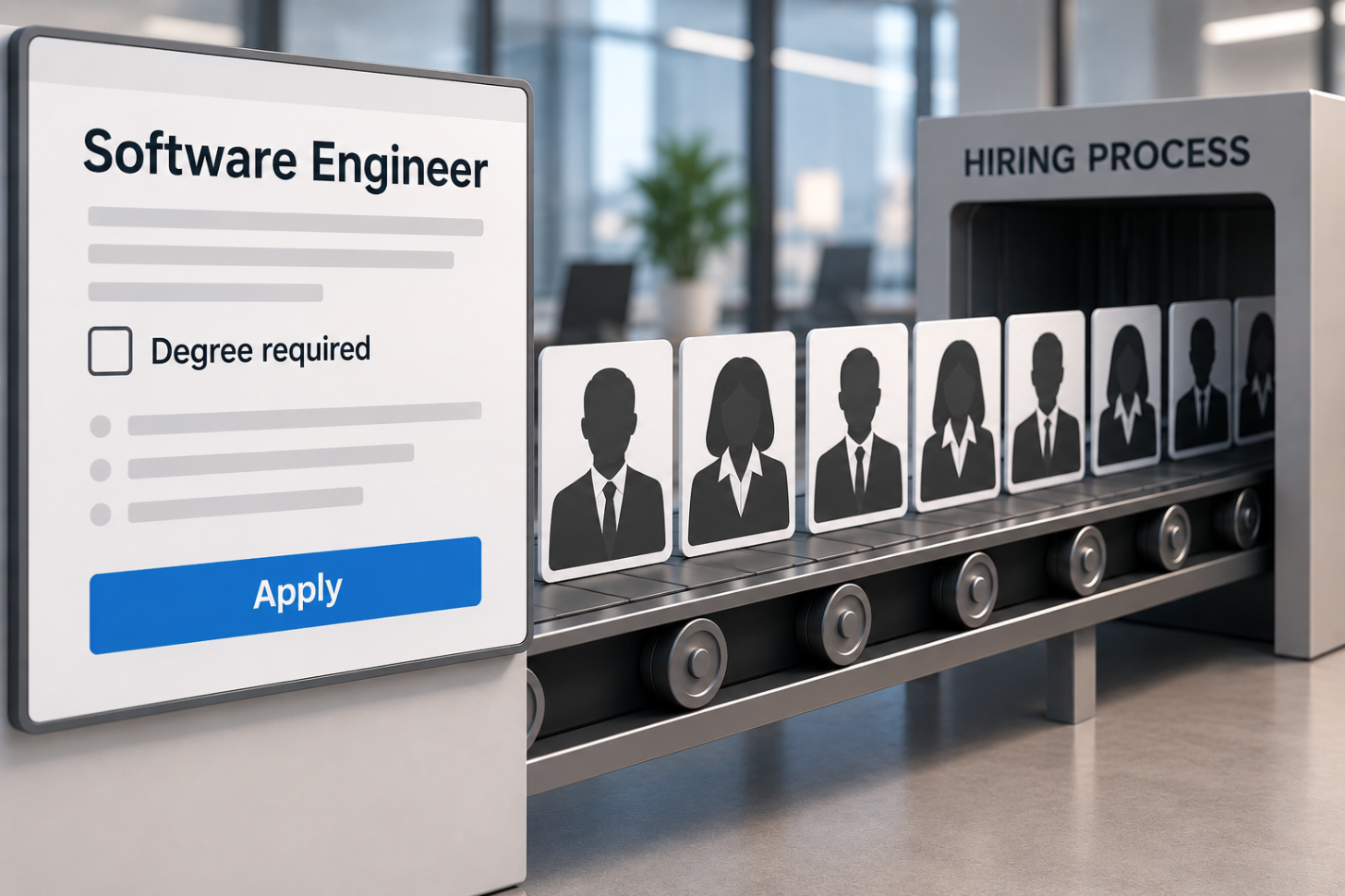
What most organizations did instead was remove the degree checkbox from their job postings.

The assessment process stayed the same. The interview questions stayed the same. Hiring manager behavior stayed the same. Applicant tracking systems continued to surface and score degree-holders favorably, even when the official policy said they weren't required.

Why It Happened This Way

Removing a degree requirement from a job posting takes one person and one afternoon. The press release writes itself. The LinkedIn post gets easy applause.

Redesigning how you actually evaluate candidates is a different category of work. It requires defining which behaviors predict performance in this specific role: not generic "leadership potential" or "communication skills," but the concrete, measurable things that distinguish high performers from average ones in this context. It requires valid assessment tools, structured evaluation criteria, and hiring manager training that doesn't erode the moment someone is running behind.

None of that is visible to the outside world. None of it generates headlines.

So organizations reached for the visible thing. Credential washing, meaning removing a requirement on paper, without changing anything beneath it, became the dominant form of skills-based hiring. It looked like progress. It counted in surveys. It satisfied the communications function.

It didn't change who got hired.

Where the Bias Went

Here is the part that tends to get underplayed: organizations that removed degree requirements but didn't change their evaluation process didn't eliminate bias. They made it less legible.

When a degree requirement is explicit, its effects are at least traceable. You can see who gets screened out before the interview, you can audit the pattern, you can be held accountable for it.

When the degree requirement disappears but the hiring manager is still running an unstructured conversation shaped by implicit preferences, for the right school, the right type of fluency, the right cultural reference points, the same outcomes occur with less of a paper trail. Research consistently shows that unstructured interviews are the most susceptible to the very biases that skills-based hiring claims to address: affinity, confirmation, halo effects, and the tendency to hire people who pattern-match to the current team.

The degree was functioning as a proxy for something. When you remove the proxy without replacing it with valid measurement, interviewers find another proxy. Usually a less visible one.

The problem has simply shifted somewhere harder to trace.

What Actual Skills-Based Hiring Requires

It is not a skills checklist. A list of competencies on a job description is not an assessment system.

It is not a LinkedIn badge or a portfolio. These have face validity, but they rarely have predictive validity for the specific role.

It is not a generic pre-employment test administered because "we do assessments now." A test that isn't validated against performance criteria in your context is still a proxy, just a newer one.

What the evidence points toward is considerably more specific. Evidence suggests that structured interviews and contextualized personality assessments, where items are explicitly anchored to work behavior, perform better than general ability tests alone. The keyword is contextualized. Generic measures applied generically get you generic results.

Skills-based hiring, done properly, starts with a question: what behaviors and traits actually differentiate high performers in this role, at this level, in this organization? The answer to that question should drive assessment design, not the other way around.

This is slower. It requires analytical work before the first job posting goes live. It requires organizations to treat selection as a measurement problem rather than a workflow problem.

Most organizations may not be doing this. 

The Real Cost: Organizations Think They've Solved It

The most expensive version of the skills-based hiring failure is the one which is well-intentioned.

A CHRO announces the degree requirement is gone. The communications team writes about opening pathways. The diversity metrics get cited in the annual report. Internal belief consolidates around the idea that something has changed.

And because the belief is sincere, no one goes back and asks whether the actual hiring patterns shifted. Why would they? The policy changed.

Harvard's own data shows that the majority of firms in the study, those classified as "in name only" adopters, made genuine policy announcements without any corresponding change in hiring behavior. This is not fraud. It is the predictable result of treating a structural problem as a communications problem.

The organizations that did show real change, roughly 37% of the sample, shared a common feature:they changed how hiring managers actually evaluated candidates, going beyond updating the job posting. That's the distinction that matters.

Our View: Measurement Comes Before the Announcement

Skills-based hiring will fail because changing evaluation is hard and invisible, and organizations keep reaching for the easy visible action over the hard invisible one.

The solution isn't better rhetoric. It isn't more conference sessions on "skills-first culture." It is building the measurement infrastructure that should have been the first step: valid assessment of the specific behaviors that predict performance in the role, applied consistently, with scoring criteria that don't let interviewer intuition reassert itself through the back door.

At Deeper Signals, we work with organizations who have realized that assessment design is where hiring work actually begins. A personality profile that maps to role-relevant behaviors, administered before a structured conversation with scoring criteria, changes who advances, and does so in a way that can actually be audited.

Changing the checkbox signals intent. Only changing the evaluation process delivers results. Until the evaluation process changes, the outcomes won't.

Frequently Asked Questions

1. What is skills-based hiring? 

Skills-based hiring means evaluating candidates on the specific competencies and behaviors that predict performance in a role, rather than using credentials like a degree as a proxy for those competencies. In practice, it requires valid assessment tools designed around the actual demands of the job.

2. Why isn't skills-based hiring working despite widespread adoption? 

Because most organizations changed their job postings without changing their evaluation process. The Harvard Business School and Burning Glass Institute study found that 45% of firms that dropped degree requirements did so in name only, with no measurable shift in who they actually hired. The assessment tools, interview structure, and hiring manager behavior remained unchanged.

3. How is removing a degree requirement different from actual skills-based hiring?

Removing a degree requirement adjusts the stated entry criteria. Skills-based hiring redesigns how candidates are evaluated once they enter the process. The first is a policy change, the second is a measurement redesign. Without the second, the first changes very little.

4. Does skills-based hiring reduce bias in hiring? 

It can, but only when it replaces biased proxies with valid structured assessment. When organizations remove a degree requirement without changing their evaluation method, bias often shifts into the unstructured interview or informal screening stage, where it is harder to trace and audit.

5. What is Deeper Signals and how does it relate to skills-based hiring? 

Deeper Signals is a psychometric assessment and AI-powered talent platform. Its Core Drivers framework maps personality to role-relevant work behaviors, enabling organizations to move from credential screening to behavioral measurement in their hiring and development processes.

6. Does skills-based hiring replace the interview? 

No. The evidence from the same research base suggests that structured interviews remain among the strongest predictors of job performance. Skills-based hiring works best when it pairs valid personality or competency assessment with a structured interview designed around the same behavioral criteria.

All posts

Is Skills-Based Hiring Actually Happening?

Author
Anjana Unni
Created on
June 18, 2026

Skills-based hiring is the most repeated phrase in talent strategy right now and one of the least acted on. A 2024 joint study by Harvard Business School and the Burning Glass Institute found that fewer than 1 in 700 actual hires were affected by companies dropping degree requirements, even as 85% of employers claim to have adopted skills-first practices. The gap isn't cynicism. It's a structural failure. Organizations changed their job postings and left everything else alone. The shift from credentials to competence requires valid measurement of the specific behaviors and traits that predict performance in a given role. Removing a checkbox is not that. The shift is from performative equity to actual assessment infrastructure.

What the Data Actually Shows

Fewer than 1 in 700.

That is the share of new hires in 2023 who benefited from employers dropping degree requirements, according to this study, covering a decade of actual hiring data.

Eighty-five per cent of employers claim to be doing skills-based hiring. The practice, in measurable terms, touched 0.14% of hires.

That gap deserves more attention than it typically gets.

What "Skills-Based Hiring" Became vs. What It Was Supposed to Mean

The original promise was clear: evaluate candidates on what they can do, not where they studied. Stop using a degree as a proxy for capability. Assess the behaviors, traits, and competencies that actually predict success in the specific role.

What most organizations did instead was remove the degree checkbox from their job postings.

The assessment process stayed the same. The interview questions stayed the same. Hiring manager behavior stayed the same. Applicant tracking systems continued to surface and score degree-holders favorably, even when the official policy said they weren't required.

Why It Happened This Way

Removing a degree requirement from a job posting takes one person and one afternoon. The press release writes itself. The LinkedIn post gets easy applause.

Redesigning how you actually evaluate candidates is a different category of work. It requires defining which behaviors predict performance in this specific role: not generic "leadership potential" or "communication skills," but the concrete, measurable things that distinguish high performers from average ones in this context. It requires valid assessment tools, structured evaluation criteria, and hiring manager training that doesn't erode the moment someone is running behind.

None of that is visible to the outside world. None of it generates headlines.

So organizations reached for the visible thing. Credential washing, meaning removing a requirement on paper, without changing anything beneath it, became the dominant form of skills-based hiring. It looked like progress. It counted in surveys. It satisfied the communications function.

It didn't change who got hired.

Where the Bias Went

Here is the part that tends to get underplayed: organizations that removed degree requirements but didn't change their evaluation process didn't eliminate bias. They made it less legible.

When a degree requirement is explicit, its effects are at least traceable. You can see who gets screened out before the interview, you can audit the pattern, you can be held accountable for it.

When the degree requirement disappears but the hiring manager is still running an unstructured conversation shaped by implicit preferences, for the right school, the right type of fluency, the right cultural reference points, the same outcomes occur with less of a paper trail. Research consistently shows that unstructured interviews are the most susceptible to the very biases that skills-based hiring claims to address: affinity, confirmation, halo effects, and the tendency to hire people who pattern-match to the current team.

The degree was functioning as a proxy for something. When you remove the proxy without replacing it with valid measurement, interviewers find another proxy. Usually a less visible one.

The problem has simply shifted somewhere harder to trace.

What Actual Skills-Based Hiring Requires

It is not a skills checklist. A list of competencies on a job description is not an assessment system.

It is not a LinkedIn badge or a portfolio. These have face validity, but they rarely have predictive validity for the specific role.

It is not a generic pre-employment test administered because "we do assessments now." A test that isn't validated against performance criteria in your context is still a proxy, just a newer one.

What the evidence points toward is considerably more specific. Evidence suggests that structured interviews and contextualized personality assessments, where items are explicitly anchored to work behavior, perform better than general ability tests alone. The keyword is contextualized. Generic measures applied generically get you generic results.

Skills-based hiring, done properly, starts with a question: what behaviors and traits actually differentiate high performers in this role, at this level, in this organization? The answer to that question should drive assessment design, not the other way around.

This is slower. It requires analytical work before the first job posting goes live. It requires organizations to treat selection as a measurement problem rather than a workflow problem.

Most organizations may not be doing this. 
The Real Cost: Organizations Think They've Solved It

The most expensive version of the skills-based hiring failure is the one which is well-intentioned.

A CHRO announces the degree requirement is gone. The communications team writes about opening pathways. The diversity metrics get cited in the annual report. Internal belief consolidates around the idea that something has changed.

And because the belief is sincere, no one goes back and asks whether the actual hiring patterns shifted. Why would they? The policy changed.

Harvard's own data shows that the majority of firms in the study, those classified as "in name only" adopters, made genuine policy announcements without any corresponding change in hiring behavior. This is not fraud. It is the predictable result of treating a structural problem as a communications problem.

The organizations that did show real change, roughly 37% of the sample, shared a common feature:they changed how hiring managers actually evaluated candidates, going beyond updating the job posting. That's the distinction that matters.

Our View: Measurement Comes Before the Announcement

Skills-based hiring will fail because changing evaluation is hard and invisible, and organizations keep reaching for the easy visible action over the hard invisible one.

The solution isn't better rhetoric. It isn't more conference sessions on "skills-first culture." It is building the measurement infrastructure that should have been the first step: valid assessment of the specific behaviors that predict performance in the role, applied consistently, with scoring criteria that don't let interviewer intuition reassert itself through the back door.

At Deeper Signals, we work with organizations who have realized that assessment design is where hiring work actually begins. A personality profile that maps to role-relevant behaviors, administered before a structured conversation with scoring criteria, changes who advances, and does so in a way that can actually be audited.

Changing the checkbox signals intent. Only changing the evaluation process delivers results. Until the evaluation process changes, the outcomes won't.

Frequently Asked Questions

1. What is skills-based hiring? 

Skills-based hiring means evaluating candidates on the specific competencies and behaviors that predict performance in a role, rather than using credentials like a degree as a proxy for those competencies. In practice, it requires valid assessment tools designed around the actual demands of the job.

2. Why isn't skills-based hiring working despite widespread adoption? 

Because most organizations changed their job postings without changing their evaluation process. The Harvard Business School and Burning Glass Institute study found that 45% of firms that dropped degree requirements did so in name only, with no measurable shift in who they actually hired. The assessment tools, interview structure, and hiring manager behavior remained unchanged.

3. How is removing a degree requirement different from actual skills-based hiring?

Removing a degree requirement adjusts the stated entry criteria. Skills-based hiring redesigns how candidates are evaluated once they enter the process. The first is a policy change, the second is a measurement redesign. Without the second, the first changes very little.

4. Does skills-based hiring reduce bias in hiring? 

It can, but only when it replaces biased proxies with valid structured assessment. When organizations remove a degree requirement without changing their evaluation method, bias often shifts into the unstructured interview or informal screening stage, where it is harder to trace and audit.

5. What is Deeper Signals and how does it relate to skills-based hiring? 

Deeper Signals is a psychometric assessment and AI-powered talent platform. Its Core Drivers framework maps personality to role-relevant work behaviors, enabling organizations to move from credential screening to behavioral measurement in their hiring and development processes.

6. Does skills-based hiring replace the interview? 

No. The evidence from the same research base suggests that structured interviews remain among the strongest predictors of job performance. Skills-based hiring works best when it pairs valid personality or competency assessment with a structured interview designed around the same behavioral criteria.

All posts

Is Skills-Based Hiring Actually Happening?

Author
Anjana Unni
Created on
June 18, 2026

Skills-based hiring is the most repeated phrase in talent strategy right now and one of the least acted on. A 2024 joint study by Harvard Business School and the Burning Glass Institute found that fewer than 1 in 700 actual hires were affected by companies dropping degree requirements, even as 85% of employers claim to have adopted skills-first practices. The gap isn't cynicism. It's a structural failure. Organizations changed their job postings and left everything else alone. The shift from credentials to competence requires valid measurement of the specific behaviors and traits that predict performance in a given role. Removing a checkbox is not that. The shift is from performative equity to actual assessment infrastructure.

What the Data Actually Shows

Fewer than 1 in 700.

That is the share of new hires in 2023 who benefited from employers dropping degree requirements, according to this study, covering a decade of actual hiring data.

Eighty-five per cent of employers claim to be doing skills-based hiring. The practice, in measurable terms, touched 0.14% of hires.

That gap deserves more attention than it typically gets.

What "Skills-Based Hiring" Became vs. What It Was Supposed to Mean

The original promise was clear: evaluate candidates on what they can do, not where they studied. Stop using a degree as a proxy for capability. Assess the behaviors, traits, and competencies that actually predict success in the specific role.

What most organizations did instead was remove the degree checkbox from their job postings.

The assessment process stayed the same. The interview questions stayed the same. Hiring manager behavior stayed the same. Applicant tracking systems continued to surface and score degree-holders favorably, even when the official policy said they weren't required.

Why It Happened This Way

Removing a degree requirement from a job posting takes one person and one afternoon. The press release writes itself. The LinkedIn post gets easy applause.

Redesigning how you actually evaluate candidates is a different category of work. It requires defining which behaviors predict performance in this specific role: not generic "leadership potential" or "communication skills," but the concrete, measurable things that distinguish high performers from average ones in this context. It requires valid assessment tools, structured evaluation criteria, and hiring manager training that doesn't erode the moment someone is running behind.

None of that is visible to the outside world. None of it generates headlines.

So organizations reached for the visible thing. Credential washing, meaning removing a requirement on paper, without changing anything beneath it, became the dominant form of skills-based hiring. It looked like progress. It counted in surveys. It satisfied the communications function.

It didn't change who got hired.

Where the Bias Went

Here is the part that tends to get underplayed: organizations that removed degree requirements but didn't change their evaluation process didn't eliminate bias. They made it less legible.

When a degree requirement is explicit, its effects are at least traceable. You can see who gets screened out before the interview, you can audit the pattern, you can be held accountable for it.

When the degree requirement disappears but the hiring manager is still running an unstructured conversation shaped by implicit preferences, for the right school, the right type of fluency, the right cultural reference points, the same outcomes occur with less of a paper trail. Research consistently shows that unstructured interviews are the most susceptible to the very biases that skills-based hiring claims to address: affinity, confirmation, halo effects, and the tendency to hire people who pattern-match to the current team.

The degree was functioning as a proxy for something. When you remove the proxy without replacing it with valid measurement, interviewers find another proxy. Usually a less visible one.

The problem has simply shifted somewhere harder to trace.

What Actual Skills-Based Hiring Requires

It is not a skills checklist. A list of competencies on a job description is not an assessment system.

It is not a LinkedIn badge or a portfolio. These have face validity, but they rarely have predictive validity for the specific role.

It is not a generic pre-employment test administered because "we do assessments now." A test that isn't validated against performance criteria in your context is still a proxy, just a newer one.

What the evidence points toward is considerably more specific. Evidence suggests that structured interviews and contextualized personality assessments, where items are explicitly anchored to work behavior, perform better than general ability tests alone. The keyword is contextualized. Generic measures applied generically get you generic results.

Skills-based hiring, done properly, starts with a question: what behaviors and traits actually differentiate high performers in this role, at this level, in this organization? The answer to that question should drive assessment design, not the other way around.

This is slower. It requires analytical work before the first job posting goes live. It requires organizations to treat selection as a measurement problem rather than a workflow problem.

Most organizations may not be doing this. 

The Real Cost: Organizations Think They've Solved It

The most expensive version of the skills-based hiring failure is the one which is well-intentioned.

A CHRO announces the degree requirement is gone. The communications team writes about opening pathways. The diversity metrics get cited in the annual report. Internal belief consolidates around the idea that something has changed.

And because the belief is sincere, no one goes back and asks whether the actual hiring patterns shifted. Why would they? The policy changed.

Harvard's own data shows that the majority of firms in the study, those classified as "in name only" adopters, made genuine policy announcements without any corresponding change in hiring behavior. This is not fraud. It is the predictable result of treating a structural problem as a communications problem.

The organizations that did show real change, roughly 37% of the sample, shared a common feature:they changed how hiring managers actually evaluated candidates, going beyond updating the job posting. That's the distinction that matters.

Our View: Measurement Comes Before the Announcement

Skills-based hiring will fail because changing evaluation is hard and invisible, and organizations keep reaching for the easy visible action over the hard invisible one.

The solution isn't better rhetoric. It isn't more conference sessions on "skills-first culture." It is building the measurement infrastructure that should have been the first step: valid assessment of the specific behaviors that predict performance in the role, applied consistently, with scoring criteria that don't let interviewer intuition reassert itself through the back door.

At Deeper Signals, we work with organizations who have realized that assessment design is where hiring work actually begins. A personality profile that maps to role-relevant behaviors, administered before a structured conversation with scoring criteria, changes who advances, and does so in a way that can actually be audited.

Changing the checkbox signals intent. Only changing the evaluation process delivers results. Until the evaluation process changes, the outcomes won't.

Frequently Asked Questions

1. What is skills-based hiring? 

Skills-based hiring means evaluating candidates on the specific competencies and behaviors that predict performance in a role, rather than using credentials like a degree as a proxy for those competencies. In practice, it requires valid assessment tools designed around the actual demands of the job.

2. Why isn't skills-based hiring working despite widespread adoption? 

Because most organizations changed their job postings without changing their evaluation process. The Harvard Business School and Burning Glass Institute study found that 45% of firms that dropped degree requirements did so in name only, with no measurable shift in who they actually hired. The assessment tools, interview structure, and hiring manager behavior remained unchanged.

3. How is removing a degree requirement different from actual skills-based hiring?

Removing a degree requirement adjusts the stated entry criteria. Skills-based hiring redesigns how candidates are evaluated once they enter the process. The first is a policy change, the second is a measurement redesign. Without the second, the first changes very little.

4. Does skills-based hiring reduce bias in hiring? 

It can, but only when it replaces biased proxies with valid structured assessment. When organizations remove a degree requirement without changing their evaluation method, bias often shifts into the unstructured interview or informal screening stage, where it is harder to trace and audit.

5. What is Deeper Signals and how does it relate to skills-based hiring? 

Deeper Signals is a psychometric assessment and AI-powered talent platform. Its Core Drivers framework maps personality to role-relevant work behaviors, enabling organizations to move from credential screening to behavioral measurement in their hiring and development processes.

6. Does skills-based hiring replace the interview? 

No. The evidence from the same research base suggests that structured interviews remain among the strongest predictors of job performance. Skills-based hiring works best when it pairs valid personality or competency assessment with a structured interview designed around the same behavioral criteria.

All posts

Is Skills-Based Hiring Actually Happening?

Author
Anjana Unni
Created on
June 18, 2026

Skills-based hiring is the most repeated phrase in talent strategy right now and one of the least acted on. A 2024 joint study by Harvard Business School and the Burning Glass Institute found that fewer than 1 in 700 actual hires were affected by companies dropping degree requirements, even as 85% of employers claim to have adopted skills-first practices. The gap isn't cynicism. It's a structural failure. Organizations changed their job postings and left everything else alone. The shift from credentials to competence requires valid measurement of the specific behaviors and traits that predict performance in a given role. Removing a checkbox is not that. The shift is from performative equity to actual assessment infrastructure.

What the Data Actually Shows

Fewer than 1 in 700.

That is the share of new hires in 2023 who benefited from employers dropping degree requirements, according to this study, covering a decade of actual hiring data.

Eighty-five per cent of employers claim to be doing skills-based hiring. The practice, in measurable terms, touched 0.14% of hires.

That gap deserves more attention than it typically gets.

What "Skills-Based Hiring" Became vs. What It Was Supposed to Mean

The original promise was clear: evaluate candidates on what they can do, not where they studied. Stop using a degree as a proxy for capability. Assess the behaviors, traits, and competencies that actually predict success in the specific role.

What most organizations did instead was remove the degree checkbox from their job postings.

The assessment process stayed the same. The interview questions stayed the same. Hiring manager behavior stayed the same. Applicant tracking systems continued to surface and score degree-holders favorably, even when the official policy said they weren't required.

Why It Happened This Way

Removing a degree requirement from a job posting takes one person and one afternoon. The press release writes itself. The LinkedIn post gets easy applause.

Redesigning how you actually evaluate candidates is a different category of work. It requires defining which behaviors predict performance in this specific role: not generic "leadership potential" or "communication skills," but the concrete, measurable things that distinguish high performers from average ones in this context. It requires valid assessment tools, structured evaluation criteria, and hiring manager training that doesn't erode the moment someone is running behind.

None of that is visible to the outside world. None of it generates headlines.

So organizations reached for the visible thing. Credential washing, meaning removing a requirement on paper, without changing anything beneath it, became the dominant form of skills-based hiring. It looked like progress. It counted in surveys. It satisfied the communications function.

It didn't change who got hired.

Where the Bias Went

Here is the part that tends to get underplayed: organizations that removed degree requirements but didn't change their evaluation process didn't eliminate bias. They made it less legible.

When a degree requirement is explicit, its effects are at least traceable. You can see who gets screened out before the interview, you can audit the pattern, you can be held accountable for it.

When the degree requirement disappears but the hiring manager is still running an unstructured conversation shaped by implicit preferences, for the right school, the right type of fluency, the right cultural reference points, the same outcomes occur with less of a paper trail. Research consistently shows that unstructured interviews are the most susceptible to the very biases that skills-based hiring claims to address: affinity, confirmation, halo effects, and the tendency to hire people who pattern-match to the current team.

The degree was functioning as a proxy for something. When you remove the proxy without replacing it with valid measurement, interviewers find another proxy. Usually a less visible one.

The problem has simply shifted somewhere harder to trace.

What Actual Skills-Based Hiring Requires

It is not a skills checklist. A list of competencies on a job description is not an assessment system.

It is not a LinkedIn badge or a portfolio. These have face validity, but they rarely have predictive validity for the specific role.

It is not a generic pre-employment test administered because "we do assessments now." A test that isn't validated against performance criteria in your context is still a proxy, just a newer one.

What the evidence points toward is considerably more specific. Evidence suggests that structured interviews and contextualized personality assessments, where items are explicitly anchored to work behavior, perform better than general ability tests alone. The keyword is contextualized. Generic measures applied generically get you generic results.

Skills-based hiring, done properly, starts with a question: what behaviors and traits actually differentiate high performers in this role, at this level, in this organization? The answer to that question should drive assessment design, not the other way around.

This is slower. It requires analytical work before the first job posting goes live. It requires organizations to treat selection as a measurement problem rather than a workflow problem.

Most organizations may not be doing this. 

The Real Cost: Organizations Think They've Solved It

The most expensive version of the skills-based hiring failure is the one which is well-intentioned.

A CHRO announces the degree requirement is gone. The communications team writes about opening pathways. The diversity metrics get cited in the annual report. Internal belief consolidates around the idea that something has changed.

And because the belief is sincere, no one goes back and asks whether the actual hiring patterns shifted. Why would they? The policy changed.

Harvard's own data shows that the majority of firms in the study, those classified as "in name only" adopters, made genuine policy announcements without any corresponding change in hiring behavior. This is not fraud. It is the predictable result of treating a structural problem as a communications problem.

The organizations that did show real change, roughly 37% of the sample, shared a common feature:they changed how hiring managers actually evaluated candidates, going beyond updating the job posting. That's the distinction that matters.

Our View: Measurement Comes Before the Announcement

Skills-based hiring will fail because changing evaluation is hard and invisible, and organizations keep reaching for the easy visible action over the hard invisible one.

The solution isn't better rhetoric. It isn't more conference sessions on "skills-first culture." It is building the measurement infrastructure that should have been the first step: valid assessment of the specific behaviors that predict performance in the role, applied consistently, with scoring criteria that don't let interviewer intuition reassert itself through the back door.

At Deeper Signals, we work with organizations who have realized that assessment design is where hiring work actually begins. A personality profile that maps to role-relevant behaviors, administered before a structured conversation with scoring criteria, changes who advances, and does so in a way that can actually be audited.

Changing the checkbox signals intent. Only changing the evaluation process delivers results. Until the evaluation process changes, the outcomes won't.

Frequently Asked Questions

1. What is skills-based hiring? 

Skills-based hiring means evaluating candidates on the specific competencies and behaviors that predict performance in a role, rather than using credentials like a degree as a proxy for those competencies. In practice, it requires valid assessment tools designed around the actual demands of the job.

2. Why isn't skills-based hiring working despite widespread adoption? 

Because most organizations changed their job postings without changing their evaluation process. The Harvard Business School and Burning Glass Institute study found that 45% of firms that dropped degree requirements did so in name only, with no measurable shift in who they actually hired. The assessment tools, interview structure, and hiring manager behavior remained unchanged.

3. How is removing a degree requirement different from actual skills-based hiring?

Removing a degree requirement adjusts the stated entry criteria. Skills-based hiring redesigns how candidates are evaluated once they enter the process. The first is a policy change, the second is a measurement redesign. Without the second, the first changes very little.

4. Does skills-based hiring reduce bias in hiring? 

It can, but only when it replaces biased proxies with valid structured assessment. When organizations remove a degree requirement without changing their evaluation method, bias often shifts into the unstructured interview or informal screening stage, where it is harder to trace and audit.

5. What is Deeper Signals and how does it relate to skills-based hiring? 

Deeper Signals is a psychometric assessment and AI-powered talent platform. Its Core Drivers framework maps personality to role-relevant work behaviors, enabling organizations to move from credential screening to behavioral measurement in their hiring and development processes.

6. Does skills-based hiring replace the interview? 

No. The evidence from the same research base suggests that structured interviews remain among the strongest predictors of job performance. Skills-based hiring works best when it pairs valid personality or competency assessment with a structured interview designed around the same behavioral criteria.

All posts

Is Skills-Based Hiring Actually Happening?

Customer
Job Title

Skills-based hiring is the most repeated phrase in talent strategy right now and one of the least acted on. A 2024 joint study by Harvard Business School and the Burning Glass Institute found that fewer than 1 in 700 actual hires were affected by companies dropping degree requirements, even as 85% of employers claim to have adopted skills-first practices. The gap isn't cynicism. It's a structural failure. Organizations changed their job postings and left everything else alone. The shift from credentials to competence requires valid measurement of the specific behaviors and traits that predict performance in a given role. Removing a checkbox is not that. The shift is from performative equity to actual assessment infrastructure.

What the Data Actually Shows

Fewer than 1 in 700.

That is the share of new hires in 2023 who benefited from employers dropping degree requirements, according to this study, covering a decade of actual hiring data.

Eighty-five per cent of employers claim to be doing skills-based hiring. The practice, in measurable terms, touched 0.14% of hires.

That gap deserves more attention than it typically gets.

What "Skills-Based Hiring" Became vs. What It Was Supposed to Mean

The original promise was clear: evaluate candidates on what they can do, not where they studied. Stop using a degree as a proxy for capability. Assess the behaviors, traits, and competencies that actually predict success in the specific role.

What most organizations did instead was remove the degree checkbox from their job postings.

The assessment process stayed the same. The interview questions stayed the same. Hiring manager behavior stayed the same. Applicant tracking systems continued to surface and score degree-holders favorably, even when the official policy said they weren't required.

Why It Happened This Way

Removing a degree requirement from a job posting takes one person and one afternoon. The press release writes itself. The LinkedIn post gets easy applause.

Redesigning how you actually evaluate candidates is a different category of work. It requires defining which behaviors predict performance in this specific role: not generic "leadership potential" or "communication skills," but the concrete, measurable things that distinguish high performers from average ones in this context. It requires valid assessment tools, structured evaluation criteria, and hiring manager training that doesn't erode the moment someone is running behind.

None of that is visible to the outside world. None of it generates headlines.

So organizations reached for the visible thing. Credential washing, meaning removing a requirement on paper, without changing anything beneath it, became the dominant form of skills-based hiring. It looked like progress. It counted in surveys. It satisfied the communications function.

It didn't change who got hired.

Where the Bias Went

Here is the part that tends to get underplayed: organizations that removed degree requirements but didn't change their evaluation process didn't eliminate bias. They made it less legible.

When a degree requirement is explicit, its effects are at least traceable. You can see who gets screened out before the interview, you can audit the pattern, you can be held accountable for it.

When the degree requirement disappears but the hiring manager is still running an unstructured conversation shaped by implicit preferences, for the right school, the right type of fluency, the right cultural reference points, the same outcomes occur with less of a paper trail. Research consistently shows that unstructured interviews are the most susceptible to the very biases that skills-based hiring claims to address: affinity, confirmation, halo effects, and the tendency to hire people who pattern-match to the current team.

The degree was functioning as a proxy for something. When you remove the proxy without replacing it with valid measurement, interviewers find another proxy. Usually a less visible one.

The problem has simply shifted somewhere harder to trace.

What Actual Skills-Based Hiring Requires

It is not a skills checklist. A list of competencies on a job description is not an assessment system.

It is not a LinkedIn badge or a portfolio. These have face validity, but they rarely have predictive validity for the specific role.

It is not a generic pre-employment test administered because "we do assessments now." A test that isn't validated against performance criteria in your context is still a proxy, just a newer one.

What the evidence points toward is considerably more specific. Evidence suggests that structured interviews and contextualized personality assessments, where items are explicitly anchored to work behavior, perform better than general ability tests alone. The keyword is contextualized. Generic measures applied generically get you generic results.

Skills-based hiring, done properly, starts with a question: what behaviors and traits actually differentiate high performers in this role, at this level, in this organization? The answer to that question should drive assessment design, not the other way around.

This is slower. It requires analytical work before the first job posting goes live. It requires organizations to treat selection as a measurement problem rather than a workflow problem.

Most organizations may not be doing this. 

The Real Cost: Organizations Think They've Solved It

The most expensive version of the skills-based hiring failure is the one which is well-intentioned.

A CHRO announces the degree requirement is gone. The communications team writes about opening pathways. The diversity metrics get cited in the annual report. Internal belief consolidates around the idea that something has changed.

And because the belief is sincere, no one goes back and asks whether the actual hiring patterns shifted. Why would they? The policy changed.

Harvard's own data shows that the majority of firms in the study, those classified as "in name only" adopters, made genuine policy announcements without any corresponding change in hiring behavior. This is not fraud. It is the predictable result of treating a structural problem as a communications problem.

The organizations that did show real change, roughly 37% of the sample, shared a common feature:they changed how hiring managers actually evaluated candidates, going beyond updating the job posting. That's the distinction that matters.

Our View: Measurement Comes Before the Announcement

Skills-based hiring will fail because changing evaluation is hard and invisible, and organizations keep reaching for the easy visible action over the hard invisible one.

The solution isn't better rhetoric. It isn't more conference sessions on "skills-first culture." It is building the measurement infrastructure that should have been the first step: valid assessment of the specific behaviors that predict performance in the role, applied consistently, with scoring criteria that don't let interviewer intuition reassert itself through the back door.

At Deeper Signals, we work with organizations who have realized that assessment design is where hiring work actually begins. A personality profile that maps to role-relevant behaviors, administered before a structured conversation with scoring criteria, changes who advances, and does so in a way that can actually be audited.

Changing the checkbox signals intent. Only changing the evaluation process delivers results. Until the evaluation process changes, the outcomes won't.

Frequently Asked Questions

1. What is skills-based hiring? 

Skills-based hiring means evaluating candidates on the specific competencies and behaviors that predict performance in a role, rather than using credentials like a degree as a proxy for those competencies. In practice, it requires valid assessment tools designed around the actual demands of the job.

2. Why isn't skills-based hiring working despite widespread adoption? 

Because most organizations changed their job postings without changing their evaluation process. The Harvard Business School and Burning Glass Institute study found that 45% of firms that dropped degree requirements did so in name only, with no measurable shift in who they actually hired. The assessment tools, interview structure, and hiring manager behavior remained unchanged.

3. How is removing a degree requirement different from actual skills-based hiring?

Removing a degree requirement adjusts the stated entry criteria. Skills-based hiring redesigns how candidates are evaluated once they enter the process. The first is a policy change, the second is a measurement redesign. Without the second, the first changes very little.

4. Does skills-based hiring reduce bias in hiring? 

It can, but only when it replaces biased proxies with valid structured assessment. When organizations remove a degree requirement without changing their evaluation method, bias often shifts into the unstructured interview or informal screening stage, where it is harder to trace and audit.

5. What is Deeper Signals and how does it relate to skills-based hiring? 

Deeper Signals is a psychometric assessment and AI-powered talent platform. Its Core Drivers framework maps personality to role-relevant work behaviors, enabling organizations to move from credential screening to behavioral measurement in their hiring and development processes.

6. Does skills-based hiring replace the interview? 

No. The evidence from the same research base suggests that structured interviews remain among the strongest predictors of job performance. Skills-based hiring works best when it pairs valid personality or competency assessment with a structured interview designed around the same behavioral criteria.

Ready for your Spotlight?
Contact us to book your Customer Spotlight and showcase your work to an extensive, global audience!
Start your free trial today
Free access to Deeper Signals’ quick, scientific assessments, feedback tools, and more.
Start Free Trial
Recent posts
Articles
Is Skills-Based Hiring Actually Happening?
A guide to performative equity, the proxy swap hiding in plain sight, and the measurement infrastructure that makes skills-first hiring real.
Read more
Articles
High Performance vs. High Potential: Why Confusing Them Is Breaking Your Succession Pipeline
A guide to separating performance from potential, understanding why your strongest individual contributors often make weak first-line managers, and changing what your succession process actually measures.
Read more
Articles
Why SJTs Are Expanding How We Assess Talent
Learn why personality and cognitive ability are only part of the picture, and how SJTs help organizations understand workplace behavior in context.
Read more
Articles
From Assessment to Action: How AI Coaching Closes the Development Gap
The HR teams seeing real behavior change aren't running more assessments - they're using talent data the way drivers use GPS: live, in context, recalculating with every turn. A guide to how Sola turns Core Drivers results into nudges, manager 1:1 prompts, and learning paths.
Read more
Articles
The Hidden Cost of Low Team Visibility: A Case for Modern Team Diagnostics
The HR leaders fixing their pipelines aren't running another personality offsite - they're treating team data like product teams treat user data. A guide to closing the gap between team visibility and psychological safety, succession, and effectiveness.
Read more
Want more articles like this?
Subscribe to our newsletter
Practical insights on people and performance, delivered to your inbox
Subscribe
Recent posts
Articles
Is Skills-Based Hiring Actually Happening?
A guide to performative equity, the proxy swap hiding in plain sight, and the measurement infrastructure that makes skills-first hiring real.
Read more
Articles
High Performance vs. High Potential: Why Confusing Them Is Breaking Your Succession Pipeline
A guide to separating performance from potential, understanding why your strongest individual contributors often make weak first-line managers, and changing what your succession process actually measures.
Read more
Articles
Why SJTs Are Expanding How We Assess Talent
Learn why personality and cognitive ability are only part of the picture, and how SJTs help organizations understand workplace behavior in context.
Read more
Articles
From Assessment to Action: How AI Coaching Closes the Development Gap
The HR teams seeing real behavior change aren't running more assessments - they're using talent data the way drivers use GPS: live, in context, recalculating with every turn. A guide to how Sola turns Core Drivers results into nudges, manager 1:1 prompts, and learning paths.
Read more
Articles
The Hidden Cost of Low Team Visibility: A Case for Modern Team Diagnostics
The HR leaders fixing their pipelines aren't running another personality offsite - they're treating team data like product teams treat user data. A guide to closing the gap between team visibility and psychological safety, succession, and effectiveness.
Read more
Curious to learn more?

Schedule a call with Deeper Signals to understand how our assessments and feedback tools help people gain a deep awareness of their talents and reach their full potential. Underpinned by science and technology, we build talented people, leaders and companies.

  • Scalable and engaging assessment solutions
  • Measurable and predictive talent insights
  • Powered by technology and science that drives results
Let's talk!
  • Scalable interventions for growth
  • Measureable data, insights and outcomes for high performance
  • Proven scientific expertise that links results to outcomes
Thank you! Your submission has been received!
Please fill all fields before submiting the form.