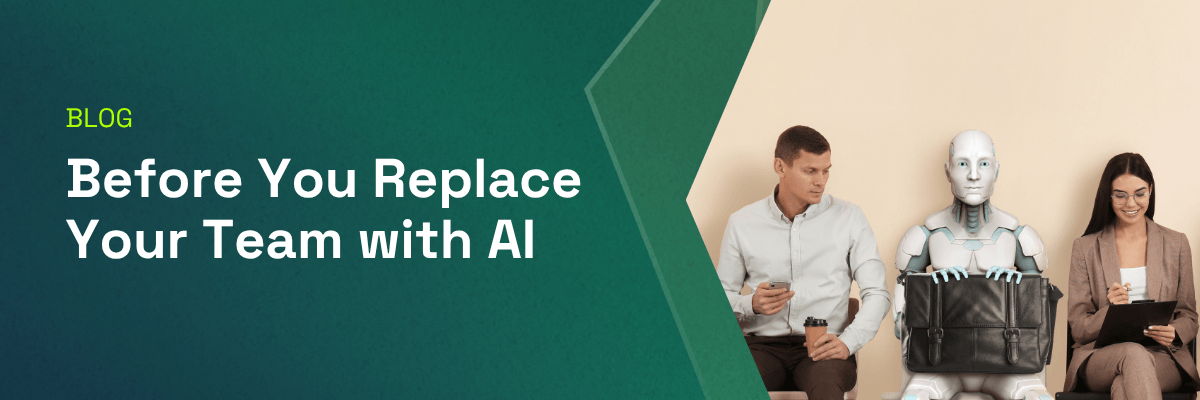
Before You Replace Your Team with AI


Everyone remembers when ordering dinner from a delivery app felt like a bargain
A restaurant meal at your door in thirty minutes, with fees that nobody really thought twice about. What wasn't visible was the economics behind it: the four biggest delivery platforms, DoorDash, Delivery Hero, Just Eat Takeaway, and Deliveroo, accumulated over $20 billion in combined operating losses, absorbing the cost of building habit and making cooking feel like a step backwards. The product wasn't convenience. It was dependency, carefully priced.
Then, once that dependency was established, prices went up. Significantly. Delivery fees alone rose 58% in a single year in some markets, and consumers reported paying consistently more than ordering directly. The artificially cheap era was over.
We are watching the same dynamic unfold with AI. And most organizations are not doing the math.
The Hidden Economics of AI
When a company decides to replace a task, such as analysis, customer support, or code review, with AI, they typically run a simple comparison: what does this cost in tokens versus what does this cost in human hours? On today's numbers, AI looks compelling. And so decisions get made: roles are restructured, workflows are rebuilt, and headcount is cut.
But there are two problems with that calculation.
The first is iteration. AI rarely gets it right in one pass. Every "try again but more concise" adds cost. The real price per task is almost always higher than the theoretical one, sometimes by a factor of three or four, once you account for oversight, review, and the human time spent managing the output.
The second problem is bigger: you are pricing against a subsidised baseline.
Token costs right now are low because the major providers need them to be. This is a land grab. These companies are absorbing losses to drive adoption and lock in workflows before the market stabilises. That window will close. A 2–3x increase in token costs, which is a realistic correction, could flip entire use cases from "clearly cheaper than human" to "roughly equivalent" or worse.
Factor in iteration cycles, oversight time, and the clean spreadsheet calculation starts to look considerably messier. The gap between AI and human cost narrows, and in some cases, closes entirely. But even that is the wrong place to focus. Because the deeper problem isn't the price. It's that not every task should be measured in tokens at all.
Where Humans Win
Some work looks automatable on paper. Take a difficult conversation between a manager and an underperforming team member, where the outcome depends less on what is said and more on who is saying it. That falls apart the moment you reduce it to a prompt. The value was never in the output. It was in the human capabilities - willingness to show up, be accountable, and own the outcome.
The moments that actually move organisations forward are hard to systematise. A manager who spots a team member struggling before it becomes a problem. A founder who kills a product line because experience says the timing is wrong. These aren't tasks to be completed. These are judgments to be made. And judgments carry something tokens don't: accountability.
This is what the AI conversation keeps getting wrong. The skills that drive organisational success - curiosity, accountability, emotional intelligence, ability to read a room and respond - are not features that can be prompted. They are uniquely human, and they are precisely the capabilities that determine whether a team performs or stalls when things get hard.
The organisations that get this right are honest about which tasks benefit from automation and which depend on a human. Sadly, many have already made those decisions and are in the process of locking themselves in before the real cost becomes clear.
The Lock-in Risk
Headcount decisions made today are also decisions about where knowledge lives. The experienced analyst who knew which numbers to trust. The account manager who held the client relationship together through three product changes. When those people leave, that knowledge leaves with them.
Delivery apps hooked their customers on convenience, then raised prices. The same dynamic is playing out in organisations right now. Teams are being redesigned around today's AI capabilities and today's token costs. Workflows that used to require human judgment are being handed to systems that are fast, cheap, and, for now, good enough. And with every role eliminated, the ability to course-correct quietly shrinks.
When prices rise, or when the task turns out to need a human after all, many organisations will find themselves without the people or the knowledge to respond. And by then, rebuilding will cost far more than the tokens ever saved.
A Better Way to Evaluate
Most ROI frameworks ask one question: is AI cheaper than the human alternative today? The more useful question is whether that will still be true in two years, and what it costs if the answer is no.
Before automating any task, there are three questions worth sitting with. What is the true cost at market-rate token pricing, not today's subsidised baseline? What is the full cost of the human alternative, together with the judgment and relationships that come with it? And how reversible is this decision if it turns out to be wrong?
Knowing with precision which tool belongs where, and why, is what separates a durable AI strategy from an expensive experiment.
Not Anti-AI. Pro-Clarity.
This is not an argument against AI. The technology is real, the productivity gains are real, and organisations that use it well will have a genuine edge.
But genuine edge comes from clear thinking. Right now, the noise around AI is making that harder. Decision timelines have compressed, structural bets have been normalised, and scepticism has started to feel like a liability. Leaders who ask hard questions about ROI are being read as slow. Leaders who don't are building on ground that may not hold.
AI will permanently change how organisations work. That's not the debate worth having. The debate worth having is about timing, reversibility, and honest accounting. The smartest move right now isn't to go all in or hold back. It's to know exactly what you're buying and at what price.