All posts

How to Build a Finance-Ready Business Case with the Assessment ROI Calculator

Author
Dariia Komarova
Created on
July 22, 2026

The Assessment ROI Calculator is a free Deeper Signals AI Skill that turns a handful of workforce data points into a defensible business case for assessment investment. You give it your hiring or promotion volume, average salary, current and proposed selection process, and budget. It returns a professional document built for conversations with finance and executive leadership. The report estimates the talent value of better hiring and promotion decisions, presents a realistic range of outcomes, and documents its methodology. It compresses days of financial modeling into a single conversation.

This guide walks through how the skill works, how to use it, and how to read the output.

Why building an assessment business case is hard

Every assessment conversation reaches the same question: what is the return on investment? It is a fair question, and a surprisingly hard one to answer well.

Most organizations can estimate what they spend on assessments. Estimating the value of better hiring or promotion decisions is harder. You have to weigh the current selection process, the evidence behind the methods you are proposing, and your assumptions about performance and tenure.

You then have to present it so finance or executive leadership can understand and challenge it. Building that model takes time, and it is not something most HR teams do often. This skill is designed to do that groundwork.

What the Assessment ROI Calculator does

The Assessment ROI Calculator is one of four free AI Skills created by Deeper Signals. It is designed for HR leaders, consultants, and talent practitioners who need to justify an assessment investment.

You provide a few workforce data points, and the skill generates a professional document for real conversations with finance and leadership. It compares your current selection process with the proposed one, estimates the financial value of the improvement, and shows how that estimate was produced.

How to build a business case in minutes

Here is the full walkthrough, using a fictional healthcare organization called Vantara Health. Vantara makes around 450 hiring decisions a year for roles with an average salary of $85,000. It currently relies mainly on unstructured interviews and is considering adding Deeper Signals' Core Drivers assessment alongside a structured interview. The planned annual investment is $50,000.

Step 1 — Enter the organization and program details. Open Claude/ChatGPT with the Deeper Signals skill installed. You can find a guide for installing skills here. Call the skill in a new chat and ask it to build an assessment ROI business case. Then enter the hiring volume and average salary: 450 hires a year at $85,000.

Step 2 — Describe the current and proposed process. Enter the current approach, unstructured interviews, and the proposed one: Core Drivers together with structured interviews.

Step 3 — Add the budget and a few refining inputs. Enter the annual assessment budget of $50,000. Add details like expected tenure and the selection ratio, which make the estimate more specific to the organization.

Step 4 — Confirm and let it build. The skill confirms the assumptions and starts building. It compares the current and proposed processes using published selection research, estimates the improvement in predictive validity, and translates that into a financial estimate.

A few moments later, the report is ready.

How to read the output like a practitioner

The cover page leads with the headline estimate. In this example, every dollar invested in the proposed hiring process could generate around $337.83 in talent value over the time those employees stay with the organization.

The next section explains the business case in plain language. It describes the opportunity, outlines the proposed assessment strategy, and explains how moving from unstructured interviews to Core Drivers with structured interviews is expected to improve hiring decisions.

The report then presents three scenarios: Conservative, Expected, and Strong. Instead of a single number, it shows a realistic range based on different assumptions. Here, the estimated value runs from around $250 to almost $400 for every dollar invested.

Finally, the methodology page documents exactly how the estimate was produced, so finance can follow and challenge the assumptions.

What the skill can and can't do

The figures are estimates, not guarantees. They are based on the workforce data you provide, published research, and conservative modeling assumptions.

The report is not a prediction of future business performance, and it does not replace financial review or professional judgment. Its purpose is to help you build a transparent, evidence-based business case rather than to promise a specific outcome.

How Deeper Signals approaches AI-supported business cases

Deeper Signals builds scientifically validated assessments for hiring, development, and succession decisions. Decades of selection research show that structured, validated methods predict job performance more accurately than unstructured interviews (Schmidt & Hunter, 1998). That evidence is what makes a credible ROI estimate possible in the first place.

The same principle underpins this skill. It grounds each estimate in published validity research rather than assumption, and documents every step so the numbers can be examined. The model does the calculation, but the practitioner still owns the assumptions and the final case.

The Assessment ROI Calculator is part of the free Deeper Signals AI Skills toolbox. The “How to get started” guide is available through the link below.

FAQ

What data do I need to use it?

A few workforce data points: hiring volume, average salary, your current and proposed selection process, and the annual budget. Optional inputs like expected tenure and selection ratio make the estimate more specific.

Is the ROI figure a guarantee?

No. It is an evidence-based estimate built on conservative assumptions, not a prediction of business performance.

Who is the skill for?

HR leaders, consultants, and talent practitioners who need to justify an assessment investment to finance or executive leadership.

Can finance challenge the numbers?

Yes. The methodology page documents every assumption and calculation, so they can be reviewed and adjusted.

How long does it take?

Most business cases are ready in minutes, compared with the days this modeling can otherwise take.

All posts

How to Build a Finance-Ready Business Case with the Assessment ROI Calculator

Author
Dariia Komarova
Created on
July 15, 2026

The Assessment ROI Calculator is a free Deeper Signals AI Skill that turns a handful of workforce data points into a defensible business case for assessment investment. You give it your hiring or promotion volume, average salary, current and proposed selection process, and budget. It returns a professional document built for conversations with finance and executive leadership. The report estimates the talent value of better hiring and promotion decisions, presents a realistic range of outcomes, and documents its methodology. It compresses days of financial modeling into a single conversation.

This guide walks through how the skill works, how to use it, and how to read the output.

Why building an assessment business case is hard

Every assessment conversation reaches the same question: what is the return on investment? It is a fair question, and a surprisingly hard one to answer well.

Most organizations can estimate what they spend on assessments. Estimating the value of better hiring or promotion decisions is harder. You have to weigh the current selection process, the evidence behind the methods you are proposing, and your assumptions about performance and tenure.

You then have to present it so finance or executive leadership can understand and challenge it. Building that model takes time, and it is not something most HR teams do often. This skill is designed to do that groundwork.

What the Assessment ROI Calculator does

The Assessment ROI Calculator is one of four free AI Skills created by Deeper Signals. It is designed for HR leaders, consultants, and talent practitioners who need to justify an assessment investment.

You provide a few workforce data points, and the skill generates a professional document for real conversations with finance and leadership. It compares your current selection process with the proposed one, estimates the financial value of the improvement, and shows how that estimate was produced.

How to build a business case in minutes

Here is the full walkthrough, using a fictional healthcare organization called Vantara Health. Vantara makes around 450 hiring decisions a year for roles with an average salary of $85,000. It currently relies mainly on unstructured interviews and is considering adding Deeper Signals' Core Drivers assessment alongside a structured interview. The planned annual investment is $50,000.

Step 1 — Enter the organization and program details. Open Claude/ChatGPT with the Deeper Signals skill installed. You can find a guide for installing skills here. Call the skill in a new chat and ask it to build an assessment ROI business case. Then enter the hiring volume and average salary: 450 hires a year at $85,000.

Step 2 — Describe the current and proposed process. Enter the current approach, unstructured interviews, and the proposed one: Core Drivers together with structured interviews.

Step 3 — Add the budget and a few refining inputs. Enter the annual assessment budget of $50,000. Add details like expected tenure and the selection ratio, which make the estimate more specific to the organization.
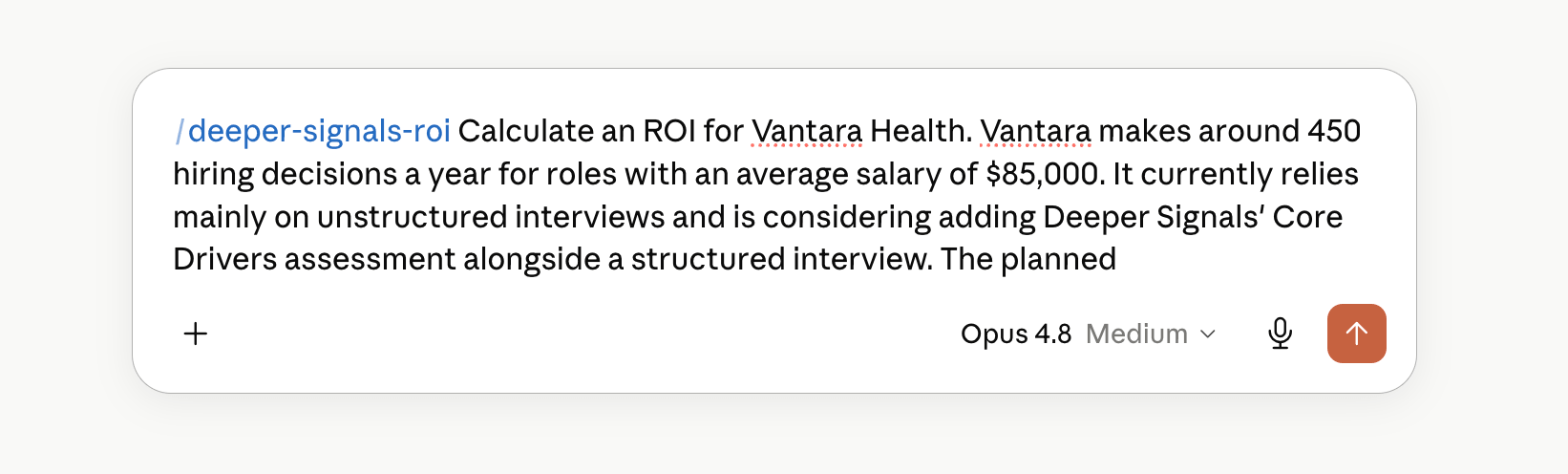
Step 4 — Confirm and let it build. The skill confirms the assumptions and starts building. It compares the current and proposed processes using published selection research, estimates the improvement in predictive validity, and translates that into a financial estimate.

A few moments later, the report is ready.

How to read the output like a practitioner

The cover page leads with the headline estimate. In this example, every dollar invested in the proposed hiring process could generate around $337.83 in talent value over the time those employees stay with the organization.

The next section explains the business case in plain language. It describes the opportunity, outlines the proposed assessment strategy, and explains how moving from unstructured interviews to Core Drivers with structured interviews is expected to improve hiring decisions.

The report then presents three scenarios: Conservative, Expected, and Strong. Instead of a single number, it shows a realistic range based on different assumptions. Here, the estimated value runs from around $250 to almost $400 for every dollar invested.

Finally, the methodology page documents exactly how the estimate was produced, so finance can follow and challenge the assumptions.

What the skill can and can't do

The figures are estimates, not guarantees. They are based on the workforce data you provide, published research, and conservative modeling assumptions.

The report is not a prediction of future business performance, and it does not replace financial review or professional judgment. Its purpose is to help you build a transparent, evidence-based business case rather than to promise a specific outcome.

How Deeper Signals approaches AI-supported business cases

Deeper Signals builds scientifically validated assessments for hiring, development, and succession decisions. Decades of selection research show that structured, validated methods predict job performance more accurately than unstructured interviews (Schmidt & Hunter, 1998). That evidence is what makes a credible ROI estimate possible in the first place.

The same principle underpins this skill. It grounds each estimate in published validity research rather than assumption, and documents every step so the numbers can be examined. The model does the calculation, but the practitioner still owns the assumptions and the final case.

The Assessment ROI Calculator is part of the free Deeper Signals AI Skills toolbox. The “How to get started” guide is available through the link below.

FAQ

What data do I need to use it?

A few workforce data points: hiring volume, average salary, your current and proposed selection process, and the annual budget. Optional inputs like expected tenure and selection ratio make the estimate more specific.

Is the ROI figure a guarantee?

No. It is an evidence-based estimate built on conservative assumptions, not a prediction of business performance.

Who is the skill for?

HR leaders, consultants, and talent practitioners who need to justify an assessment investment to finance or executive leadership.

Can finance challenge the numbers?

Yes. The methodology page documents every assumption and calculation, so they can be reviewed and adjusted.

How long does it take?

Most business cases are ready in minutes, compared with the days this modeling can otherwise take.

All posts

How to Build a Finance-Ready Business Case with the Assessment ROI Calculator

Author
Dariia Komarova
Created on
July 22, 2026

The Assessment ROI Calculator is a free Deeper Signals AI Skill that turns a handful of workforce data points into a defensible business case for assessment investment. You give it your hiring or promotion volume, average salary, current and proposed selection process, and budget. It returns a professional document built for conversations with finance and executive leadership. The report estimates the talent value of better hiring and promotion decisions, presents a realistic range of outcomes, and documents its methodology. It compresses days of financial modeling into a single conversation.

This guide walks through how the skill works, how to use it, and how to read the output.

Why building an assessment business case is hard

Every assessment conversation reaches the same question: what is the return on investment? It is a fair question, and a surprisingly hard one to answer well.

Most organizations can estimate what they spend on assessments. Estimating the value of better hiring or promotion decisions is harder. You have to weigh the current selection process, the evidence behind the methods you are proposing, and your assumptions about performance and tenure.

You then have to present it so finance or executive leadership can understand and challenge it. Building that model takes time, and it is not something most HR teams do often. This skill is designed to do that groundwork.

What the Assessment ROI Calculator does

The Assessment ROI Calculator is one of four free AI Skills created by Deeper Signals. It is designed for HR leaders, consultants, and talent practitioners who need to justify an assessment investment.

You provide a few workforce data points, and the skill generates a professional document for real conversations with finance and leadership. It compares your current selection process with the proposed one, estimates the financial value of the improvement, and shows how that estimate was produced.

How to build a business case in minutes

Here is the full walkthrough, using a fictional healthcare organization called Vantara Health. Vantara makes around 450 hiring decisions a year for roles with an average salary of $85,000. It currently relies mainly on unstructured interviews and is considering adding Deeper Signals' Core Drivers assessment alongside a structured interview. The planned annual investment is $50,000.

Step 1 — Enter the organization and program details. Open Claude/ChatGPT with the Deeper Signals skill installed. You can find a guide for installing skills here. Call the skill in a new chat and ask it to build an assessment ROI business case. Then enter the hiring volume and average salary: 450 hires a year at $85,000.

Step 2 — Describe the current and proposed process. Enter the current approach, unstructured interviews, and the proposed one: Core Drivers together with structured interviews.

Step 3 — Add the budget and a few refining inputs. Enter the annual assessment budget of $50,000. Add details like expected tenure and the selection ratio, which make the estimate more specific to the organization.

Step 4 — Confirm and let it build. The skill confirms the assumptions and starts building. It compares the current and proposed processes using published selection research, estimates the improvement in predictive validity, and translates that into a financial estimate.

A few moments later, the report is ready.

How to read the output like a practitioner

The cover page leads with the headline estimate. In this example, every dollar invested in the proposed hiring process could generate around $337.83 in talent value over the time those employees stay with the organization.

The next section explains the business case in plain language. It describes the opportunity, outlines the proposed assessment strategy, and explains how moving from unstructured interviews to Core Drivers with structured interviews is expected to improve hiring decisions.

The report then presents three scenarios: Conservative, Expected, and Strong. Instead of a single number, it shows a realistic range based on different assumptions. Here, the estimated value runs from around $250 to almost $400 for every dollar invested.

Finally, the methodology page documents exactly how the estimate was produced, so finance can follow and challenge the assumptions.

What the skill can and can't do

The figures are estimates, not guarantees. They are based on the workforce data you provide, published research, and conservative modeling assumptions.

The report is not a prediction of future business performance, and it does not replace financial review or professional judgment. Its purpose is to help you build a transparent, evidence-based business case rather than to promise a specific outcome.

How Deeper Signals approaches AI-supported business cases

Deeper Signals builds scientifically validated assessments for hiring, development, and succession decisions. Decades of selection research show that structured, validated methods predict job performance more accurately than unstructured interviews (Schmidt & Hunter, 1998). That evidence is what makes a credible ROI estimate possible in the first place.

The same principle underpins this skill. It grounds each estimate in published validity research rather than assumption, and documents every step so the numbers can be examined. The model does the calculation, but the practitioner still owns the assumptions and the final case.

The Assessment ROI Calculator is part of the free Deeper Signals AI Skills toolbox. The “How to get started” guide is available through the link below.

FAQ

What data do I need to use it?

A few workforce data points: hiring volume, average salary, your current and proposed selection process, and the annual budget. Optional inputs like expected tenure and selection ratio make the estimate more specific.

Is the ROI figure a guarantee?

No. It is an evidence-based estimate built on conservative assumptions, not a prediction of business performance.

Who is the skill for?

HR leaders, consultants, and talent practitioners who need to justify an assessment investment to finance or executive leadership.

Can finance challenge the numbers?

Yes. The methodology page documents every assumption and calculation, so they can be reviewed and adjusted.

How long does it take?

Most business cases are ready in minutes, compared with the days this modeling can otherwise take.

All posts

How to Build a Finance-Ready Business Case with the Assessment ROI Calculator

Author
Dariia Komarova
Created on
July 22, 2026

The Assessment ROI Calculator is a free Deeper Signals AI Skill that turns a handful of workforce data points into a defensible business case for assessment investment. You give it your hiring or promotion volume, average salary, current and proposed selection process, and budget. It returns a professional document built for conversations with finance and executive leadership. The report estimates the talent value of better hiring and promotion decisions, presents a realistic range of outcomes, and documents its methodology. It compresses days of financial modeling into a single conversation.

This guide walks through how the skill works, how to use it, and how to read the output.

Why building an assessment business case is hard

Every assessment conversation reaches the same question: what is the return on investment? It is a fair question, and a surprisingly hard one to answer well.

Most organizations can estimate what they spend on assessments. Estimating the value of better hiring or promotion decisions is harder. You have to weigh the current selection process, the evidence behind the methods you are proposing, and your assumptions about performance and tenure.

You then have to present it so finance or executive leadership can understand and challenge it. Building that model takes time, and it is not something most HR teams do often. This skill is designed to do that groundwork.

What the Assessment ROI Calculator does

The Assessment ROI Calculator is one of four free AI Skills created by Deeper Signals. It is designed for HR leaders, consultants, and talent practitioners who need to justify an assessment investment.

You provide a few workforce data points, and the skill generates a professional document for real conversations with finance and leadership. It compares your current selection process with the proposed one, estimates the financial value of the improvement, and shows how that estimate was produced.

How to build a business case in minutes

Here is the full walkthrough, using a fictional healthcare organization called Vantara Health. Vantara makes around 450 hiring decisions a year for roles with an average salary of $85,000. It currently relies mainly on unstructured interviews and is considering adding Deeper Signals' Core Drivers assessment alongside a structured interview. The planned annual investment is $50,000.

Step 1 — Enter the organization and program details. Open Claude/ChatGPT with the Deeper Signals skill installed. You can find a guide for installing skills here. Call the skill in a new chat and ask it to build an assessment ROI business case. Then enter the hiring volume and average salary: 450 hires a year at $85,000.

Step 2 — Describe the current and proposed process. Enter the current approach, unstructured interviews, and the proposed one: Core Drivers together with structured interviews.

Step 3 — Add the budget and a few refining inputs. Enter the annual assessment budget of $50,000. Add details like expected tenure and the selection ratio, which make the estimate more specific to the organization.

Step 4 — Confirm and let it build. The skill confirms the assumptions and starts building. It compares the current and proposed processes using published selection research, estimates the improvement in predictive validity, and translates that into a financial estimate.

A few moments later, the report is ready.

How to read the output like a practitioner

The cover page leads with the headline estimate. In this example, every dollar invested in the proposed hiring process could generate around $337.83 in talent value over the time those employees stay with the organization.

The next section explains the business case in plain language. It describes the opportunity, outlines the proposed assessment strategy, and explains how moving from unstructured interviews to Core Drivers with structured interviews is expected to improve hiring decisions.

The report then presents three scenarios: Conservative, Expected, and Strong. Instead of a single number, it shows a realistic range based on different assumptions. Here, the estimated value runs from around $250 to almost $400 for every dollar invested.

Finally, the methodology page documents exactly how the estimate was produced, so finance can follow and challenge the assumptions.

What the skill can and can't do

The figures are estimates, not guarantees. They are based on the workforce data you provide, published research, and conservative modeling assumptions.

The report is not a prediction of future business performance, and it does not replace financial review or professional judgment. Its purpose is to help you build a transparent, evidence-based business case rather than to promise a specific outcome.

How Deeper Signals approaches AI-supported business cases

Deeper Signals builds scientifically validated assessments for hiring, development, and succession decisions. Decades of selection research show that structured, validated methods predict job performance more accurately than unstructured interviews (Schmidt & Hunter, 1998). That evidence is what makes a credible ROI estimate possible in the first place.

The same principle underpins this skill. It grounds each estimate in published validity research rather than assumption, and documents every step so the numbers can be examined. The model does the calculation, but the practitioner still owns the assumptions and the final case.

The Assessment ROI Calculator is part of the free Deeper Signals AI Skills toolbox. The “How to get started” guide is available through the link below.

FAQ

What data do I need to use it?

A few workforce data points: hiring volume, average salary, your current and proposed selection process, and the annual budget. Optional inputs like expected tenure and selection ratio make the estimate more specific.

Is the ROI figure a guarantee?

No. It is an evidence-based estimate built on conservative assumptions, not a prediction of business performance.

Who is the skill for?

HR leaders, consultants, and talent practitioners who need to justify an assessment investment to finance or executive leadership.

Can finance challenge the numbers?

Yes. The methodology page documents every assumption and calculation, so they can be reviewed and adjusted.

How long does it take?

Most business cases are ready in minutes, compared with the days this modeling can otherwise take.

All posts

How to Build a Finance-Ready Business Case with the Assessment ROI Calculator

Customer
Job Title

The Assessment ROI Calculator is a free Deeper Signals AI Skill that turns a handful of workforce data points into a defensible business case for assessment investment. You give it your hiring or promotion volume, average salary, current and proposed selection process, and budget. It returns a professional document built for conversations with finance and executive leadership. The report estimates the talent value of better hiring and promotion decisions, presents a realistic range of outcomes, and documents its methodology. It compresses days of financial modeling into a single conversation.

This guide walks through how the skill works, how to use it, and how to read the output.

Why building an assessment business case is hard

Every assessment conversation reaches the same question: what is the return on investment? It is a fair question, and a surprisingly hard one to answer well.

Most organizations can estimate what they spend on assessments. Estimating the value of better hiring or promotion decisions is harder. You have to weigh the current selection process, the evidence behind the methods you are proposing, and your assumptions about performance and tenure.

You then have to present it so finance or executive leadership can understand and challenge it. Building that model takes time, and it is not something most HR teams do often. This skill is designed to do that groundwork.

What the Assessment ROI Calculator does

The Assessment ROI Calculator is one of four free AI Skills created by Deeper Signals. It is designed for HR leaders, consultants, and talent practitioners who need to justify an assessment investment.

You provide a few workforce data points, and the skill generates a professional document for real conversations with finance and leadership. It compares your current selection process with the proposed one, estimates the financial value of the improvement, and shows how that estimate was produced.

How to build a business case in minutes

Here is the full walkthrough, using a fictional healthcare organization called Vantara Health. Vantara makes around 450 hiring decisions a year for roles with an average salary of $85,000. It currently relies mainly on unstructured interviews and is considering adding Deeper Signals' Core Drivers assessment alongside a structured interview. The planned annual investment is $50,000.

Step 1 — Enter the organization and program details. Open Claude/ChatGPT with the Deeper Signals skill installed. You can find a guide for installing skills here. Call the skill in a new chat and ask it to build an assessment ROI business case. Then enter the hiring volume and average salary: 450 hires a year at $85,000.

Step 2 — Describe the current and proposed process. Enter the current approach, unstructured interviews, and the proposed one: Core Drivers together with structured interviews.

Step 3 — Add the budget and a few refining inputs. Enter the annual assessment budget of $50,000. Add details like expected tenure and the selection ratio, which make the estimate more specific to the organization.

Step 4 — Confirm and let it build. The skill confirms the assumptions and starts building. It compares the current and proposed processes using published selection research, estimates the improvement in predictive validity, and translates that into a financial estimate.

A few moments later, the report is ready.

How to read the output like a practitioner

The cover page leads with the headline estimate. In this example, every dollar invested in the proposed hiring process could generate around $337.83 in talent value over the time those employees stay with the organization.

The next section explains the business case in plain language. It describes the opportunity, outlines the proposed assessment strategy, and explains how moving from unstructured interviews to Core Drivers with structured interviews is expected to improve hiring decisions.

The report then presents three scenarios: Conservative, Expected, and Strong. Instead of a single number, it shows a realistic range based on different assumptions. Here, the estimated value runs from around $250 to almost $400 for every dollar invested.

Finally, the methodology page documents exactly how the estimate was produced, so finance can follow and challenge the assumptions.

What the skill can and can't do

The figures are estimates, not guarantees. They are based on the workforce data you provide, published research, and conservative modeling assumptions.

The report is not a prediction of future business performance, and it does not replace financial review or professional judgment. Its purpose is to help you build a transparent, evidence-based business case rather than to promise a specific outcome.

How Deeper Signals approaches AI-supported business cases

Deeper Signals builds scientifically validated assessments for hiring, development, and succession decisions. Decades of selection research show that structured, validated methods predict job performance more accurately than unstructured interviews (Schmidt & Hunter, 1998). That evidence is what makes a credible ROI estimate possible in the first place.

The same principle underpins this skill. It grounds each estimate in published validity research rather than assumption, and documents every step so the numbers can be examined. The model does the calculation, but the practitioner still owns the assumptions and the final case.

The Assessment ROI Calculator is part of the free Deeper Signals AI Skills toolbox. The “How to get started” guide is available through the link below.

FAQ

What data do I need to use it?

A few workforce data points: hiring volume, average salary, your current and proposed selection process, and the annual budget. Optional inputs like expected tenure and selection ratio make the estimate more specific.

Is the ROI figure a guarantee?

No. It is an evidence-based estimate built on conservative assumptions, not a prediction of business performance.

Who is the skill for?

HR leaders, consultants, and talent practitioners who need to justify an assessment investment to finance or executive leadership.

Can finance challenge the numbers?

Yes. The methodology page documents every assumption and calculation, so they can be reviewed and adjusted.

How long does it take?

Most business cases are ready in minutes, compared with the days this modeling can otherwise take.

Ready for your Spotlight?
Contact us to book your Customer Spotlight and showcase your work to an extensive, global audience!
Start your free trial today
Free access to Deeper Signals’ quick, scientific assessments, feedback tools, and more.
Start Free Trial
Recent posts
Guides & Tips
How to Turn Executive Assessment Data into a Leadership Narrative with an AI Skill
Psychometrics, 360s, interviews, references — this free Deeper Signals skill codes it all against a role's success criteria into an auditable leadership narrative.
Read more
Guides & Tips
How to Review an Assessment's Evidence Base with an AI Skill
How well is that assessment actually evidenced? This free Deeper Signals AI skill maps any instrument against the APA, SIOP, EFPA, and ITC standards.
Read more
Guides & Tips
How to Create a Coaching Plan from Assessment Results in Under 10 Minutes
Learn how Deeper Signals' free Development Plan skill turns assessment results into a coach-ready plan in under 10 minutes.
Read more
Guides & Tips
How to Build a Finance-Ready Business Case with the Assessment ROI Calculator
See how Deeper Signals' free Assessment ROI Calculator turns a few workforce data points into a finance-ready business case for assessment investment.
Read more
Guides & Tips
How to Install the Deeper Signals AI Skills
Install all four Deeper Signals AI skills in about two minutes. This step-by-step guide, with screenshots, shows you how to set them up and use them in any chat.
Read more
Want more articles like this?
Subscribe to our newsletter
Practical insights on people and performance, delivered to your inbox
Subscribe
Recent posts
Guides & Tips
How to Turn Executive Assessment Data into a Leadership Narrative with an AI Skill
Psychometrics, 360s, interviews, references — this free Deeper Signals skill codes it all against a role's success criteria into an auditable leadership narrative.
Read more
Guides & Tips
How to Review an Assessment's Evidence Base with an AI Skill
How well is that assessment actually evidenced? This free Deeper Signals AI skill maps any instrument against the APA, SIOP, EFPA, and ITC standards.
Read more
Guides & Tips
How to Create a Coaching Plan from Assessment Results in Under 10 Minutes
Learn how Deeper Signals' free Development Plan skill turns assessment results into a coach-ready plan in under 10 minutes.
Read more
Guides & Tips
How to Build a Finance-Ready Business Case with the Assessment ROI Calculator
See how Deeper Signals' free Assessment ROI Calculator turns a few workforce data points into a finance-ready business case for assessment investment.
Read more
Guides & Tips
How to Install the Deeper Signals AI Skills
Install all four Deeper Signals AI skills in about two minutes. This step-by-step guide, with screenshots, shows you how to set them up and use them in any chat.
Read more
Curious to learn more?

Schedule a call with Deeper Signals to understand how our assessments and feedback tools help people gain a deep awareness of their talents and reach their full potential. Underpinned by science and technology, we build talented people, leaders and companies.

  • Scalable and engaging assessment solutions
  • Measurable and predictive talent insights
  • Powered by technology and science that drives results
Let's talk!
  • Scalable interventions for growth
  • Measurable data, insights and outcomes for high performance
  • Proven scientific expertise that links results to outcomes
Thank you!
Would you like to schedule a meeting?
Please fill all fields before submitting the form.
All posts

Heading

Author
This is some text inside of a div block.
Created on
This is some text inside of a div block.

Heading 1

Heading 2

Heading 3

Heading 4

Heading 5
Heading 6

Lorem ipsum dolor sit amet, consectetur adipiscing elit, sed do eiusmod tempor incididunt ut labore et dolore magna aliqua. Ut enim ad minim veniam, quis nostrud exercitation ullamco laboris nisi ut aliquip ex ea commodo consequat. Duis aute irure dolor in reprehenderit in voluptate velit esse cillum dolore eu fugiat nulla pariatur.

Block quote

Ordered list

  1. Item 1
  2. Item 2
  3. Item 3

Unordered list

  • Item A
  • Item B
  • Item C

Text link

Bold text

Emphasis

Superscript

Subscript