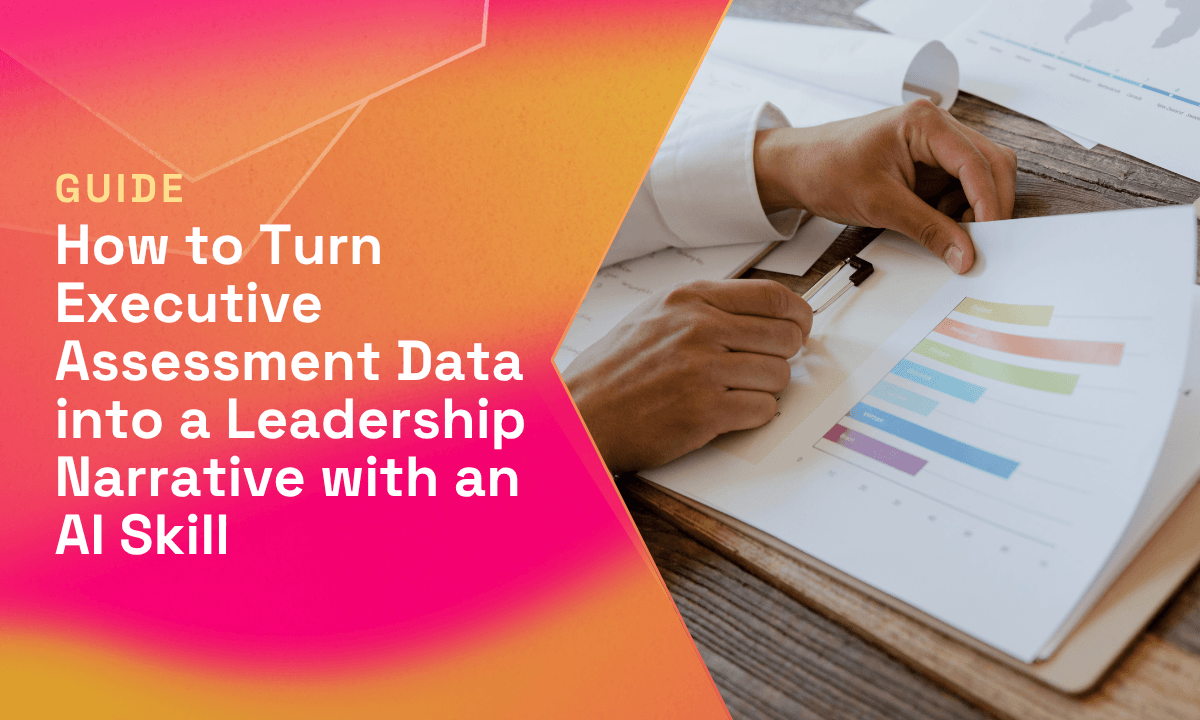
How to Turn Executive Assessment Data into a Leadership Narrative with an AI Skill


The Leadership Narrative Summary is a free Deeper Signals AI Skill that synthesizes multi-source executive assessment data into a criteria-aligned narrative for a search committee, hiring CEO, or board. It works with psychometrics from any vendor, 360 feedback, interview transcripts, references, case performance, and biodata. You give it the role's success criteria and the candidate materials, and it codes the evidence against confirmed behavioral indicators, computes an evidence status for every criterion, and drafts a professional document. It gives no score, no ranking, and no hire or no-hire verdict. It characterizes the evidence against the criteria and leaves the judgment to the assessor.
This guide walks through how the skill works, how to use it, and how to read the output.
Why turning assessment data into a narrative is hard
By the time a committee meets, the evidence usually exists: a psychometric profile, a 360, interview notes, maybe references. Pulling it into one coherent, criteria-mapped narrative is the slow part. It is the work a search consultant often does by hand, under time pressure, with the reasoning living only in their head.
Doing it well means deciding what each source actually shows, weighing observed behavior against self-report, and mapping all of it to the role's success criteria. It is easy to let one strong interview answer color unrelated areas, or to slide into a verdict the evidence does not support.
This skill forces that reasoning into a structure that can be checked, line by line, against the evidence.
What the Leadership Narrative Summary does
The Leadership Narrative Summary is one of the free AI Skills created by Deeper Signals. It is designed for executive search consultants, internal talent teams, and anyone preparing a leadership assessment for a committee or board.
Before it reads any candidate material, it confirms the success criteria and agrees a set of behavioral indicators for good and poor performance against each one. It then decomposes every source into discrete evidence items, codes each item against that frame one at a time, and re-derives every coding in a second pass. The skill excludes protected-characteristic content even when a source volunteers it, and it works on one candidate at a time.
How to build a leadership narrative
Here is the full walkthrough, using the fictional Head of Marketing search at Northwind.
Step 1 — Confirm the success criteria. Open Claude/ChatGPT with the Deeper Signals skill installed. You can find a guide for installing skills here. Call the skill in a new chat and provide the criteria. For John, that is six competencies, including Strategic Marketing Vision, Execution and Delivery, Developing the Team, Cross-functional Influence, Composure Under Pressure, and Commercial Judgment, plus two derailers to watch: over-control under stress and bluntness that reads as insensitive.
Step 2 — Confirm the coding frame. If no behavioral indicators exist yet, the skill drafts a set for each criterion and asks you to confirm them. For Developing the Team, "good" might include delegating genuinely stretching work with real ownership, while "poor" might include retaining the hard, visible work rather than handing it over. This frame is agreed before any candidate material is read.
Step 3 — Provide the materials and context. Add the candidate sources, any mix of vendors and formats. For John, that is a 360 Leadership Readiness Review and a Core Drivers personality profile. Add a short paragraph of role context, for example, Northwind is moving from founder-led, campaign-by-campaign marketing to a function that must set a multi-year strategy and partner closely with Product and Sales through a platform launch.
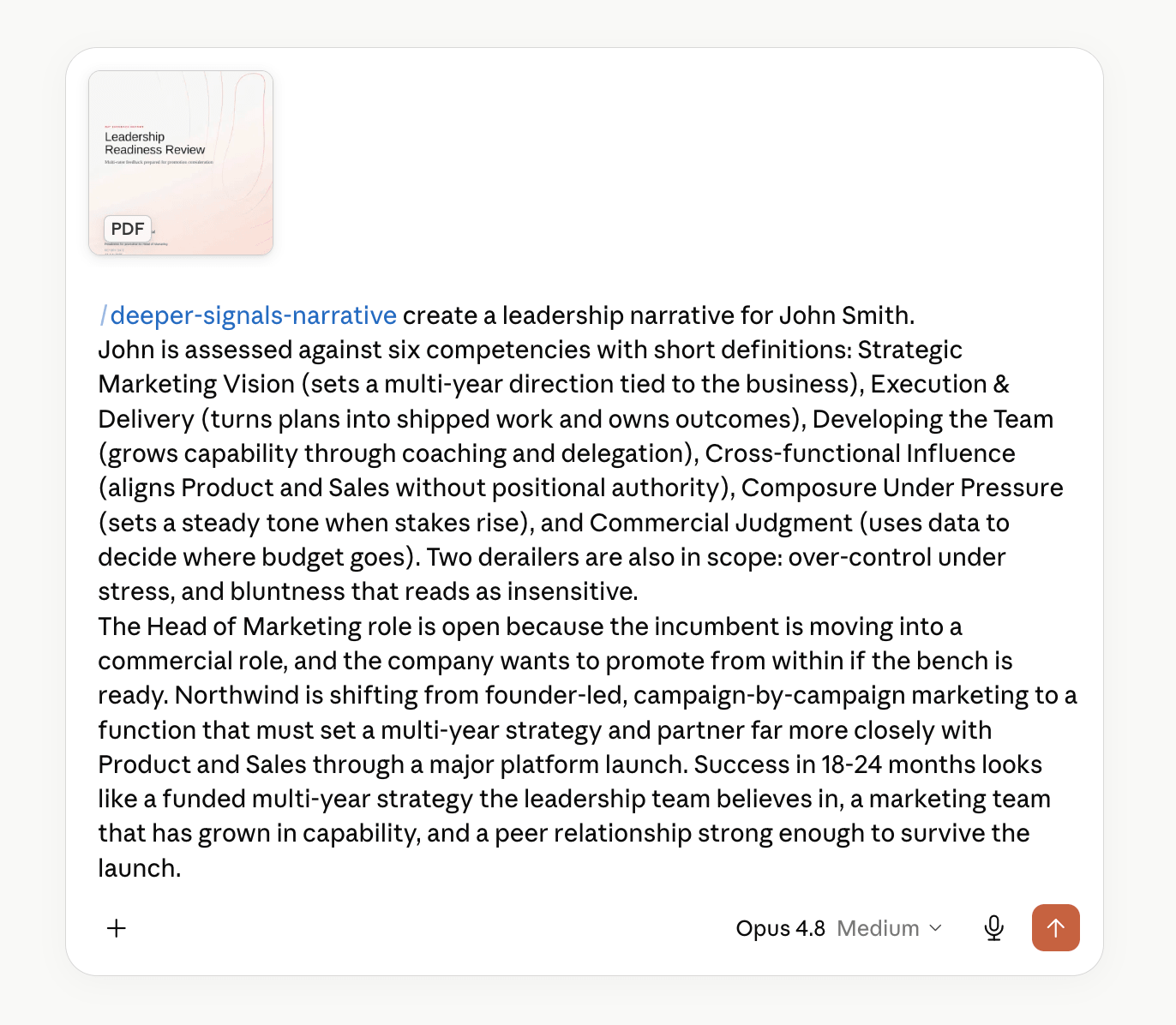
Step 4 — Confirm and let it build. The skill confirms the assumptions, codes the evidence against the frame, runs its verification pass, and computes a status per criterion. It then drafts the narrative from that evidence base alone.
A few moments later, the professional document is ready.
How to read the output like a practitioner
The report opens with a "how to use this document" note. It states plainly that this is an AI-generated working draft, not a finished assessment, and that the judgment belongs to the assessor and the committee.
The assessment basis section explains how the evidence was weighed. For John, observed 360 behavior carries the substantive weight, and the personality profile is read as disposition rather than as witnessed behavior.
Then comes the criteria-at-a-glance view, with a computed status per criterion:
Each criterion is then written up from the coded evidence. Execution is John's clearest strength, unanimous across rater groups and anchored in concrete verbatims. The four capabilities the next role leans on most, forward strategy, developing the team, lateral influence, and composure, are all development areas that point in one coherent direction: an outstanding individual operator whose growth frontier is leading through others. Commercial Judgment is left open, because the materials describe how fast John decides but not whether he allocates budget from data. That gap is named rather than inferred.
The document then covers strengths, development areas, and onboarding conditions, followed by open questions for the committee. Those questions are specific and evidence-grounded, such as asking John for a worked example of reallocating budget from data. It closes with a methodology, evidence map, and the full coding frame in an appendix.
What the skill can and can't do
The skill gives no score, no ranking, and no hire or no-hire verdict. It characterizes the evidence against the criteria and never expresses a preference across candidates. Where evidence is thin, it says so plainly rather than padding the gap, as it does with Commercial Judgment for John.
The output is a draft, not a decision. The underlying evidence register maps every claim back to its source for line-by-line verification. Every document includes a plain-language disclosure that AI systems can make mistakes and that nothing should be relied on until the assessor has verified it.
How Deeper Signals approaches AI-assisted leadership assessment
Deeper Signals treats a leadership narrative as something that must be auditable. That is why the reasoning is forced into a structure a human can check. Evidence is coded against confirmed indicators rather than judged freely, statuses are computed from a fixed decision table, and a second pass re-derives every coding before anything is finalized.
Throughout, it is explicit that the judgment stays with the human. The document is a structured first draft the assessor reviews, tests, edits, and owns.
The Leadership Narrative Summary is part of the free Deeper Signals AI Skills toolbox. The “How to get started” guide is available through the link below.
FAQ
Does the skill recommend whether to hire the candidate?
No. It gives no score, ranking, or verdict. It characterizes the evidence against the criteria and leaves the decision to the assessor and the committee.
Can it combine assessments from different vendors?
Yes. It is vendor-agnostic and can synthesize psychometrics, 360s, interviews, references, and case performance from any provider into one narrative.
What happens when the evidence is thin?
It says so. A criterion with too little to read is marked "insufficient evidence" rather than inferred, and the document stays shorter and honest.
How does it avoid bias from protected characteristics?
It screens for and excludes protected-characteristic content such as age, health, and family status, even when a source volunteers it.
Is the output ready to send to the committee?
No. It is a working draft. A qualified assessor must review it, test its interpretations against their own evidence, edit it, and take ownership before it is used.