All posts

How to Review an Assessment's Evidence Base with an AI Skill

Author
Dariia Komarova
Created on
July 22, 2026

The Assessment Evidence Review is a free Deeper Signals AI Skill that reviews how well a psychometric assessment is evidenced against four professional testing standards: APA, SIOP, EFPA, and ITC. You name the assessment, give it the evidence to review, and set the intended use. It returns a professional document that sets out what the evidence shows, states plainly where information was not found, and lists the questions and next steps to complete the picture. It gives no verdict, no rating, and no ranking. It reviews the instrument and its evidence, never a candidate.

This guide walks through how the skill works, how to use it, and how to read the output.

Why reviewing an assessment's evidence is hard

"How well is this assessment evidenced?" is a question every serious practitioner faces. Few can answer it rigorously or neutrally. Most informal reviews are inconsistent, opinion-led, or colored by brand reputation.

Doing it properly means working through construct rationale, reliability, validity, fairness, and norms, then mapping each to a recognized testing standard. That is slow, specialized work. It is also easy to slide into a verdict rather than a fair description of the evidence.

This skill answers the question neutrally for any instrument.

What the Assessment Evidence Review does

The Assessment Evidence Review is one of the free AI Skills created by Deeper Signals. It is designed for HR scientists, consultants, procurement teams, and anyone responsible for assessment governance.

It reviews a single instrument or a whole battery across five core pillars: theoretical rationale, reliability, validity, fairness, and norms and scoring. Each area gets a neutral status that describes how well the evidence is documented, not whether the tool is good or bad. Where something is not in the materials, it is recorded as "not found in materials reviewed" and kept separate from partial evidence. The skill never fabricates evidence, and it cites every external source it relies on.

How to review an assessment's evidence base

Here is the full walkthrough, reviewing the Deeper Signals Core Drivers Diagnostic for a development use.

Step 1 — Name the assessment. Open Claude/ChatGPT with the Deeper Signals skill installed. You can find a guide for installing skills here. Call the skill in a new chat and name the assessment and publisher: the Core Drivers Diagnostic from Deeper Signals.

Step 2 — Set the use, decision weight, and population. The skill asks a few framing questions. For this example, the intended use is development, Core Drivers is a decisive input into those decisions, and the population is North America. These set which standards the review emphasizes. They never produce a verdict.

Step 3 — Provide the evidence. Point the skill to the evidence to review: a technical manual, permission to search public sources, or both.

Step 4 — Confirm and let it build. The skill confirms the assumptions and works through the standards framework. It reviews each pillar, assigns a documentation status, and turns anything missing into questions and next steps.

A few moments later, the document is ready.

How to read the output like a practitioner

The report opens with the scope of review: the assessment, the use, the decision weight, the population, and the standards applied.

The overview describes what the instrument measures in plain language. Core Drivers is a self-report personality measure built on the Five Factor Model, reporting six dimensions, twelve Drivers, thirty Sub-Drivers, and twelve Core Risks, delivered with an interactive digital coach.

Then comes the findings table, grouped by pillar. Each area carries a neutral status and the basis for it. A few examples from this review:

Area Status Basis
Construct definition and grounding Well documented Six FFM dimensions defined, with Drivers, Sub-Drivers, and Risks mapped to each
Internal consistency Documented Scale alpha of .68 to .82 on a normative sample of 94,226
Construct validity Well documented Convergent and discriminant evidence against NEO PI-R, HPI, HEXACO, and others
Standard error and score bands Partially documented Scores shown as deviation from the normative mean; explicit SEM bands not found

After the table, the report summarizes where the evidence base is well documented, then reframes what was not found as areas that would strengthen the picture. For Core Drivers in a development use, the strong areas include the theoretical basis, construct validity, internal consistency, and coaching-oriented feedback. The areas to confirm include test-retest stability, explicit score-band information, and a North America-specific norm.

Because the review is framed for a decisive development input, it notes that individual-level interpretation carries more weight, so score-band and stability evidence matter more here. It then lists specific questions to ask the publisher and next steps split into immediate and short-term. It closes with the sources reviewed, marked by type.

What the skill can and can't do

The skill gives no verdict, no rating, and no ranking, and it never says a tool is or is not suitable. It reviews the instrument and its evidence, never a candidate, and it makes no hiring decisions about people.

It never fabricates evidence. If something is not in the materials, it says so, and "not found in materials reviewed" is treated as neutral rather than a fault. Every report includes a plain-language disclaimer stating that it is AI-generated, makes no claim about suitability, and is not a certification, endorsement, or ranking.

How Deeper Signals approaches assessment transparency

Deeper Signals treats assessment quality as a matter of evidence. Every finding maps to a recognized professional standard: the APA Standards for Educational and Psychological Testing (2014), the SIOP Principles (2018), the EFPA Test Review Model, and the ITC Guidelines. The same framework and the same bar apply to every instrument, including our own.

The Assessment Evidence Review is part of the free Deeper Signals AI Skills toolbox. The “How to get started” guide is available through the link below.

FAQ

Does the review say whether an assessment is any good?

No. It gives no verdict, rating, or ranking. It describes how well each area is evidenced and lets the reader draw their own conclusion.

What does "not found in materials reviewed" mean?

That the information was not located in what was reviewed. It is neutral, and it is not evidence that the information does not exist.

Can I review a competitor's assessment?

Yes. The skill is publisher-agnostic and non-disparaging, so it is safe to review any tool.

Which standards does it use?

The APA Standards (2014), the SIOP Principles (2018), the EFPA Test Review Model, and the ITC Guidelines.

Does it evaluate candidates?

No. It reviews the instrument and its evidence, never a person, and it makes no hiring decisions.

All posts

How to Review an Assessment's Evidence Base with an AI Skill

Author
Dariia Komarova
Created on
July 15, 2026

The Assessment Evidence Review is a free Deeper Signals AI Skill that reviews how well a psychometric assessment is evidenced against four professional testing standards: APA, SIOP, EFPA, and ITC. You name the assessment, give it the evidence to review, and set the intended use. It returns a professional document that sets out what the evidence shows, states plainly where information was not found, and lists the questions and next steps to complete the picture. It gives no verdict, no rating, and no ranking. It reviews the instrument and its evidence, never a candidate.

This guide walks through how the skill works, how to use it, and how to read the output.

Why reviewing an assessment's evidence is hard

"How well is this assessment evidenced?" is a question every serious practitioner faces. Few can answer it rigorously or neutrally. Most informal reviews are inconsistent, opinion-led, or colored by brand reputation.

Doing it properly means working through construct rationale, reliability, validity, fairness, and norms, then mapping each to a recognized testing standard. That is slow, specialized work. It is also easy to slide into a verdict rather than a fair description of the evidence.

This skill answers the question neutrally for any instrument.

What the Assessment Evidence Review does

The Assessment Evidence Review is one of the free AI Skills created by Deeper Signals. It is designed for HR scientists, consultants, procurement teams, and anyone responsible for assessment governance.

It reviews a single instrument or a whole battery across five core pillars: theoretical rationale, reliability, validity, fairness, and norms and scoring. Each area gets a neutral status that describes how well the evidence is documented, not whether the tool is good or bad. Where something is not in the materials, it is recorded as "not found in materials reviewed" and kept separate from partial evidence. The skill never fabricates evidence, and it cites every external source it relies on.

How to review an assessment's evidence base

Here is the full walkthrough, reviewing the Deeper Signals Core Drivers Diagnostic for a development use.

Step 1 — Name the assessment. Open Claude/ChatGPT with the Deeper Signals skill installed. You can find a guide for installing skills here. Call the skill in a new chat and name the assessment and publisher: the Core Drivers Diagnostic from Deeper Signals.
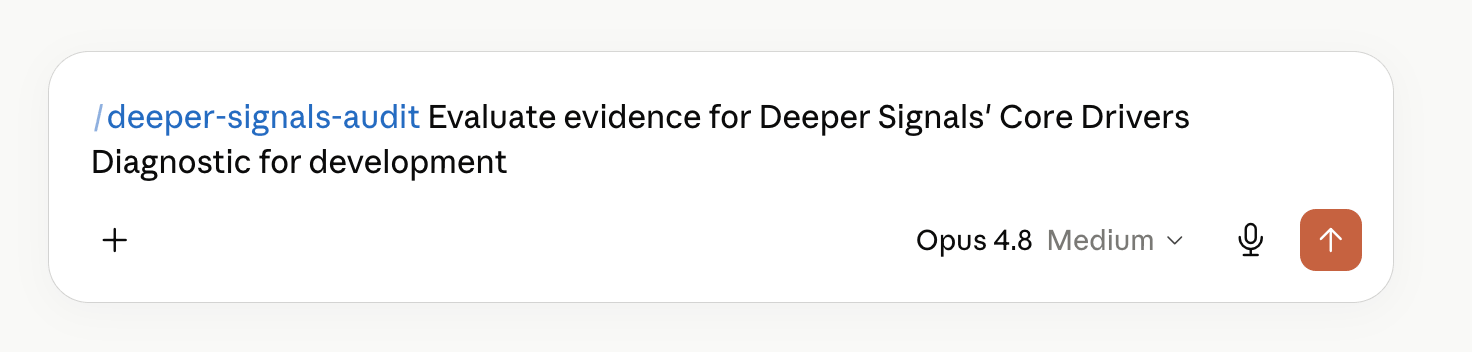
Step 2 — Set the use, decision weight, and population. The skill asks a few framing questions. For this example, the intended use is development, Core Drivers is a decisive input into those decisions, and the population is North America. These set which standards the review emphasizes. They never produce a verdict.

Step 3 — Provide the evidence. Point the skill to the evidence to review: a technical manual, permission to search public sources, or both.

Step 4 — Confirm and let it build. The skill confirms the assumptions and works through the standards framework. It reviews each pillar, assigns a documentation status, and turns anything missing into questions and next steps.

A few moments later, the document is ready.

How to read the output like a practitioner

The report opens with the scope of review: the assessment, the use, the decision weight, the population, and the standards applied.

The overview describes what the instrument measures in plain language. Core Drivers is a self-report personality measure built on the Five Factor Model, reporting six dimensions, twelve Drivers, thirty Sub-Drivers, and twelve Core Risks, delivered with an interactive digital coach.

Then comes the findings table, grouped by pillar. Each area carries a neutral status and the basis for it. A few examples from this review:

Area Status Basis
Construct definition and grounding Well documented Six FFM dimensions defined, with Drivers, Sub-Drivers, and Risks mapped to each
Internal consistency Documented Scale alpha of .68 to .82 on a normative sample of 94,226
Construct validity Well documented Convergent and discriminant evidence against NEO PI-R, HPI, HEXACO, and others
Standard error and score bands Partially documented Scores shown as deviation from the normative mean; explicit SEM bands not found

After the table, the report summarizes where the evidence base is well documented, then reframes what was not found as areas that would strengthen the picture. For Core Drivers in a development use, the strong areas include the theoretical basis, construct validity, internal consistency, and coaching-oriented feedback. The areas to confirm include test-retest stability, explicit score-band information, and a North America-specific norm.

Because the review is framed for a decisive development input, it notes that individual-level interpretation carries more weight, so score-band and stability evidence matter more here. It then lists specific questions to ask the publisher and next steps split into immediate and short-term. It closes with the sources reviewed, marked by type.

What the skill can and can't do

The skill gives no verdict, no rating, and no ranking, and it never says a tool is or is not suitable. It reviews the instrument and its evidence, never a candidate, and it makes no hiring decisions about people.

It never fabricates evidence. If something is not in the materials, it says so, and "not found in materials reviewed" is treated as neutral rather than a fault. Every report includes a plain-language disclaimer stating that it is AI-generated, makes no claim about suitability, and is not a certification, endorsement, or ranking.

How Deeper Signals approaches assessment transparency

Deeper Signals treats assessment quality as a matter of evidence. Every finding maps to a recognized professional standard: the APA Standards for Educational and Psychological Testing (2014), the SIOP Principles (2018), the EFPA Test Review Model, and the ITC Guidelines. The same framework and the same bar apply to every instrument, including our own.

The Assessment Evidence Review is part of the free Deeper Signals AI Skills toolbox. The “How to get started” guide is available through the link below.

FAQ

Does the review say whether an assessment is any good?

No. It gives no verdict, rating, or ranking. It describes how well each area is evidenced and lets the reader draw their own conclusion.

What does "not found in materials reviewed" mean?

That the information was not located in what was reviewed. It is neutral, and it is not evidence that the information does not exist.

Can I review a competitor's assessment?

Yes. The skill is publisher-agnostic and non-disparaging, so it is safe to review any tool.

Which standards does it use?

The APA Standards (2014), the SIOP Principles (2018), the EFPA Test Review Model, and the ITC Guidelines.

Does it evaluate candidates?

No. It reviews the instrument and its evidence, never a person, and it makes no hiring decisions.

All posts

How to Review an Assessment's Evidence Base with an AI Skill

Author
Dariia Komarova
Created on
July 22, 2026

The Assessment Evidence Review is a free Deeper Signals AI Skill that reviews how well a psychometric assessment is evidenced against four professional testing standards: APA, SIOP, EFPA, and ITC. You name the assessment, give it the evidence to review, and set the intended use. It returns a professional document that sets out what the evidence shows, states plainly where information was not found, and lists the questions and next steps to complete the picture. It gives no verdict, no rating, and no ranking. It reviews the instrument and its evidence, never a candidate.

This guide walks through how the skill works, how to use it, and how to read the output.

Why reviewing an assessment's evidence is hard

"How well is this assessment evidenced?" is a question every serious practitioner faces. Few can answer it rigorously or neutrally. Most informal reviews are inconsistent, opinion-led, or colored by brand reputation.

Doing it properly means working through construct rationale, reliability, validity, fairness, and norms, then mapping each to a recognized testing standard. That is slow, specialized work. It is also easy to slide into a verdict rather than a fair description of the evidence.

This skill answers the question neutrally for any instrument.

What the Assessment Evidence Review does

The Assessment Evidence Review is one of the free AI Skills created by Deeper Signals. It is designed for HR scientists, consultants, procurement teams, and anyone responsible for assessment governance.

It reviews a single instrument or a whole battery across five core pillars: theoretical rationale, reliability, validity, fairness, and norms and scoring. Each area gets a neutral status that describes how well the evidence is documented, not whether the tool is good or bad. Where something is not in the materials, it is recorded as "not found in materials reviewed" and kept separate from partial evidence. The skill never fabricates evidence, and it cites every external source it relies on.

How to review an assessment's evidence base

Here is the full walkthrough, reviewing the Deeper Signals Core Drivers Diagnostic for a development use.

Step 1 — Name the assessment. Open Claude/ChatGPT with the Deeper Signals skill installed. You can find a guide for installing skills here. Call the skill in a new chat and name the assessment and publisher: the Core Drivers Diagnostic from Deeper Signals.

Step 2 — Set the use, decision weight, and population. The skill asks a few framing questions. For this example, the intended use is development, Core Drivers is a decisive input into those decisions, and the population is North America. These set which standards the review emphasizes. They never produce a verdict.

Step 3 — Provide the evidence. Point the skill to the evidence to review: a technical manual, permission to search public sources, or both.

Step 4 — Confirm and let it build. The skill confirms the assumptions and works through the standards framework. It reviews each pillar, assigns a documentation status, and turns anything missing into questions and next steps.

A few moments later, the document is ready.

How to read the output like a practitioner

The report opens with the scope of review: the assessment, the use, the decision weight, the population, and the standards applied.

The overview describes what the instrument measures in plain language. Core Drivers is a self-report personality measure built on the Five Factor Model, reporting six dimensions, twelve Drivers, thirty Sub-Drivers, and twelve Core Risks, delivered with an interactive digital coach.

Then comes the findings table, grouped by pillar. Each area carries a neutral status and the basis for it. A few examples from this review:

Area Status Basis
Construct definition and grounding Well documented Six FFM dimensions defined, with Drivers, Sub-Drivers, and Risks mapped to each
Internal consistency Documented Scale alpha of .68 to .82 on a normative sample of 94,226
Construct validity Well documented Convergent and discriminant evidence against NEO PI-R, HPI, HEXACO, and others
Standard error and score bands Partially documented Scores shown as deviation from the normative mean; explicit SEM bands not found

After the table, the report summarizes where the evidence base is well documented, then reframes what was not found as areas that would strengthen the picture. For Core Drivers in a development use, the strong areas include the theoretical basis, construct validity, internal consistency, and coaching-oriented feedback. The areas to confirm include test-retest stability, explicit score-band information, and a North America-specific norm.

Because the review is framed for a decisive development input, it notes that individual-level interpretation carries more weight, so score-band and stability evidence matter more here. It then lists specific questions to ask the publisher and next steps split into immediate and short-term. It closes with the sources reviewed, marked by type.

What the skill can and can't do

The skill gives no verdict, no rating, and no ranking, and it never says a tool is or is not suitable. It reviews the instrument and its evidence, never a candidate, and it makes no hiring decisions about people.

It never fabricates evidence. If something is not in the materials, it says so, and "not found in materials reviewed" is treated as neutral rather than a fault. Every report includes a plain-language disclaimer stating that it is AI-generated, makes no claim about suitability, and is not a certification, endorsement, or ranking.

How Deeper Signals approaches assessment transparency

Deeper Signals treats assessment quality as a matter of evidence. Every finding maps to a recognized professional standard: the APA Standards for Educational and Psychological Testing (2014), the SIOP Principles (2018), the EFPA Test Review Model, and the ITC Guidelines. The same framework and the same bar apply to every instrument, including our own.

The Assessment Evidence Review is part of the free Deeper Signals AI Skills toolbox. The “How to get started” guide is available through the link below.

FAQ

Does the review say whether an assessment is any good?

No. It gives no verdict, rating, or ranking. It describes how well each area is evidenced and lets the reader draw their own conclusion.

What does "not found in materials reviewed" mean?

That the information was not located in what was reviewed. It is neutral, and it is not evidence that the information does not exist.

Can I review a competitor's assessment?

Yes. The skill is publisher-agnostic and non-disparaging, so it is safe to review any tool.

Which standards does it use?

The APA Standards (2014), the SIOP Principles (2018), the EFPA Test Review Model, and the ITC Guidelines.

Does it evaluate candidates?

No. It reviews the instrument and its evidence, never a person, and it makes no hiring decisions.

All posts

How to Review an Assessment's Evidence Base with an AI Skill

Author
Dariia Komarova
Created on
July 22, 2026

The Assessment Evidence Review is a free Deeper Signals AI Skill that reviews how well a psychometric assessment is evidenced against four professional testing standards: APA, SIOP, EFPA, and ITC. You name the assessment, give it the evidence to review, and set the intended use. It returns a professional document that sets out what the evidence shows, states plainly where information was not found, and lists the questions and next steps to complete the picture. It gives no verdict, no rating, and no ranking. It reviews the instrument and its evidence, never a candidate.

This guide walks through how the skill works, how to use it, and how to read the output.

Why reviewing an assessment's evidence is hard

"How well is this assessment evidenced?" is a question every serious practitioner faces. Few can answer it rigorously or neutrally. Most informal reviews are inconsistent, opinion-led, or colored by brand reputation.

Doing it properly means working through construct rationale, reliability, validity, fairness, and norms, then mapping each to a recognized testing standard. That is slow, specialized work. It is also easy to slide into a verdict rather than a fair description of the evidence.

This skill answers the question neutrally for any instrument.

What the Assessment Evidence Review does

The Assessment Evidence Review is one of the free AI Skills created by Deeper Signals. It is designed for HR scientists, consultants, procurement teams, and anyone responsible for assessment governance.

It reviews a single instrument or a whole battery across five core pillars: theoretical rationale, reliability, validity, fairness, and norms and scoring. Each area gets a neutral status that describes how well the evidence is documented, not whether the tool is good or bad. Where something is not in the materials, it is recorded as "not found in materials reviewed" and kept separate from partial evidence. The skill never fabricates evidence, and it cites every external source it relies on.

How to review an assessment's evidence base

Here is the full walkthrough, reviewing the Deeper Signals Core Drivers Diagnostic for a development use.

Step 1 — Name the assessment. Open Claude/ChatGPT with the Deeper Signals skill installed. You can find a guide for installing skills here. Call the skill in a new chat and name the assessment and publisher: the Core Drivers Diagnostic from Deeper Signals.

Step 2 — Set the use, decision weight, and population. The skill asks a few framing questions. For this example, the intended use is development, Core Drivers is a decisive input into those decisions, and the population is North America. These set which standards the review emphasizes. They never produce a verdict.

Step 3 — Provide the evidence. Point the skill to the evidence to review: a technical manual, permission to search public sources, or both.

Step 4 — Confirm and let it build. The skill confirms the assumptions and works through the standards framework. It reviews each pillar, assigns a documentation status, and turns anything missing into questions and next steps.

A few moments later, the document is ready.

How to read the output like a practitioner

The report opens with the scope of review: the assessment, the use, the decision weight, the population, and the standards applied.

The overview describes what the instrument measures in plain language. Core Drivers is a self-report personality measure built on the Five Factor Model, reporting six dimensions, twelve Drivers, thirty Sub-Drivers, and twelve Core Risks, delivered with an interactive digital coach.

Then comes the findings table, grouped by pillar. Each area carries a neutral status and the basis for it. A few examples from this review:

Area Status Basis
Construct definition and grounding Well documented Six FFM dimensions defined, with Drivers, Sub-Drivers, and Risks mapped to each
Internal consistency Documented Scale alpha of .68 to .82 on a normative sample of 94,226
Construct validity Well documented Convergent and discriminant evidence against NEO PI-R, HPI, HEXACO, and others
Standard error and score bands Partially documented Scores shown as deviation from the normative mean; explicit SEM bands not found

After the table, the report summarizes where the evidence base is well documented, then reframes what was not found as areas that would strengthen the picture. For Core Drivers in a development use, the strong areas include the theoretical basis, construct validity, internal consistency, and coaching-oriented feedback. The areas to confirm include test-retest stability, explicit score-band information, and a North America-specific norm.

Because the review is framed for a decisive development input, it notes that individual-level interpretation carries more weight, so score-band and stability evidence matter more here. It then lists specific questions to ask the publisher and next steps split into immediate and short-term. It closes with the sources reviewed, marked by type.

What the skill can and can't do

The skill gives no verdict, no rating, and no ranking, and it never says a tool is or is not suitable. It reviews the instrument and its evidence, never a candidate, and it makes no hiring decisions about people.

It never fabricates evidence. If something is not in the materials, it says so, and "not found in materials reviewed" is treated as neutral rather than a fault. Every report includes a plain-language disclaimer stating that it is AI-generated, makes no claim about suitability, and is not a certification, endorsement, or ranking.

How Deeper Signals approaches assessment transparency

Deeper Signals treats assessment quality as a matter of evidence. Every finding maps to a recognized professional standard: the APA Standards for Educational and Psychological Testing (2014), the SIOP Principles (2018), the EFPA Test Review Model, and the ITC Guidelines. The same framework and the same bar apply to every instrument, including our own.

The Assessment Evidence Review is part of the free Deeper Signals AI Skills toolbox. The “How to get started” guide is available through the link below.

FAQ

Does the review say whether an assessment is any good?

No. It gives no verdict, rating, or ranking. It describes how well each area is evidenced and lets the reader draw their own conclusion.

What does "not found in materials reviewed" mean?

That the information was not located in what was reviewed. It is neutral, and it is not evidence that the information does not exist.

Can I review a competitor's assessment?

Yes. The skill is publisher-agnostic and non-disparaging, so it is safe to review any tool.

Which standards does it use?

The APA Standards (2014), the SIOP Principles (2018), the EFPA Test Review Model, and the ITC Guidelines.

Does it evaluate candidates?

No. It reviews the instrument and its evidence, never a person, and it makes no hiring decisions.

All posts

How to Review an Assessment's Evidence Base with an AI Skill

Customer
Job Title

The Assessment Evidence Review is a free Deeper Signals AI Skill that reviews how well a psychometric assessment is evidenced against four professional testing standards: APA, SIOP, EFPA, and ITC. You name the assessment, give it the evidence to review, and set the intended use. It returns a professional document that sets out what the evidence shows, states plainly where information was not found, and lists the questions and next steps to complete the picture. It gives no verdict, no rating, and no ranking. It reviews the instrument and its evidence, never a candidate.

This guide walks through how the skill works, how to use it, and how to read the output.

Why reviewing an assessment's evidence is hard

"How well is this assessment evidenced?" is a question every serious practitioner faces. Few can answer it rigorously or neutrally. Most informal reviews are inconsistent, opinion-led, or colored by brand reputation.

Doing it properly means working through construct rationale, reliability, validity, fairness, and norms, then mapping each to a recognized testing standard. That is slow, specialized work. It is also easy to slide into a verdict rather than a fair description of the evidence.

This skill answers the question neutrally for any instrument.

What the Assessment Evidence Review does

The Assessment Evidence Review is one of the free AI Skills created by Deeper Signals. It is designed for HR scientists, consultants, procurement teams, and anyone responsible for assessment governance.

It reviews a single instrument or a whole battery across five core pillars: theoretical rationale, reliability, validity, fairness, and norms and scoring. Each area gets a neutral status that describes how well the evidence is documented, not whether the tool is good or bad. Where something is not in the materials, it is recorded as "not found in materials reviewed" and kept separate from partial evidence. The skill never fabricates evidence, and it cites every external source it relies on.

How to review an assessment's evidence base

Here is the full walkthrough, reviewing the Deeper Signals Core Drivers Diagnostic for a development use.

Step 1 — Name the assessment. Open Claude/ChatGPT with the Deeper Signals skill installed. You can find a guide for installing skills here. Call the skill in a new chat and name the assessment and publisher: the Core Drivers Diagnostic from Deeper Signals.

Step 2 — Set the use, decision weight, and population. The skill asks a few framing questions. For this example, the intended use is development, Core Drivers is a decisive input into those decisions, and the population is North America. These set which standards the review emphasizes. They never produce a verdict.

Step 3 — Provide the evidence. Point the skill to the evidence to review: a technical manual, permission to search public sources, or both.

Step 4 — Confirm and let it build. The skill confirms the assumptions and works through the standards framework. It reviews each pillar, assigns a documentation status, and turns anything missing into questions and next steps.

A few moments later, the document is ready.

How to read the output like a practitioner

The report opens with the scope of review: the assessment, the use, the decision weight, the population, and the standards applied.

The overview describes what the instrument measures in plain language. Core Drivers is a self-report personality measure built on the Five Factor Model, reporting six dimensions, twelve Drivers, thirty Sub-Drivers, and twelve Core Risks, delivered with an interactive digital coach.

Then comes the findings table, grouped by pillar. Each area carries a neutral status and the basis for it. A few examples from this review:

Area Status Basis
Construct definition and grounding Well documented Six FFM dimensions defined, with Drivers, Sub-Drivers, and Risks mapped to each
Internal consistency Documented Scale alpha of .68 to .82 on a normative sample of 94,226
Construct validity Well documented Convergent and discriminant evidence against NEO PI-R, HPI, HEXACO, and others
Standard error and score bands Partially documented Scores shown as deviation from the normative mean; explicit SEM bands not found

After the table, the report summarizes where the evidence base is well documented, then reframes what was not found as areas that would strengthen the picture. For Core Drivers in a development use, the strong areas include the theoretical basis, construct validity, internal consistency, and coaching-oriented feedback. The areas to confirm include test-retest stability, explicit score-band information, and a North America-specific norm.

Because the review is framed for a decisive development input, it notes that individual-level interpretation carries more weight, so score-band and stability evidence matter more here. It then lists specific questions to ask the publisher and next steps split into immediate and short-term. It closes with the sources reviewed, marked by type.

What the skill can and can't do

The skill gives no verdict, no rating, and no ranking, and it never says a tool is or is not suitable. It reviews the instrument and its evidence, never a candidate, and it makes no hiring decisions about people.

It never fabricates evidence. If something is not in the materials, it says so, and "not found in materials reviewed" is treated as neutral rather than a fault. Every report includes a plain-language disclaimer stating that it is AI-generated, makes no claim about suitability, and is not a certification, endorsement, or ranking.

How Deeper Signals approaches assessment transparency

Deeper Signals treats assessment quality as a matter of evidence. Every finding maps to a recognized professional standard: the APA Standards for Educational and Psychological Testing (2014), the SIOP Principles (2018), the EFPA Test Review Model, and the ITC Guidelines. The same framework and the same bar apply to every instrument, including our own.

The Assessment Evidence Review is part of the free Deeper Signals AI Skills toolbox. The “How to get started” guide is available through the link below.

FAQ

Does the review say whether an assessment is any good?

No. It gives no verdict, rating, or ranking. It describes how well each area is evidenced and lets the reader draw their own conclusion.

What does "not found in materials reviewed" mean?

That the information was not located in what was reviewed. It is neutral, and it is not evidence that the information does not exist.

Can I review a competitor's assessment?

Yes. The skill is publisher-agnostic and non-disparaging, so it is safe to review any tool.

Which standards does it use?

The APA Standards (2014), the SIOP Principles (2018), the EFPA Test Review Model, and the ITC Guidelines.

Does it evaluate candidates?

No. It reviews the instrument and its evidence, never a person, and it makes no hiring decisions.

Ready for your Spotlight?
Contact us to book your Customer Spotlight and showcase your work to an extensive, global audience!
Start your free trial today
Free access to Deeper Signals’ quick, scientific assessments, feedback tools, and more.
Start Free Trial
Recent posts
Guides & Tips
How to Turn Executive Assessment Data into a Leadership Narrative with an AI Skill
Psychometrics, 360s, interviews, references — this free Deeper Signals skill codes it all against a role's success criteria into an auditable leadership narrative.
Read more
Guides & Tips
How to Review an Assessment's Evidence Base with an AI Skill
How well is that assessment actually evidenced? This free Deeper Signals AI skill maps any instrument against the APA, SIOP, EFPA, and ITC standards.
Read more
Guides & Tips
How to Create a Coaching Plan from Assessment Results in Under 10 Minutes
Learn how Deeper Signals' free Development Plan skill turns assessment results into a coach-ready plan in under 10 minutes.
Read more
Guides & Tips
How to Build a Finance-Ready Business Case with the Assessment ROI Calculator
See how Deeper Signals' free Assessment ROI Calculator turns a few workforce data points into a finance-ready business case for assessment investment.
Read more
Guides & Tips
How to Install the Deeper Signals AI Skills
Install all four Deeper Signals AI skills in about two minutes. This step-by-step guide, with screenshots, shows you how to set them up and use them in any chat.
Read more
Want more articles like this?
Subscribe to our newsletter
Practical insights on people and performance, delivered to your inbox
Subscribe
Recent posts
Guides & Tips
How to Turn Executive Assessment Data into a Leadership Narrative with an AI Skill
Psychometrics, 360s, interviews, references — this free Deeper Signals skill codes it all against a role's success criteria into an auditable leadership narrative.
Read more
Guides & Tips
How to Review an Assessment's Evidence Base with an AI Skill
How well is that assessment actually evidenced? This free Deeper Signals AI skill maps any instrument against the APA, SIOP, EFPA, and ITC standards.
Read more
Guides & Tips
How to Create a Coaching Plan from Assessment Results in Under 10 Minutes
Learn how Deeper Signals' free Development Plan skill turns assessment results into a coach-ready plan in under 10 minutes.
Read more
Guides & Tips
How to Build a Finance-Ready Business Case with the Assessment ROI Calculator
See how Deeper Signals' free Assessment ROI Calculator turns a few workforce data points into a finance-ready business case for assessment investment.
Read more
Guides & Tips
How to Install the Deeper Signals AI Skills
Install all four Deeper Signals AI skills in about two minutes. This step-by-step guide, with screenshots, shows you how to set them up and use them in any chat.
Read more
Curious to learn more?

Schedule a call with Deeper Signals to understand how our assessments and feedback tools help people gain a deep awareness of their talents and reach their full potential. Underpinned by science and technology, we build talented people, leaders and companies.

  • Scalable and engaging assessment solutions
  • Measurable and predictive talent insights
  • Powered by technology and science that drives results
Let's talk!
  • Scalable interventions for growth
  • Measurable data, insights and outcomes for high performance
  • Proven scientific expertise that links results to outcomes
Thank you!
Would you like to schedule a meeting?
Please fill all fields before submitting the form.
All posts

Heading

Author
This is some text inside of a div block.
Created on
This is some text inside of a div block.

Heading 1

Heading 2

Heading 3

Heading 4

Heading 5
Heading 6

Lorem ipsum dolor sit amet, consectetur adipiscing elit, sed do eiusmod tempor incididunt ut labore et dolore magna aliqua. Ut enim ad minim veniam, quis nostrud exercitation ullamco laboris nisi ut aliquip ex ea commodo consequat. Duis aute irure dolor in reprehenderit in voluptate velit esse cillum dolore eu fugiat nulla pariatur.

Block quote

Ordered list

  1. Item 1
  2. Item 2
  3. Item 3

Unordered list

  • Item A
  • Item B
  • Item C

Text link

Bold text

Emphasis

Superscript

Subscript