All posts

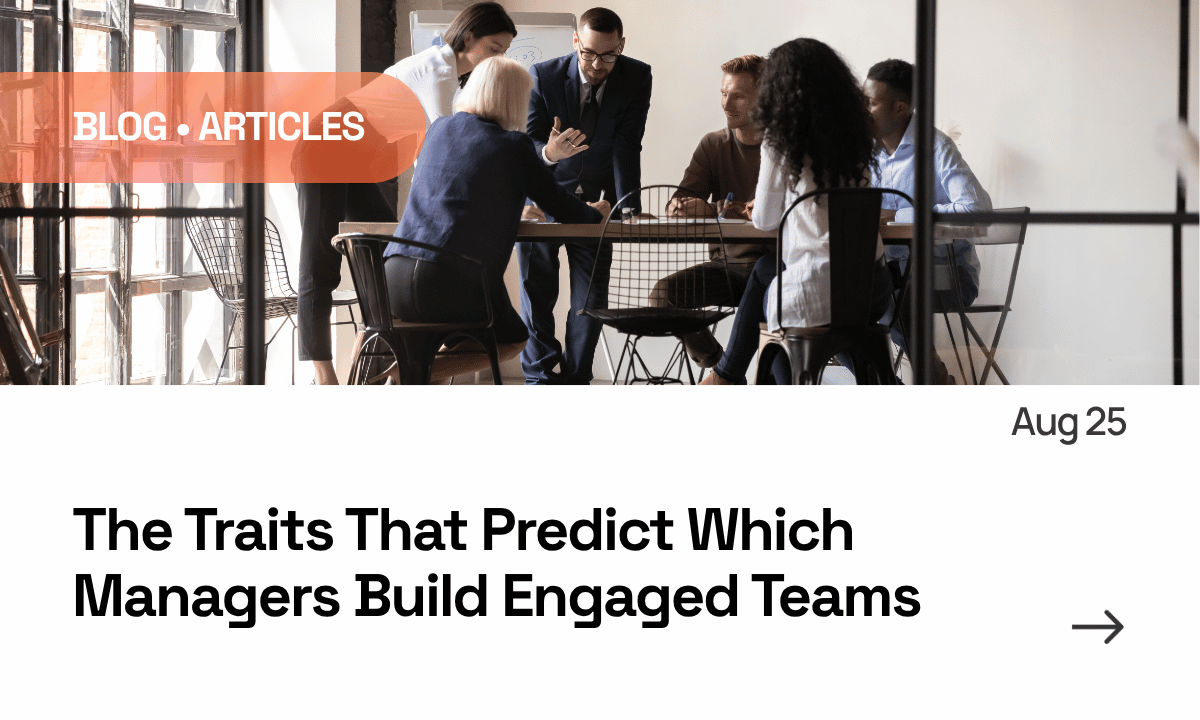
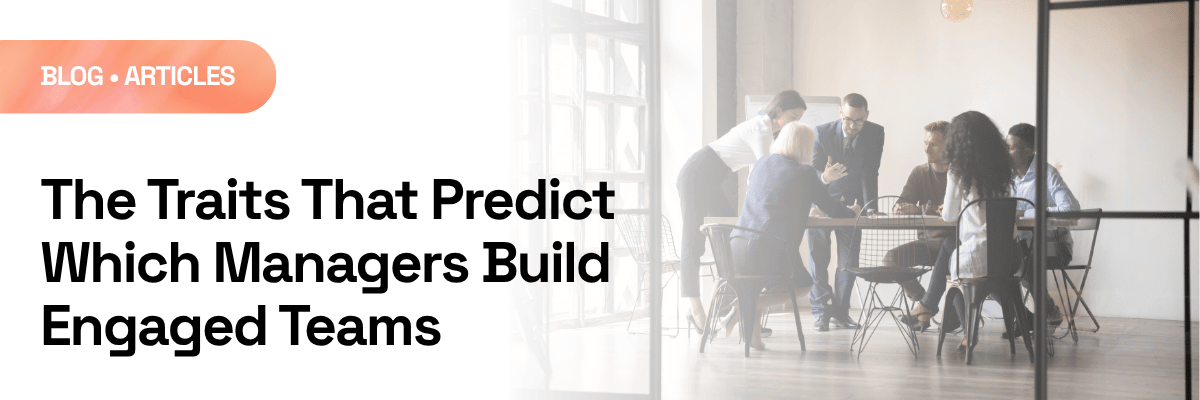
The Traits That Predict Which Managers Build Engaged Teams

Author
Dariia Komarova
Created on
August 26, 2026

Most organizations promote the confident, commanding person into management, because that person looks the part. The trouble is that looking like a leader and building an engaged team are different things. The traits that win someone the promotion are often not the traits that make them good at the job. You can see the gap in how engaged their teams end up feeling.

The instinct is to promote confidence and read it as competence

When a management role opens up, the person who seems most sure of themselves tends to get it. They speak with conviction and project certainty, and that reads as capability. Tomas Chamorro-Premuzic, a co-founder of Deeper Signals, has spent much of his career showing where this goes wrong. Organizations keep confusing confidence with competence, treating how sure someone sounds as a stand-in for how good they actually are.

There is a reason this is so hard to shake. People carry a mental picture of what a leader looks like, and that picture is heavily loaded on dominance, extraversion, and confident speech. Research on implicit leadership theory, mapped by Lord and Maher and confirmed by Epitropaki and Martin (2004), shows how consistent this prototype is across people and settings.

So the most dominant person in the room simply looks the most like a leader, whether or not they would lead well. As Chamorro-Premuzic puts it, the traits that help someone get the job are often the ones that hold them back once they have it.

The counter-finding: engaged teams come from a different profile

Deeper Signals recently put this to the test against real outcomes. In a validation study of 146 supervisors across 12 US distribution sites, assessment data was linked to team engagement and turnover. The supervisors who built the most engaged teams did not match the commanding archetype.

Their personality profile explained 25–27% of the variance in team engagement. In a field where predictors of engagement rarely pass 10–15%, that is a strong signal. Three qualities defined these supervisors. They led without leaning on authority, stayed curious and open to new approaches, and built real relationships with their people. Higher scores on Power and Competitiveness went the other way, and were tied to lower engagement.

The broader research lands in the same place. Grant, Gino, and Hofmann (2011) found that extraverted leaders did worse with proactive teams, because they were less open to input. Judge and colleagues (2002) showed that extraversion predicts who emerges as a leader more than whether they lead effectively. The two are easy to confuse, and expensive to mix up.

The quieter traits do a lot of the work. Owens and Hekman (2012) found that leaders who were low on self-promotion and high on other-orientation produced stronger engagement. The relationship between a manager and each of their people matters just as much. Leader-member exchange research, from Graen and Uhl-Bien (1995) to the meta-analysis by Gerstner and Day (1997), makes that bond one of the most reliable predictors of engagement and retention we have.

The internal-versus-external surprise

The supervisor study surfaced a second pattern worth pausing on. Internally promoted supervisors led noticeably more engaged teams than external hires, even though both groups felt similarly engaged themselves.

The profiles explain the difference. External hires scored higher on sociability, which shows well in an interview. They also scored higher on Power and Competitive drive. Internal promotes scored lower on dominance, and sat closer to the profile that actually predicts engagement.

Internal promotes also bring something no interview can measure. They arrive with existing trust, relationships, and knowledge of how the place works, which shortens the time a new manager needs before a team will follow them. Bidwell (2011), in a study he called the paradox of the contented hire, found that external hires often score higher on the visible traits that interviews reward, yet take a year or two to catch up on the outcomes that depend on fitting in. This is not an argument against hiring externally. It is an argument for giving external hires the onboarding and calibration that the role actually needs.

Why the instinct misleads us

The underlying problem is that we select on signal rather than substance. Some traits are just easy to show in a 45-minute conversation. Huffcutt and colleagues (2001) found that unstructured interviews lean heavily on fluency, assertiveness, and presence, none of which predict how a team will do.

The same bias shows up after the promotion. We notice the visible, effortful-looking behavior and overlook the quiet enabling work of listening, delegating, and clearing obstacles for the team. Those quieter behaviors often predict team performance better, and they rarely get the credit.

The cost arrives later, and it lands on the team. Gallup's research on managers found that the manager drives most of the difference in team engagement, which is why so many people who leave are really leaving a manager, not a company. Promote the wrong person and a team quietly disengages long before anyone connects it back to the decision.

What to do differently

The fix starts with the decision itself. Structured interviews and validated assessments consistently beat unstructured gut-read judgment. Schmidt and Hunter (1998), in one of the most robust findings in the field, showed that structured methods predict performance far better than intuition on its own.

From there, measure the qualities that actually matter for leading people. That means looking at humility and low dominance, openness and curiosity, and the interpersonal warmth that supports real cooperation. These are the traits the supervisor data rewarded, and they seldom show themselves in a confident interview.

The last step is development. A capable, low-dominance leader sometimes needs help building the visibility and self-advocacy they were never screened for, because their team still needs them to speak up on its behalf. None of this treats personality as fixed. It uses the data to pick better, then to develop what selection alone will always miss.

The pattern keeps repeating

This is the pattern Deeper Signals' own data keeps surfacing, and it matches what Dr. Chamorro-Premuzic has argued for years. The traits that get people promoted and the traits that make them good managers are often not the same at all.

The hard part is the timing. Most organizations only realize they promoted the wrong instinct once a team has already started to switch off. The evidence to catch it earlier exists, and it shows up first in the people who quietly stop speaking up.

Author: Stephanie Sands, Deeper Signals. LinkedIn: linkedin.com/in/stephaniejsands

  1. Chamorro-Premuzic, T. — on organizations confusing confidence with competence, and the traits that win promotion undermining performance in role. (Referenced as DS co-founder; drawn from his HBR work and Why Do So Many Incompetent Men Become Leaders?)
  2. Lord, R. G., & Maher, K. J. — foundational work mapping implicit leadership theory (the mental "leader prototype").
  3. Epitropaki, O., & Martin, R. (2004) — confirming the stability of implicit leadership prototypes (loaded on dominance, extraversion, confident speech).
  4. Grant, A. M., Gino, F., & Hofmann, D. A. (2011) — extraverted leaders performed worse with proactive teams due to lower receptivity to input. (Academy of Management Journal)
  5. Judge, T. A., Bono, J. E., Ilies, R., & Gerhardt, M. W. (2002) — extraversion predicts leadership emergence more strongly than leadership effectiveness.
  6. Owens, B. P., & Hekman, D. R. (2012) — humble, low-self-promotion, other-oriented leaders produce stronger employee engagement. (Academy of Management Journal, 55(4), 787–818) — also used as the outbound "further reading" citation.
  7. Graen, G. B., & Uhl-Bien, M. (1995) — leader-member exchange (LMX) theory; quality of the manager-report relationship.
  8. Gerstner, C. R., & Day, D. V. (1997) — meta-analysis confirming LMX links to engagement and retention.
  9. Bidwell, M. (2011) — "Paradox of the Contented Hire"; external hires rated higher on visible traits but underperform internal candidates on integration-dependent outcomes.
  10. Huffcutt, A. I., et al. (2001) — unstructured interviews disproportionately swayed by fluency, assertiveness, and presence, which lack criterion validity for team outcomes.
  11. Gallup — State of the American Manager research; the manager accounts for most of the variance in team engagement ("people quit managers, not companies").
  12. Schmidt, F. L., & Hunter, J. E. (1998) — meta-analysis on selection-method validity; structured methods substantially outperform unstructured judgment.

Proprietary source:

  1. Deeper Signals supervisor validation study (December 2025) — 146 supervisors, 12 US distribution sites; R²=.25–.27 for team/supervisor engagement; r=–.21 engagement-turnover link; three validated competencies (Lead Without Dominance, Curious and Open, Relational and Connected). Client anonymized.

All posts

The Traits That Predict Which Managers Build Engaged Teams

Author
Dariia Komarova
Created on
August 25, 2026

Most organizations promote the confident, commanding person into management, because that person looks the part. The trouble is that looking like a leader and building an engaged team are different things. The traits that win someone the promotion are often not the traits that make them good at the job. You can see the gap in how engaged their teams end up feeling.

The instinct is to promote confidence and read it as competence

When a management role opens up, the person who seems most sure of themselves tends to get it. They speak with conviction and project certainty, and that reads as capability. Tomas Chamorro-Premuzic, a co-founder of Deeper Signals, has spent much of his career showing where this goes wrong. Organizations keep confusing confidence with competence, treating how sure someone sounds as a stand-in for how good they actually are.

There is a reason this is so hard to shake. People carry a mental picture of what a leader looks like, and that picture is heavily loaded on dominance, extraversion, and confident speech. Research on implicit leadership theory, mapped by Lord and Maher and confirmed by Epitropaki and Martin (2004), shows how consistent this prototype is across people and settings.

So the most dominant person in the room simply looks the most like a leader, whether or not they would lead well. As Chamorro-Premuzic puts it, the traits that help someone get the job are often the ones that hold them back once they have it.

The counter-finding: engaged teams come from a different profile

Deeper Signals recently put this to the test against real outcomes. In a validation study of 146 supervisors across 12 US distribution sites, assessment data was linked to team engagement and turnover. The supervisors who built the most engaged teams did not match the commanding archetype.

Their personality profile explained 25–27% of the variance in team engagement. In a field where predictors of engagement rarely pass 10–15%, that is a strong signal. Three qualities defined these supervisors. They led without leaning on authority, stayed curious and open to new approaches, and built real relationships with their people. Higher scores on Power and Competitiveness went the other way, and were tied to lower engagement.

The broader research lands in the same place. Grant, Gino, and Hofmann (2011) found that extraverted leaders did worse with proactive teams, because they were less open to input. Judge and colleagues (2002) showed that extraversion predicts who emerges as a leader more than whether they lead effectively. The two are easy to confuse, and expensive to mix up.

The quieter traits do a lot of the work. Owens and Hekman (2012) found that leaders who were low on self-promotion and high on other-orientation produced stronger engagement. The relationship between a manager and each of their people matters just as much. Leader-member exchange research, from Graen and Uhl-Bien (1995) to the meta-analysis by Gerstner and Day (1997), makes that bond one of the most reliable predictors of engagement and retention we have.

The internal-versus-external surprise

The supervisor study surfaced a second pattern worth pausing on. Internally promoted supervisors led noticeably more engaged teams than external hires, even though both groups felt similarly engaged themselves.

The profiles explain the difference. External hires scored higher on sociability, which shows well in an interview. They also scored higher on Power and Competitive drive. Internal promotes scored lower on dominance, and sat closer to the profile that actually predicts engagement.

Internal promotes also bring something no interview can measure. They arrive with existing trust, relationships, and knowledge of how the place works, which shortens the time a new manager needs before a team will follow them. Bidwell (2011), in a study he called the paradox of the contented hire, found that external hires often score higher on the visible traits that interviews reward, yet take a year or two to catch up on the outcomes that depend on fitting in. This is not an argument against hiring externally. It is an argument for giving external hires the onboarding and calibration that the role actually needs.

Why the instinct misleads us

The underlying problem is that we select on signal rather than substance. Some traits are just easy to show in a 45-minute conversation. Huffcutt and colleagues (2001) found that unstructured interviews lean heavily on fluency, assertiveness, and presence, none of which predict how a team will do.

The same bias shows up after the promotion. We notice the visible, effortful-looking behavior and overlook the quiet enabling work of listening, delegating, and clearing obstacles for the team. Those quieter behaviors often predict team performance better, and they rarely get the credit.

The cost arrives later, and it lands on the team. Gallup's research on managers found that the manager drives most of the difference in team engagement, which is why so many people who leave are really leaving a manager, not a company. Promote the wrong person and a team quietly disengages long before anyone connects it back to the decision.

What to do differently

The fix starts with the decision itself. Structured interviews and validated assessments consistently beat unstructured gut-read judgment. Schmidt and Hunter (1998), in one of the most robust findings in the field, showed that structured methods predict performance far better than intuition on its own.

From there, measure the qualities that actually matter for leading people. That means looking at humility and low dominance, openness and curiosity, and the interpersonal warmth that supports real cooperation. These are the traits the supervisor data rewarded, and they seldom show themselves in a confident interview.

The last step is development. A capable, low-dominance leader sometimes needs help building the visibility and self-advocacy they were never screened for, because their team still needs them to speak up on its behalf. None of this treats personality as fixed. It uses the data to pick better, then to develop what selection alone will always miss.

The pattern keeps repeating

This is the pattern Deeper Signals' own data keeps surfacing, and it matches what Dr. Chamorro-Premuzic has argued for years. The traits that get people promoted and the traits that make them good managers are often not the same at all.

The hard part is the timing. Most organizations only realize they promoted the wrong instinct once a team has already started to switch off. The evidence to catch it earlier exists, and it shows up first in the people who quietly stop speaking up.

Author: Stephanie Sands, Deeper Signals. LinkedIn: linkedin.com/in/stephaniejsands

  1. Chamorro-Premuzic, T. — on organizations confusing confidence with competence, and the traits that win promotion undermining performance in role. (Referenced as DS co-founder; drawn from his HBR work and Why Do So Many Incompetent Men Become Leaders?)
  2. Lord, R. G., & Maher, K. J. — foundational work mapping implicit leadership theory (the mental "leader prototype").
  3. Epitropaki, O., & Martin, R. (2004) — confirming the stability of implicit leadership prototypes (loaded on dominance, extraversion, confident speech).
  4. Grant, A. M., Gino, F., & Hofmann, D. A. (2011) — extraverted leaders performed worse with proactive teams due to lower receptivity to input. (Academy of Management Journal)
  5. Judge, T. A., Bono, J. E., Ilies, R., & Gerhardt, M. W. (2002) — extraversion predicts leadership emergence more strongly than leadership effectiveness.
  6. Owens, B. P., & Hekman, D. R. (2012) — humble, low-self-promotion, other-oriented leaders produce stronger employee engagement. (Academy of Management Journal, 55(4), 787–818) — also used as the outbound "further reading" citation.
  7. Graen, G. B., & Uhl-Bien, M. (1995) — leader-member exchange (LMX) theory; quality of the manager-report relationship.
  8. Gerstner, C. R., & Day, D. V. (1997) — meta-analysis confirming LMX links to engagement and retention.
  9. Bidwell, M. (2011) — "Paradox of the Contented Hire"; external hires rated higher on visible traits but underperform internal candidates on integration-dependent outcomes.
  10. Huffcutt, A. I., et al. (2001) — unstructured interviews disproportionately swayed by fluency, assertiveness, and presence, which lack criterion validity for team outcomes.
  11. Gallup — State of the American Manager research; the manager accounts for most of the variance in team engagement ("people quit managers, not companies").
  12. Schmidt, F. L., & Hunter, J. E. (1998) — meta-analysis on selection-method validity; structured methods substantially outperform unstructured judgment.

Proprietary source:

  1. Deeper Signals supervisor validation study (December 2025) — 146 supervisors, 12 US distribution sites; R²=.25–.27 for team/supervisor engagement; r=–.21 engagement-turnover link; three validated competencies (Lead Without Dominance, Curious and Open, Relational and Connected). Client anonymized.

All posts

The Traits That Predict Which Managers Build Engaged Teams

Author
Dariia Komarova
Created on
August 26, 2026

Most organizations promote the confident, commanding person into management, because that person looks the part. The trouble is that looking like a leader and building an engaged team are different things. The traits that win someone the promotion are often not the traits that make them good at the job. You can see the gap in how engaged their teams end up feeling.

The instinct is to promote confidence and read it as competence

When a management role opens up, the person who seems most sure of themselves tends to get it. They speak with conviction and project certainty, and that reads as capability. Tomas Chamorro-Premuzic, a co-founder of Deeper Signals, has spent much of his career showing where this goes wrong. Organizations keep confusing confidence with competence, treating how sure someone sounds as a stand-in for how good they actually are.

There is a reason this is so hard to shake. People carry a mental picture of what a leader looks like, and that picture is heavily loaded on dominance, extraversion, and confident speech. Research on implicit leadership theory, mapped by Lord and Maher and confirmed by Epitropaki and Martin (2004), shows how consistent this prototype is across people and settings.

So the most dominant person in the room simply looks the most like a leader, whether or not they would lead well. As Chamorro-Premuzic puts it, the traits that help someone get the job are often the ones that hold them back once they have it.

The counter-finding: engaged teams come from a different profile

Deeper Signals recently put this to the test against real outcomes. In a validation study of 146 supervisors across 12 US distribution sites, assessment data was linked to team engagement and turnover. The supervisors who built the most engaged teams did not match the commanding archetype.

Their personality profile explained 25–27% of the variance in team engagement. In a field where predictors of engagement rarely pass 10–15%, that is a strong signal. Three qualities defined these supervisors. They led without leaning on authority, stayed curious and open to new approaches, and built real relationships with their people. Higher scores on Power and Competitiveness went the other way, and were tied to lower engagement.

The broader research lands in the same place. Grant, Gino, and Hofmann (2011) found that extraverted leaders did worse with proactive teams, because they were less open to input. Judge and colleagues (2002) showed that extraversion predicts who emerges as a leader more than whether they lead effectively. The two are easy to confuse, and expensive to mix up.

The quieter traits do a lot of the work. Owens and Hekman (2012) found that leaders who were low on self-promotion and high on other-orientation produced stronger engagement. The relationship between a manager and each of their people matters just as much. Leader-member exchange research, from Graen and Uhl-Bien (1995) to the meta-analysis by Gerstner and Day (1997), makes that bond one of the most reliable predictors of engagement and retention we have.

The internal-versus-external surprise

The supervisor study surfaced a second pattern worth pausing on. Internally promoted supervisors led noticeably more engaged teams than external hires, even though both groups felt similarly engaged themselves.

The profiles explain the difference. External hires scored higher on sociability, which shows well in an interview. They also scored higher on Power and Competitive drive. Internal promotes scored lower on dominance, and sat closer to the profile that actually predicts engagement.

Internal promotes also bring something no interview can measure. They arrive with existing trust, relationships, and knowledge of how the place works, which shortens the time a new manager needs before a team will follow them. Bidwell (2011), in a study he called the paradox of the contented hire, found that external hires often score higher on the visible traits that interviews reward, yet take a year or two to catch up on the outcomes that depend on fitting in. This is not an argument against hiring externally. It is an argument for giving external hires the onboarding and calibration that the role actually needs.

Why the instinct misleads us

The underlying problem is that we select on signal rather than substance. Some traits are just easy to show in a 45-minute conversation. Huffcutt and colleagues (2001) found that unstructured interviews lean heavily on fluency, assertiveness, and presence, none of which predict how a team will do.

The same bias shows up after the promotion. We notice the visible, effortful-looking behavior and overlook the quiet enabling work of listening, delegating, and clearing obstacles for the team. Those quieter behaviors often predict team performance better, and they rarely get the credit.

The cost arrives later, and it lands on the team. Gallup's research on managers found that the manager drives most of the difference in team engagement, which is why so many people who leave are really leaving a manager, not a company. Promote the wrong person and a team quietly disengages long before anyone connects it back to the decision.

What to do differently

The fix starts with the decision itself. Structured interviews and validated assessments consistently beat unstructured gut-read judgment. Schmidt and Hunter (1998), in one of the most robust findings in the field, showed that structured methods predict performance far better than intuition on its own.

From there, measure the qualities that actually matter for leading people. That means looking at humility and low dominance, openness and curiosity, and the interpersonal warmth that supports real cooperation. These are the traits the supervisor data rewarded, and they seldom show themselves in a confident interview.

The last step is development. A capable, low-dominance leader sometimes needs help building the visibility and self-advocacy they were never screened for, because their team still needs them to speak up on its behalf. None of this treats personality as fixed. It uses the data to pick better, then to develop what selection alone will always miss.

The pattern keeps repeating

This is the pattern Deeper Signals' own data keeps surfacing, and it matches what Dr. Chamorro-Premuzic has argued for years. The traits that get people promoted and the traits that make them good managers are often not the same at all.

The hard part is the timing. Most organizations only realize they promoted the wrong instinct once a team has already started to switch off. The evidence to catch it earlier exists, and it shows up first in the people who quietly stop speaking up.

Author: Stephanie Sands, Deeper Signals. LinkedIn: linkedin.com/in/stephaniejsands

  1. Chamorro-Premuzic, T. — on organizations confusing confidence with competence, and the traits that win promotion undermining performance in role. (Referenced as DS co-founder; drawn from his HBR work and Why Do So Many Incompetent Men Become Leaders?)
  2. Lord, R. G., & Maher, K. J. — foundational work mapping implicit leadership theory (the mental "leader prototype").
  3. Epitropaki, O., & Martin, R. (2004) — confirming the stability of implicit leadership prototypes (loaded on dominance, extraversion, confident speech).
  4. Grant, A. M., Gino, F., & Hofmann, D. A. (2011) — extraverted leaders performed worse with proactive teams due to lower receptivity to input. (Academy of Management Journal)
  5. Judge, T. A., Bono, J. E., Ilies, R., & Gerhardt, M. W. (2002) — extraversion predicts leadership emergence more strongly than leadership effectiveness.
  6. Owens, B. P., & Hekman, D. R. (2012) — humble, low-self-promotion, other-oriented leaders produce stronger employee engagement. (Academy of Management Journal, 55(4), 787–818) — also used as the outbound "further reading" citation.
  7. Graen, G. B., & Uhl-Bien, M. (1995) — leader-member exchange (LMX) theory; quality of the manager-report relationship.
  8. Gerstner, C. R., & Day, D. V. (1997) — meta-analysis confirming LMX links to engagement and retention.
  9. Bidwell, M. (2011) — "Paradox of the Contented Hire"; external hires rated higher on visible traits but underperform internal candidates on integration-dependent outcomes.
  10. Huffcutt, A. I., et al. (2001) — unstructured interviews disproportionately swayed by fluency, assertiveness, and presence, which lack criterion validity for team outcomes.
  11. Gallup — State of the American Manager research; the manager accounts for most of the variance in team engagement ("people quit managers, not companies").
  12. Schmidt, F. L., & Hunter, J. E. (1998) — meta-analysis on selection-method validity; structured methods substantially outperform unstructured judgment.

Proprietary source:

  1. Deeper Signals supervisor validation study (December 2025) — 146 supervisors, 12 US distribution sites; R²=.25–.27 for team/supervisor engagement; r=–.21 engagement-turnover link; three validated competencies (Lead Without Dominance, Curious and Open, Relational and Connected). Client anonymized.

All posts

The Traits That Predict Which Managers Build Engaged Teams

Author
Dariia Komarova
Created on
August 26, 2026

Most organizations promote the confident, commanding person into management, because that person looks the part. The trouble is that looking like a leader and building an engaged team are different things. The traits that win someone the promotion are often not the traits that make them good at the job. You can see the gap in how engaged their teams end up feeling.

The instinct is to promote confidence and read it as competence

When a management role opens up, the person who seems most sure of themselves tends to get it. They speak with conviction and project certainty, and that reads as capability. Tomas Chamorro-Premuzic, a co-founder of Deeper Signals, has spent much of his career showing where this goes wrong. Organizations keep confusing confidence with competence, treating how sure someone sounds as a stand-in for how good they actually are.

There is a reason this is so hard to shake. People carry a mental picture of what a leader looks like, and that picture is heavily loaded on dominance, extraversion, and confident speech. Research on implicit leadership theory, mapped by Lord and Maher and confirmed by Epitropaki and Martin (2004), shows how consistent this prototype is across people and settings.

So the most dominant person in the room simply looks the most like a leader, whether or not they would lead well. As Chamorro-Premuzic puts it, the traits that help someone get the job are often the ones that hold them back once they have it.

The counter-finding: engaged teams come from a different profile

Deeper Signals recently put this to the test against real outcomes. In a validation study of 146 supervisors across 12 US distribution sites, assessment data was linked to team engagement and turnover. The supervisors who built the most engaged teams did not match the commanding archetype.

Their personality profile explained 25–27% of the variance in team engagement. In a field where predictors of engagement rarely pass 10–15%, that is a strong signal. Three qualities defined these supervisors. They led without leaning on authority, stayed curious and open to new approaches, and built real relationships with their people. Higher scores on Power and Competitiveness went the other way, and were tied to lower engagement.

The broader research lands in the same place. Grant, Gino, and Hofmann (2011) found that extraverted leaders did worse with proactive teams, because they were less open to input. Judge and colleagues (2002) showed that extraversion predicts who emerges as a leader more than whether they lead effectively. The two are easy to confuse, and expensive to mix up.

The quieter traits do a lot of the work. Owens and Hekman (2012) found that leaders who were low on self-promotion and high on other-orientation produced stronger engagement. The relationship between a manager and each of their people matters just as much. Leader-member exchange research, from Graen and Uhl-Bien (1995) to the meta-analysis by Gerstner and Day (1997), makes that bond one of the most reliable predictors of engagement and retention we have.

The internal-versus-external surprise

The supervisor study surfaced a second pattern worth pausing on. Internally promoted supervisors led noticeably more engaged teams than external hires, even though both groups felt similarly engaged themselves.

The profiles explain the difference. External hires scored higher on sociability, which shows well in an interview. They also scored higher on Power and Competitive drive. Internal promotes scored lower on dominance, and sat closer to the profile that actually predicts engagement.

Internal promotes also bring something no interview can measure. They arrive with existing trust, relationships, and knowledge of how the place works, which shortens the time a new manager needs before a team will follow them. Bidwell (2011), in a study he called the paradox of the contented hire, found that external hires often score higher on the visible traits that interviews reward, yet take a year or two to catch up on the outcomes that depend on fitting in. This is not an argument against hiring externally. It is an argument for giving external hires the onboarding and calibration that the role actually needs.

Why the instinct misleads us

The underlying problem is that we select on signal rather than substance. Some traits are just easy to show in a 45-minute conversation. Huffcutt and colleagues (2001) found that unstructured interviews lean heavily on fluency, assertiveness, and presence, none of which predict how a team will do.

The same bias shows up after the promotion. We notice the visible, effortful-looking behavior and overlook the quiet enabling work of listening, delegating, and clearing obstacles for the team. Those quieter behaviors often predict team performance better, and they rarely get the credit.

The cost arrives later, and it lands on the team. Gallup's research on managers found that the manager drives most of the difference in team engagement, which is why so many people who leave are really leaving a manager, not a company. Promote the wrong person and a team quietly disengages long before anyone connects it back to the decision.

What to do differently

The fix starts with the decision itself. Structured interviews and validated assessments consistently beat unstructured gut-read judgment. Schmidt and Hunter (1998), in one of the most robust findings in the field, showed that structured methods predict performance far better than intuition on its own.

From there, measure the qualities that actually matter for leading people. That means looking at humility and low dominance, openness and curiosity, and the interpersonal warmth that supports real cooperation. These are the traits the supervisor data rewarded, and they seldom show themselves in a confident interview.

The last step is development. A capable, low-dominance leader sometimes needs help building the visibility and self-advocacy they were never screened for, because their team still needs them to speak up on its behalf. None of this treats personality as fixed. It uses the data to pick better, then to develop what selection alone will always miss.

The pattern keeps repeating

This is the pattern Deeper Signals' own data keeps surfacing, and it matches what Dr. Chamorro-Premuzic has argued for years. The traits that get people promoted and the traits that make them good managers are often not the same at all.

The hard part is the timing. Most organizations only realize they promoted the wrong instinct once a team has already started to switch off. The evidence to catch it earlier exists, and it shows up first in the people who quietly stop speaking up.

Author: Stephanie Sands, Deeper Signals. LinkedIn: linkedin.com/in/stephaniejsands

  1. Chamorro-Premuzic, T. — on organizations confusing confidence with competence, and the traits that win promotion undermining performance in role. (Referenced as DS co-founder; drawn from his HBR work and Why Do So Many Incompetent Men Become Leaders?)
  2. Lord, R. G., & Maher, K. J. — foundational work mapping implicit leadership theory (the mental "leader prototype").
  3. Epitropaki, O., & Martin, R. (2004) — confirming the stability of implicit leadership prototypes (loaded on dominance, extraversion, confident speech).
  4. Grant, A. M., Gino, F., & Hofmann, D. A. (2011) — extraverted leaders performed worse with proactive teams due to lower receptivity to input. (Academy of Management Journal)
  5. Judge, T. A., Bono, J. E., Ilies, R., & Gerhardt, M. W. (2002) — extraversion predicts leadership emergence more strongly than leadership effectiveness.
  6. Owens, B. P., & Hekman, D. R. (2012) — humble, low-self-promotion, other-oriented leaders produce stronger employee engagement. (Academy of Management Journal, 55(4), 787–818) — also used as the outbound "further reading" citation.
  7. Graen, G. B., & Uhl-Bien, M. (1995) — leader-member exchange (LMX) theory; quality of the manager-report relationship.
  8. Gerstner, C. R., & Day, D. V. (1997) — meta-analysis confirming LMX links to engagement and retention.
  9. Bidwell, M. (2011) — "Paradox of the Contented Hire"; external hires rated higher on visible traits but underperform internal candidates on integration-dependent outcomes.
  10. Huffcutt, A. I., et al. (2001) — unstructured interviews disproportionately swayed by fluency, assertiveness, and presence, which lack criterion validity for team outcomes.
  11. Gallup — State of the American Manager research; the manager accounts for most of the variance in team engagement ("people quit managers, not companies").
  12. Schmidt, F. L., & Hunter, J. E. (1998) — meta-analysis on selection-method validity; structured methods substantially outperform unstructured judgment.

Proprietary source:

  1. Deeper Signals supervisor validation study (December 2025) — 146 supervisors, 12 US distribution sites; R²=.25–.27 for team/supervisor engagement; r=–.21 engagement-turnover link; three validated competencies (Lead Without Dominance, Curious and Open, Relational and Connected). Client anonymized.

All posts

The Traits That Predict Which Managers Build Engaged Teams

Customer
Job Title

Most organizations promote the confident, commanding person into management, because that person looks the part. The trouble is that looking like a leader and building an engaged team are different things. The traits that win someone the promotion are often not the traits that make them good at the job. You can see the gap in how engaged their teams end up feeling.

The instinct is to promote confidence and read it as competence

When a management role opens up, the person who seems most sure of themselves tends to get it. They speak with conviction and project certainty, and that reads as capability. Tomas Chamorro-Premuzic, a co-founder of Deeper Signals, has spent much of his career showing where this goes wrong. Organizations keep confusing confidence with competence, treating how sure someone sounds as a stand-in for how good they actually are.

There is a reason this is so hard to shake. People carry a mental picture of what a leader looks like, and that picture is heavily loaded on dominance, extraversion, and confident speech. Research on implicit leadership theory, mapped by Lord and Maher and confirmed by Epitropaki and Martin (2004), shows how consistent this prototype is across people and settings.

So the most dominant person in the room simply looks the most like a leader, whether or not they would lead well. As Chamorro-Premuzic puts it, the traits that help someone get the job are often the ones that hold them back once they have it.

The counter-finding: engaged teams come from a different profile

Deeper Signals recently put this to the test against real outcomes. In a validation study of 146 supervisors across 12 US distribution sites, assessment data was linked to team engagement and turnover. The supervisors who built the most engaged teams did not match the commanding archetype.

Their personality profile explained 25–27% of the variance in team engagement. In a field where predictors of engagement rarely pass 10–15%, that is a strong signal. Three qualities defined these supervisors. They led without leaning on authority, stayed curious and open to new approaches, and built real relationships with their people. Higher scores on Power and Competitiveness went the other way, and were tied to lower engagement.

The broader research lands in the same place. Grant, Gino, and Hofmann (2011) found that extraverted leaders did worse with proactive teams, because they were less open to input. Judge and colleagues (2002) showed that extraversion predicts who emerges as a leader more than whether they lead effectively. The two are easy to confuse, and expensive to mix up.

The quieter traits do a lot of the work. Owens and Hekman (2012) found that leaders who were low on self-promotion and high on other-orientation produced stronger engagement. The relationship between a manager and each of their people matters just as much. Leader-member exchange research, from Graen and Uhl-Bien (1995) to the meta-analysis by Gerstner and Day (1997), makes that bond one of the most reliable predictors of engagement and retention we have.

The internal-versus-external surprise

The supervisor study surfaced a second pattern worth pausing on. Internally promoted supervisors led noticeably more engaged teams than external hires, even though both groups felt similarly engaged themselves.

The profiles explain the difference. External hires scored higher on sociability, which shows well in an interview. They also scored higher on Power and Competitive drive. Internal promotes scored lower on dominance, and sat closer to the profile that actually predicts engagement.

Internal promotes also bring something no interview can measure. They arrive with existing trust, relationships, and knowledge of how the place works, which shortens the time a new manager needs before a team will follow them. Bidwell (2011), in a study he called the paradox of the contented hire, found that external hires often score higher on the visible traits that interviews reward, yet take a year or two to catch up on the outcomes that depend on fitting in. This is not an argument against hiring externally. It is an argument for giving external hires the onboarding and calibration that the role actually needs.

Why the instinct misleads us

The underlying problem is that we select on signal rather than substance. Some traits are just easy to show in a 45-minute conversation. Huffcutt and colleagues (2001) found that unstructured interviews lean heavily on fluency, assertiveness, and presence, none of which predict how a team will do.

The same bias shows up after the promotion. We notice the visible, effortful-looking behavior and overlook the quiet enabling work of listening, delegating, and clearing obstacles for the team. Those quieter behaviors often predict team performance better, and they rarely get the credit.

The cost arrives later, and it lands on the team. Gallup's research on managers found that the manager drives most of the difference in team engagement, which is why so many people who leave are really leaving a manager, not a company. Promote the wrong person and a team quietly disengages long before anyone connects it back to the decision.

What to do differently

The fix starts with the decision itself. Structured interviews and validated assessments consistently beat unstructured gut-read judgment. Schmidt and Hunter (1998), in one of the most robust findings in the field, showed that structured methods predict performance far better than intuition on its own.

From there, measure the qualities that actually matter for leading people. That means looking at humility and low dominance, openness and curiosity, and the interpersonal warmth that supports real cooperation. These are the traits the supervisor data rewarded, and they seldom show themselves in a confident interview.

The last step is development. A capable, low-dominance leader sometimes needs help building the visibility and self-advocacy they were never screened for, because their team still needs them to speak up on its behalf. None of this treats personality as fixed. It uses the data to pick better, then to develop what selection alone will always miss.

The pattern keeps repeating

This is the pattern Deeper Signals' own data keeps surfacing, and it matches what Dr. Chamorro-Premuzic has argued for years. The traits that get people promoted and the traits that make them good managers are often not the same at all.

The hard part is the timing. Most organizations only realize they promoted the wrong instinct once a team has already started to switch off. The evidence to catch it earlier exists, and it shows up first in the people who quietly stop speaking up.

Author: Stephanie Sands, Deeper Signals. LinkedIn: linkedin.com/in/stephaniejsands

  1. Chamorro-Premuzic, T. — on organizations confusing confidence with competence, and the traits that win promotion undermining performance in role. (Referenced as DS co-founder; drawn from his HBR work and Why Do So Many Incompetent Men Become Leaders?)
  2. Lord, R. G., & Maher, K. J. — foundational work mapping implicit leadership theory (the mental "leader prototype").
  3. Epitropaki, O., & Martin, R. (2004) — confirming the stability of implicit leadership prototypes (loaded on dominance, extraversion, confident speech).
  4. Grant, A. M., Gino, F., & Hofmann, D. A. (2011) — extraverted leaders performed worse with proactive teams due to lower receptivity to input. (Academy of Management Journal)
  5. Judge, T. A., Bono, J. E., Ilies, R., & Gerhardt, M. W. (2002) — extraversion predicts leadership emergence more strongly than leadership effectiveness.
  6. Owens, B. P., & Hekman, D. R. (2012) — humble, low-self-promotion, other-oriented leaders produce stronger employee engagement. (Academy of Management Journal, 55(4), 787–818) — also used as the outbound "further reading" citation.
  7. Graen, G. B., & Uhl-Bien, M. (1995) — leader-member exchange (LMX) theory; quality of the manager-report relationship.
  8. Gerstner, C. R., & Day, D. V. (1997) — meta-analysis confirming LMX links to engagement and retention.
  9. Bidwell, M. (2011) — "Paradox of the Contented Hire"; external hires rated higher on visible traits but underperform internal candidates on integration-dependent outcomes.
  10. Huffcutt, A. I., et al. (2001) — unstructured interviews disproportionately swayed by fluency, assertiveness, and presence, which lack criterion validity for team outcomes.
  11. Gallup — State of the American Manager research; the manager accounts for most of the variance in team engagement ("people quit managers, not companies").
  12. Schmidt, F. L., & Hunter, J. E. (1998) — meta-analysis on selection-method validity; structured methods substantially outperform unstructured judgment.

Proprietary source:

  1. Deeper Signals supervisor validation study (December 2025) — 146 supervisors, 12 US distribution sites; R²=.25–.27 for team/supervisor engagement; r=–.21 engagement-turnover link; three validated competencies (Lead Without Dominance, Curious and Open, Relational and Connected). Client anonymized.

Ready for your Spotlight?
Contact us to book your Customer Spotlight and showcase your work to an extensive, global audience!
Start your free trial today
Free access to Deeper Signals’ quick, scientific assessments, feedback tools, and more.
Start Free Trial
Recent posts
Articles
The Traits That Predict Which Managers Build Engaged Teams
We promote the most confident person into management. The evidence says that's often the wrong instinct. Here's what actually predicts a manager who builds an engaged team.
Read more
Articles
What Does Your Hiring Process Signal to Candidates?
A hiring process is a two-way evaluation. While you read candidates, they're reading you. Here is what the research says about designing hiring that wins the candidates you actually want.
Read more
Guides & Tips
How to Turn Executive Assessment Data into a Leadership Narrative with an AI Skill
Psychometrics, 360s, interviews, references — this free Deeper Signals skill codes it all against a role's success criteria into an auditable leadership narrative.
Read more
Guides & Tips
How to Review an Assessment's Evidence Base with an AI Skill
How well is that assessment actually evidenced? This free Deeper Signals AI skill maps any instrument against the APA, SIOP, EFPA, and ITC standards.
Read more
Guides & Tips
How to Create a Coaching Plan from Assessment Results in Under 10 Minutes
Learn how Deeper Signals' free Development Plan skill turns assessment results into a coach-ready plan in under 10 minutes.
Read more
Want more articles like this?
Subscribe to our newsletter
Practical insights on people and performance, delivered to your inbox
Subscribe
Recent posts
Articles
The Traits That Predict Which Managers Build Engaged Teams
We promote the most confident person into management. The evidence says that's often the wrong instinct. Here's what actually predicts a manager who builds an engaged team.
Read more
Articles
What Does Your Hiring Process Signal to Candidates?
A hiring process is a two-way evaluation. While you read candidates, they're reading you. Here is what the research says about designing hiring that wins the candidates you actually want.
Read more
Guides & Tips
How to Turn Executive Assessment Data into a Leadership Narrative with an AI Skill
Psychometrics, 360s, interviews, references — this free Deeper Signals skill codes it all against a role's success criteria into an auditable leadership narrative.
Read more
Guides & Tips
How to Review an Assessment's Evidence Base with an AI Skill
How well is that assessment actually evidenced? This free Deeper Signals AI skill maps any instrument against the APA, SIOP, EFPA, and ITC standards.
Read more
Guides & Tips
How to Create a Coaching Plan from Assessment Results in Under 10 Minutes
Learn how Deeper Signals' free Development Plan skill turns assessment results into a coach-ready plan in under 10 minutes.
Read more
Curious to learn more?

Schedule a call with Deeper Signals to understand how our assessments and feedback tools help people gain a deep awareness of their talents and reach their full potential. Underpinned by science and technology, we build talented people, leaders and companies.

  • Scalable and engaging assessment solutions
  • Measurable and predictive talent insights
  • Powered by technology and science that drives results
Let's talk!
  • Scalable interventions for growth
  • Measurable data, insights and outcomes for high performance
  • Proven scientific expertise that links results to outcomes
Thank you!
Would you like to schedule a meeting?
Please fill all fields before submitting the form.